

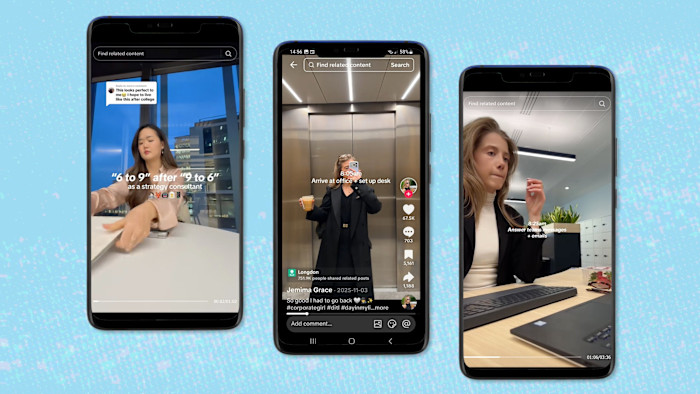
The videos often start with an early morning alarm. Then a coffee and usually a commute.
They are rarely the most gripping viewing, but corporate “day in the life” clips, where employees film themselves going about their regular working days, are proving a fast-growing hit on TikTok and Instagram, particularly among Gen Z viewers.
The hashtag #corporatelife on TikTok, which shows videos of employees’ work day routines and their office clothes — or OOTD (outfit of the day) — has more than 2mn posts, with some of the most prolific creators attracting hundreds of thousands of followers. Viewers can also scroll through #dayinmylife, #9to5 and many other reels offering similar employee-generated content, part of a popular subcategory some have dubbed “WorkTok”.
“Office content tends to outperform the regular content I post,” says Jemima Grace, 28, who works as a management consultant in the City of London and also creates social media content under the name @onelane_studios. She says she initially began filming to build her “confidence around the workplace and be motivated to go to the office more”.
“I struggled a lot after the pandemic to find my feet at work, and struggled working from home.” Now, two years after she started posting, she has 520,000 followers across Instagram and TikTok. Some of her videos, including one entitled “A full day of work as a corporate girl in London”, have been viewed as many as 6mn times.
The format of such videos is simple: viewers are invited to watch young employees as they arrive at their desks, open their laptop and type; as they stand in a queue for lunch; as they click “join” on a virtual meeting.
Creators say their motivation is to educate young viewers by sharing information on what their jobs are really like. Even if the viewers do not aspire to work in the industries featured, they may enjoy a window into a stable professional lifestyle. For creators, generating content also livens up their workday and, for the most successful, can bring in extra income.
“I had no idea how to navigate the [job] application process,” says Claudia Zhu, who has 300,000 followers on TikTok and 280,000 on Instagram, “because I didn’t have other role models in my life who had followed the same process.” “Now,” she says, “I get to show people that this industry exists, this job exists — and it’s an option for them.” Her posts include career advice alongside videos of her role and lifestyle.
Zhu, 28, who posts as @cloudsjoo, works in technology after switching from consulting, a move she acknowledges was partly due to “not being able to grow my content creation and consulting career in parallel”.
Elinor Nikolova, who works at an international law firm in London, says “knowing that small glimpses of my work or lifestyle can offer guidance or reassurance to others wanting to walk that path is incredibly meaningful”.
After beginning filming her path into law in 2023, Nikolova, 25, now regularly posts videos of her time in the office and daily routine.
Some creators say filming helps make their day feel less mundane. “Filming and vlogging has helped me romanticise aspects of my life, including my job,” says Zhu. “By filming something, you almost trick yourself into romanticising something you know isn’t that glamorous . . . sometimes I rewatch my videos and think, ‘it’s incredible, what a nice song and some aesthetic text can do’.” She says it has also motivated her to go into the office more, so she can film there.
For employers, the trend brings new risks around how they control their corporate message but also offers the opportunity to reach a new, younger audience.
Social media algorithms tend to favour the short, repeatable formats of reels, while employee-generated content can prove more relatable and authentic than traditional brand messaging — with the added bonus of being much cheaper to produce. Industry surveys suggest content produced by employees can receive more engagement than posts on corporate channels. According to a 2025 report by publicity firm Edelman, consumers trust brand employees more than journalists, the brand’s CEO or influencers, with 63 per cent saying they trust staff to give accurate information about a brand.
The appeal has prompted some to actively encourage their staff to take part in “employee advocacy”, or to post about their company on socials as a way to increase reach. For employers, staff posts can provide a cheap way to boost the company profile and even help with hiring: a survey by social media company CareerArc found nearly half of surveyed Gen Z and millennials who had a job had found the role through social media.
At Nikolova’s law firm, she says managers are supportive of her posting. “Much of my content focuses on the life I lead before, during or after the tasks I carry out for clients,” she says. “From an early careers perspective, I’ve often been told that many people on internships mention my videos, or say they’d love to work at the firm because it looks like the kind of life they’d like to lead.”
But the drive to share detailed dispatches from the world of work can backfire. When, last summer, TikTok user @brymarixx posted a detailed video depicting her average day working as a salesperson at a MAC cosmetics store in Los Angeles International Airport, she may have overstepped the mark.
The film included footage of her showing her badge as she went through staff security, picking up cash from a secure location and opening the store — all of which were identified by commenters as security risks. It seems managers noticed too. In an update post, she added “11am: get fired” to the routine, followed by a video of her leaving the airport clutching a cardboard box of her belongings. “I love my job, I never would have done anything to jeopardise it,” she says tearfully. She later said the decision was made by the airport, who did not respond to comment on the incident.
Sean Illing, managing associate at law firm Lewis Silkin, says it is a complex area for employers to navigate, which results in some choosing to issue blanket bans. “While these policies have existed for quite some time, with the rise of TikTok and videos, employers are now regulating a different form of media.” Employers who do allow staff to post content are likely to be watching it closely, he adds. “It really does come down to what is in the video — when it’s being filmed, who features in it and what information [it contains] about the employer.”
At the same time, companies cannot escape the fact that employee-generated content is chiming with an audience becoming increasingly disillusioned with polished social media feeds. “I think it stems from fatigue with influencers’ unrealistic lifestyles,” says Grace.
“When people see someone with a regular nine to five, they take a little bit of comfort in that,” adds Zhu. “People want to watch content that’s relaxing, low-stakes or less stimulating.” In a turbulent jobs market viewers — and creators themselves — are latching on to stability.
For Zhu, whose content also includes clips of her taking holidays, going to restaurants and on days off, uncertainty around unemployment was an incentive to create videos in the first place. “Having the mental security of knowing that if anything happens, I still have an income that I can rely on; I still have something I can build; I’m not left unable to pay my rent — is so mentally empowering and freeing.”
The videos, however, can attract a more hostile response. Grace points to comments regularly telling her she “looks tired”, is “living a miserable life”, or viewers telling her they “would hate to be her”, among others. Some viewers have asked her why she is not staying at home or looking after children.
Creators acknowledge they cannot take these personally. “At the same time, it’s those negative comments that bring you engagement and make you go viral. It’s actually beneficial if you’re trying to grow your page,” says Grace. “The truth is, most people do just have a regular nine-to-five job.”
Read the full article here