

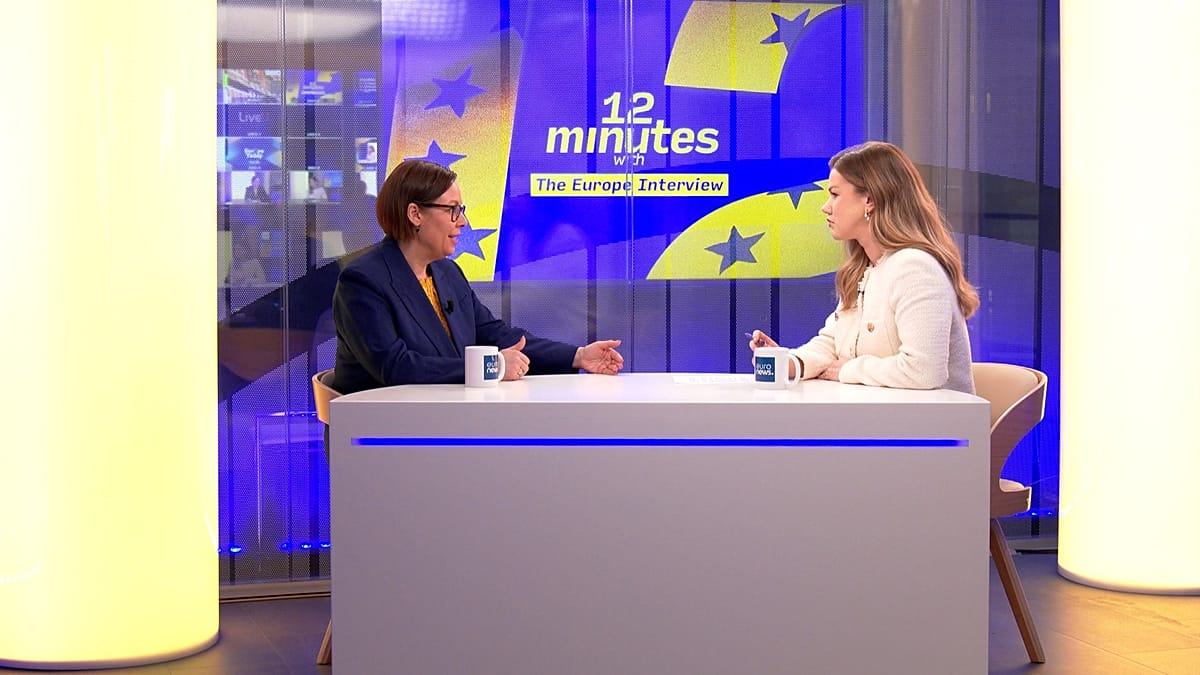
Sweden’s Minister for Foreign Affairs, Maria Malmer Stenergard, criticised comments made by Budapest that it will block financial assistance for Kyiv until transit of Russian oil resumes through a damaged pipeline connecting Hungary to Russia via Ukraine. She called the decision “illogical”.
ADVERTISEMENT

ADVERTISEMENT
“I’m very frustrated with this, and it’s not logical, because it was Russia that bombed this pipeline,” she said on Euronews’ interview programme 12 Minutes With. “So I think that their frustration should be directed towards the Kremlin and not towards Ukraine or the EU.”
Hungarian Foreign Minister Péter Szijjártó said on Monday that his country will block a €90 billion emergency loan for Ukraine, accusing the war-torn country of “blackmail” over a damaged pipeline used for the transit of Russian oil.
The southern leg of the Druzhba pipeline, located on Ukrainian territory, was damaged in January after it was hit by a Russian strike, but still, Budapest argues Ukraine is to blame, accusing it of not doing enough to repair it.
Szijjártó claimed that Kyiv, Brussels and opposition forces were working in coordination to disrupt energy flows for political reasons. In a press conference on Monday, he said the network provider informed Hungary that the pipeline is operational, a claim denied by Ukraine. Euronews contacted the network provider on Monday for comments.
Asked whether the EU will find a creative workaround to the Hungarian veto as it has in the past, including on Ukraine’s accession, Malmer Stenergard said Hungary should “stick to the decision that has already been made”.
“We need to make sure Ukraine gets that money. Around two-thirds of their budgetary needs for two years will be covered by this loan, and they need this, so we must find a way.” She argued that it is “disloyal” of the Hungarian government not to do so.
At a summit in December, Budapest negotiated an exemption alongside Slovakia and the Czech Republic, meaning they are exempted from contributing financially to the loan, which will be issued under an enhanced cooperation mechanism.
Regarding the timing of Hungary’s decision, the Swedish minister said she believes this is tied to the general election in April, a key vote in which Prime Minister Viktor Orbán is trailing in polls by double digits. “I don’t think that it is a coincidence that elections are coming up in Hungary,” she said.
Malmer Stenergard was also scathing of Slovakian Prime Minister Robert Fico’s announcement that he will cut off the emergency electricity supply to Ukraine unless Kyiv resumes pumping Russian oil to his country.
“It’s Russia that is the perpetrator. It’s Russia that should be harmed in all of this and not Ukraine. (…) I expect the rest of the European Union to put more pressure on these two countries that are behaving in this way,” she said.
‘More countries must give more support’
Malmer Stenergard’s interview with Euronews came one day ahead of the fourth anniversary of Russia’s full-scale invasion of Ukraine. She emphasised that the timing for stopping support to Ukraine is “always bad”, noting the country needs all the support it can get.
At the end of last year, Ukraine’s military and financial needs for the next two years were estimated at a staggering €135.7 billion. The Swedish minister argued that, to plug this significant gap, more countries should be offering financial aid.
“I believe that more countries should come up with bilateral support if they really mean what they say, which almost all countries do, that this fight is not only for Ukraine but also for our common freedom and future,” she said.
She pointed to the fact that Sweden presented one of the country’s largest-ever military support packages for Ukraine last week. “Our 21st support package [comprises] around €1.2 billion and concentrates on air defence,” said Malmer Stenergard.
The minister has repeatedly pointed out that Nordic countries provide a disproportionately high level of support to Ukraine compared to other NATO allies, primarily to bolster regional security against Russian aggression, which these states view as a direct threat to their own stability.
Last year, Sweden, together with Denmark, Norway, Finland and Iceland, pledged roughly one-third of all allied military aid despite representing only 3% of the alliance’s population.
“By pointing to that, I don’t mean that we should do less; I mean that others could do so much more.”
‘Must make Russia suffer more’
On the trilateral peace negotiations with Ukraine, Russia and the United States — of which a third round took place in Geneva last week, and another is expected this week — the minister says she is “grateful for all the efforts” being made to reach peace.
“[But] I don’t see any true willingness from the Russian side to actually engage in real peace talks. And that is why we need to change the calculus,” she said.
“We see that Russia is already suffering. The economy is hurting so badly. And they have lost more than one million lives. They’ve lost allies, they’ve lost influence. But we still need to increase the pressure on Russia.”
She noted that Europe must ensure Russia “suffers even more”, especially when it comes to energy reliance. Malmer Stenergard said that, since the full-scale invasion of Ukraine in February 2022, the EU has spent more on Russian oil and gas than it has provided in aid to Kyiv.
“That is so frustrating to see that we still have been feeding their war economy at the same time as we have been trying to support Ukraine. So we need to stop all imports of Russian energy,” she said, adding this is something Hungary and Slovakia — the only two EU countries that still rely on significant amounts of Russian oil — should have done “a long time ago”.
“We also need to move forward with other actions as well, such as stopping the imports of fertilisers and continuing to work on sanctions against the shadow fleets”, referring to Russian tankers circumventing European sanctions.
EU foreign ministers aimed to finalise the 20th round of sanctions against Moscow, which includes a full ban on services for Russian oil tankers, at the Foreign Affairs Council on Monday. However, it too was subject to a Hungarian ban over the same oil row.
Read the full article here