

Unlock the Editor’s Digest for free
Roula Khalaf, Editor of the FT, selects her favourite stories in this weekly newsletter.
Software is crashing, but hardware has problems of its own. Prices of memory chips, integral to computers, smartphones and plenty of other devices, are soaring as manufacturers pivot to supplying the shinier new world of AI. That creates havoc for consumer electronics companies.
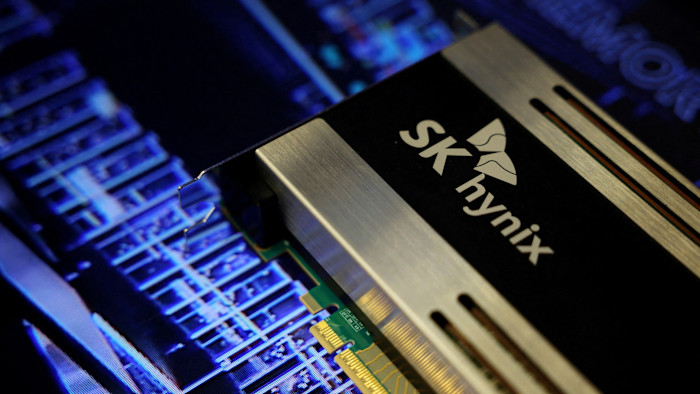
Their main problem is a reliance on three big memory-chip manufacturers, Samsung, SK Hynix and Micron, which are increasingly selling chips for AI rather than household gadgets. True, new suppliers are gaining share — China’s CXMT, planning to raise $4.2bn in an upcoming listing, is among them. But it too has its eye on AI, expanding into high-bandwidth memory (HBM) to serve Huawei, the Chinese tech group.
Constrained supply and higher prices affect Dell and Hewlett-Packard as well as others churning out cheap and cheerful smartphones. These tiny chips typically made up about one-tenth of materials costs for smartphones. Now, according to Counterpoint, the proportion is two to three times that and set to keep rising at least through the rest of this year.
Unlike many other inputs, there is no substitute. While some smartphone makers are reportedly taking more novel routes, such as scavenging old used handsets, the main options available to device makers are to raise prices — which is difficult to do without hitting sales, at least in the more competitive market segments — reduce memory intensity or watch margins shrink. Profitability is already taking a hit; one reason Cisco’s gross margins in the third quarter came in below expectations.
Darwinism protects the industry giants: they are at the front of the queue for depleting stocks, have fatter margins and generally boast less penny-pinching end customers. But there is a long tail of cheaper manufacturers and Japanese conglomerates such as Sony that persist despite a tiny global market share.
Memories needn’t be long to recall boom and bust cycles in the field: there have been five over the past four decades. But everything points to this one being among the most severe.
Normal self-righting mechanisms no longer apply. Making memory chips is supremely profitable; operating margins for so-called Dram (Dynamic random-access memory) chips now beat the 50-60 per cent available on HBM last year, but no chipmaker is rushing to revert. Hyperscalers’ demand is voracious and enduring, and contracting to fulfil three years’ requirements at a fixed cost is more attractive than taking a punt on 2028 Dram prices.
This snarl-up in chip supply chains has geopolitical ramifications, too. China’s CXMT and country peer YMTC, which makes Nand flash memory, were removed from the US Pentagon’s blacklist earlier this month. That will potentially make it easier for them to acquire knowhow, and for desperate buyers to source chips from them. This opportunity to prove their chops may come in handy when the cycle next turns.
Read the full article here