

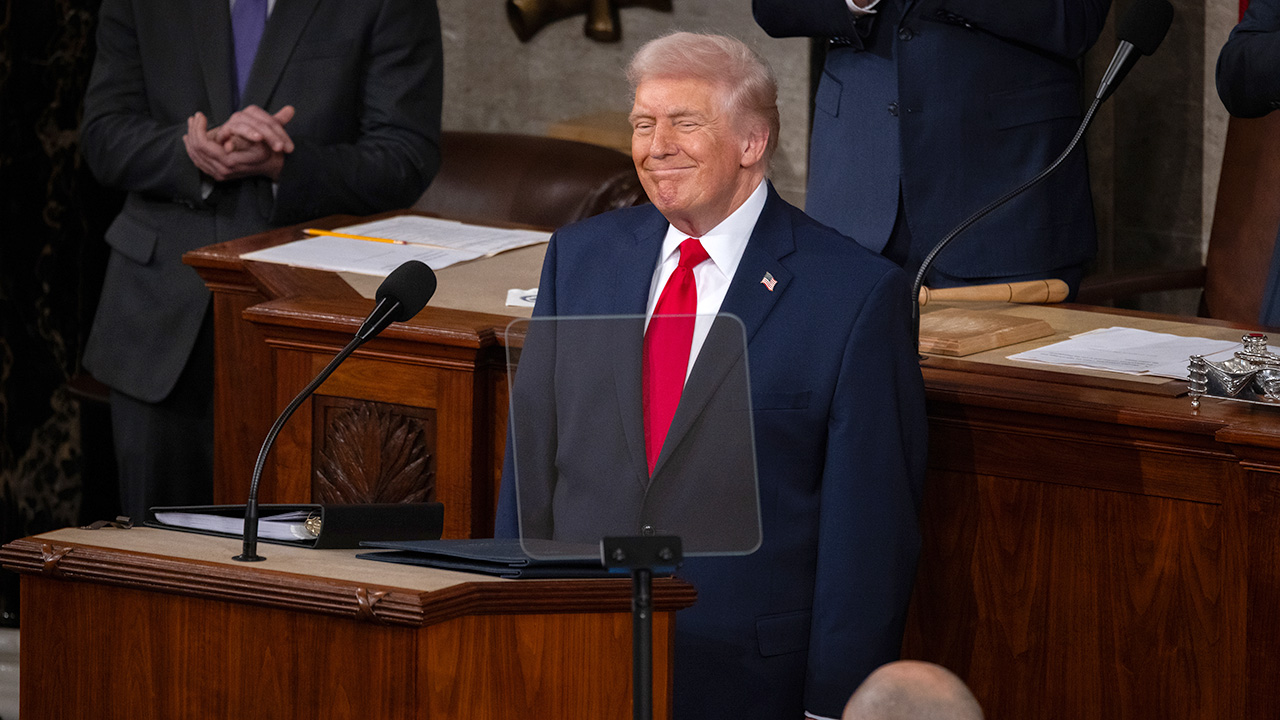
President Donald Trump on Tuesday outlined a new retirement plan that would see the federal government match a portion of the contributions made by American workers to retirement plans that aren’t matched by their employers.
Trump discussed the proposal during his State of the Union address to a joint session of Congress on Tuesday night, when he said that the federal government will start providing up to $1,000 in matching contributions to the retirement plans of workers whose employers aren’t providing a match.
“Since I took office, the typical 401(k) balance is up by at least $30,000. That’s a lot of money,” Trump said. “We have millions and millions of people, because the stock market has done so well, setting all those records – your 401(k)s are way up. Yet half of all working Americans still do not have access to a retirement plan with matching contributions from an employer.”
“To remedy this gross disparity, I’m announcing that next year, my administration will give these often forgotten American workers – great people, the people that built our country – access to the same type of retirement plan offered to every federal worker. We will match your contribution with up to $1,000 each year, as we ensure that all Americans can profit from a rising stock market,” the president said.
THE TYPICAL AMERICAN WORKER HAS JUST $955 SAVED FOR RETIREMENT, STUDY SHOWS
Trump’s proposal would build off an existing federal policy that allows the government to make a matching contribution to private sector workers’ retirement plans if they meet certain income criteria.
A bipartisan law known as the SECURE 2.0 Act was signed into law by President Joe Biden in 2022 and created a Saver’s Match that would match 50% of retirement contributions made by eligible workers up to $1,000 for individuals and $2,000 for couples starting in 2027.
HERE’S HOW MUCH TRUMP ACCOUNT BALANCES COULD GROW OVER TIME
Under the SECURE 2.0 Act, the Saver’s Match would be distributed through a federal tax credit deposited directly into a qualified pre-tax retirement account, such as a traditional IRA or traditional 401(k), though after-tax accounts like the Roth IRA or Roth 401(k) wouldn’t be eligible to receive the funds.
The existing Saver’s Match phases out for income in the $20,501 to $35,500 range for single filers, $30,751 to $53,250 for heads of households, and $41,001 to $71,000 for married couples filing jointly.
IRS REVEALS UPDATED RETIREMENT CONTRIBUTION LIMITS FOR 2026
The White House indicated that the president’s proposal would have a similar structure to the Thrift Savings Plan that federal employees can enroll in, which allows them to invest in several low-cost index funds, including U.S. Treasury bonds, an aggregate U.S. bond fund, the S&P 500, a U.S. total stock market index, and an international stock index that excludes China and Hong Kong.
A 2025 analysis by the Pew Charitable Trusts found that almost 57 million American workers – which amounts to almost half of the private sector workforce – don’t receive retirement benefits through their workplace.
Pew’s analysis estimated that the cost to federal and state governments of Americans’ insufficient retirement savings would amount to $1.3 trillion over a 20-year period, as insufficient retirement savings decreases household spending and increases demand on social assistance programs that can strain a shrinking tax base.
Read the full article here