

This article is part of FT Globetrotter’s guide to Miami
Ask anyone who you should meet to really understand Miami and you are two recommendations away from Mitchell Kaplan. To one, he’s “a champion of literature”. To another, “an absolute institution”. The accolades continue: “a real mensch”, “the godfather of books”, “the cultural heart of Miami”.
Meet Kaplan, the owner of Books & Books bookstore in Coral Gables, and he’ll tell you about driving Joan Didion around the city in his car. (“She was always very introverted, so to be a friend of Joan Didion was just . . . sigh.”) His colleague Cristina Nosti, who has led events and marketing at the shop for 23 years, will recall swapping Cuban recipes with Anthony Bourdain. (“A wonderful, wonderful man. I gave him my flan recipe in exchange for his ropa vieja.”) Bourdain was also a fan of Kaplan, she says, who he got to know over repeated visits to the South Beach Wine & Food Festival. “I remember him saying he would walk over glass for Mitchell Kaplan.”
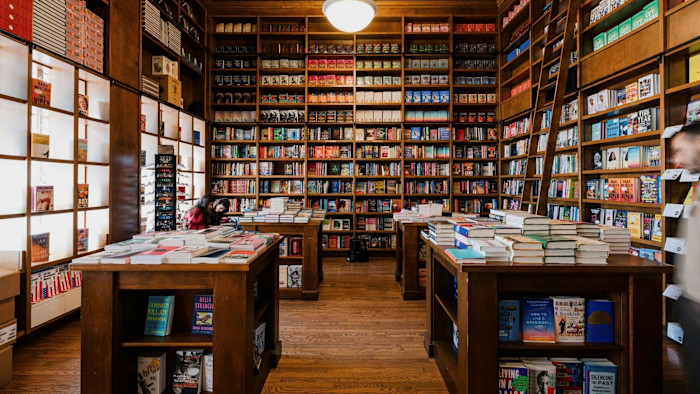
Go into Books & Books, and you’ll enter more of a rambling commune than a bookstore, set in a dreamy one-storey Mediterranean Revival building — white stucco walls, red terracotta roof — that winds around a brick courtyard open to the sky. Wander through it, from its children’s books room into a huge room full of fiction, then to a long narrow café lined with cookbooks. Beyond it, the ceilings rise. Big art books and little poetry books surround you. There might be a reading in progress. Stop and sit, or keep browsing; neither will disrupt.
Continue into the last room and, finally, the name will land: there are books and books and books and books. Books stacked to the ceiling on dark wooden shelves, ladders being pulled along rails, staff picks at the entrance, a customer asking about a gift for her mother. In the courtyard, the café and bar spills inward, full of newspapers and magazines. It’s run by Kaplan’s son Jonah. You may sit for a chopped salad, or ceviche, or a glass of wine. The people sitting next to you may be talking about a movie. They may ask you if you’ve seen it.
Kaplan opened his shop in 1982, age 26. At college, studying literature, he’d learned an important fact: that at the centre of most literary movements, there was a bookstore. Shakespeare and Company in Paris in the 1920s. Gotham Book Mart in New York for the avant garde. City Lights in San Francisco for the Beats in the ’50s. After college he tried law school in DC, but it didn’t feel right. (Mostly, he says, he hung out in bookstores.) So he moved back to Miami and started the cultural centre he’d dreamt of, in a 500 square foot space.
“Miami was at the bottom of the bottom,” Kaplan tells me. He’s now 71 and talks through a mop of bushy grey: grey hair, grey eyebrows, grey beard. “It was at its absolute nadir, everything you associate with Miami. We had just had the Mariel boatlift [the mass-Cuban emigration to the city]. We had just had the McDuffie race riots. It was the beginning of the cocaine crisis. We opened up in the teeth of all that.”
Beyond its crises, the world was mostly ignoring Miami. “But being a bookseller was exceedingly interesting, because you knew what people were reading,” he says. “And people here were reading seriously.”
One day, he remembers, the great New York publishing giant Roger Straus walked into his bookstore, pulled Hermann Broch’s 1945 novel The Death of Virgil out of the fiction section and whispered to his wife, “Oh wow, they have this!” They had it, and Miamians were reading it.
So Kaplan started offering more: he got a Betamax video cassette player, partnered with a film club and showed avant-garde foreign films at night. (“Really wild films,” he says. “We’d probably be closed down today!”) In 1984, he and a group of like-minded locals started the Miami Book Fair, securing names like Toni Morrison, Anne Rice and Allen Ginsberg in a city most thought had no literary interest. The event thrived, and has since become a template for book fairs around America — in November, it turns 43.
Meanwhile, the city was also gaining national cultural prominence. Miami Vice came out. Madonna moved down. The events became more ambitious. One evening in the mid-1990s, Kaplan invited every living Nobel Prize-winning poet to the bookshop. The night, he says, was spectacular. He can’t for the life of him remember the year, but he remembers the details with precision: “We had Derek Walcott, we had Joseph Brodsky and Czesław Miłosz. It was astonishing. We had young poets introduce them, or at least poets who were young at the time: Ed Hirsch, who’s now blind; Adam Zagajewski, who has since died.” In 1999, the bookstore moved into its current, much larger flagship in Coral Gables. In 2002, Kaplan hired Nosti, who worked the original shop’s register when she was in college, to run events. Now, Nosti estimates that they host at least one event per day, and probably around 400 per year.
Though Kaplan insists he never had grand ambitions to become a Shakespeare and Company (“I just had some hubris, and understood the power of what a bookstore could do”), he and his team seem to have done it: created an intellectual nucleus for Miami, one where you can shop for vintage clothes and get a flash tattoo on a Sunday in the courtyard, but also meet Lauren Groff, Gavin Newsom, Ibram X Kendi or Patrick Radden Keefe (all of whom have upcoming author events).
After years of being the cornerstone of Miami’s literary world, Kaplan shares his memories like they urgently need recording — like he’s astounded by his own life.
“To be able to have met and be around, even for 15 minutes, almost every major writer of the last half of the 20th into the 21st century is mind-boggling,” Kaplan tells me. “I’ve lived long enough to be boggled by it. You tell younger people, ‘I remember the day James Baldwin was here.’ Or Ken Kesey, or Hunter Thompson. Or a very young John Updike.” (How was he? I ask. Very gentlemanly, he says.)
I tell him I’ve always thought of books as little receptacles of history, but he’s right that bookstores are, too. Like books, bookstores make the past feel like it happened not so long ago. Like books, they preserve something.
“They preserve culture,” he confirms. “It’s so important that cultural history gets passed down. We want younger readers to know where this all came from. Otherwise, it becomes forgotten history.” He points to eras where details got lost: “How much literary history do we really have about the ’40s? What was Robert Lowell like? What was John Berryman like?” He recalls dining long ago with an older publisher “who was telling stories about Ezra Pound!”
It’s hard to pinpoint why Kaplan’s plans work when others’ fail, how he seemingly manages to do everything and be everywhere. Nosti says it’s he doesn’t stop.
“Mitchell is a free thinker,” she says. “He’s always been ahead of his time, open to everything and everyone. That’s the key. He really has never closed the door on anything. And it’s his welcoming spirit that incites and plants little seeds in people. They always felt they could come to Books & Books with their best ideas, so they did. They knew he understood culture.”
The bookshop continues to expand. Today it has four other outposts: in Coconut Grove, North Miami Beach, Miami International Airport, and Key West, the latter run by the author Judy Blume. In reaction to Florida’s school book bans, in which some 9,000 books (including Margaret Atwood’s The Handmaid’s Tale, Ann Patchett’s Bel Canto and Khaled Hosseini’s The Kite Runner) have been removed from state school libraries, Kaplan and his team created the Books & Books Literary Foundation. They painted the names of banned books all over the shop’s courtyard, began inviting banned authors to speak, and gave books from the ban list away in the thousands (including at a Pink concert, at the musician’s request).
I ask Kaplan if he’s hopeful about the future, for reading and for independent bookstores. He says that when the Kindle came out in 2007, a joke circulated among independent booksellers that they were following their readers to their graves.
“The last guy would come in, buy a book, walk outside, die and we’d have to close our doors. That was our last reader,” he says, laughing. “But that feeling of surrender has completely gone over the past 10 years.”
Now, he sees young people visit the store who seem to know that they’ve missed out on something. They buy records and books, use typewriters, go to readings, sit in book clubs, wear analogue watches. That makes him hopeful. “And it’s not just because of some broad general idea that people should read,” he clarifies. “It’s what reading does. There are studies that show that if you’re a reader, even a light reader, you have much more civic engagement than if you do not. Reading is crucial to who we are as a society. When you can be alone with your thoughts, you think more deeply. It leads to more considered thought.”
On my visit to Books & Books, I buy a Cuban cookbook. I learn about a Miami-based poet, and write down one of her poems. Two strangers sitting in the café do, in fact, ask me if I’ve seen a movie. I tell them I have.
You can read more of our guide to Miami here, including a field guide to flirting by Aysha Elias, how to survive Miami Beach like a local — and eat like a local — by Carlos Frías, chef Michelle Bernstein’s favourite Miami restaurants, and our where to stay guide.
We’re on Instagram at @FTGlobetrotter
Read the full article here