

Joining the Kodo taiko troupe is arduous. You have grown up around drums and taken up sticks as a toddler. You apply to enrol as an apprentice. If you are one of the 15 or so selected, you spend two years at the apprentice centre on Sado Island, a former place of exile off the western coast of Japan. You have no access to technology. You start every day at 5.30am with a training run, then practice, eat, practice, eat, practice, sleep. As well as drumming, you learn another craft — perhaps playing the bamboo flute or metal percussion, perhaps dancing. You harvest your own rice. You carve your own drumsticks from cedar wood.
After the first year, maybe half of your class do not return. After the second, maybe five of you are selected as junior members; maybe one; maybe none. If you impress for a further year, then you join as a full member. You spend a third of your year creating new music; a third touring Japan; and the final third touring abroad: North America in odd-numbered years, and in even-numbered years Europe.
Earlier this month 14 musicians rolled off an eight-hour bus ride from Bordeaux and into the Eighth Arrondissement’s Salle Pleyel. The musicians, their own road crew, have load-ins and load-outs down to a fine ritual. Collectively they hoisted into the hall their largest drum, the o-daiko, hollowed out of a single tree trunk to the size of a hot tub and approaching the weight of a grand piano, and rolled it up the stairs to the stage, to sit on its own wagon. The next day the Salle was abustle with preparations for a four-night run. Sandbag-sized sacks of Japanese rice were being hauled in — Natsumi Ikenaga, one of the tour managers, travels with her own rice cooker — and high-protein food prepared.
On yoga mats in the hallway, teams of two were tuning their okedo-daiko, small double-headed drums whose rope needs daily tightening. When one snapped, the company’s director, Yuki Hirata, and Toji Harada, promoted to full member in January, repaired it. Swapping roles as they tired, one tautened the binding, pressing bare feet against the frame and stretching flat, while the other twisted a drumstick to tension the drum as it howled like a butchered animal.
In an adjacent hall, a rehearsal was under way. “Monochrome”, composed for the group’s precursor 50 years ago by Maki Ishii, is played by a line of seven drummers in absolute synchronisation: beforehand they have a tekke-tekke session, tuning in with each other by playing the piece facing inwards in a circle. The almost-inaudible patter, like July raindrops on banana leaves, was broken by another drummer, Reo Kitabayashi, firing off loud tattoos into the acoustics of the rehearsal room. The others grinned, then locked back in. Hirata and Harada sidled into the room. Now all 14 stood in a circle as 29-year-old Seita Saegusa led a vocal warm-up, starting with eldritch groaning and ending with each member rapping a tongue-twister into the centre, chorused back at accelerating speed.
Hirata is from Kagoshima, a long way south of Sado. But growing up in a drum-loving household, his destiny was mapped out from an early age. Rebelling, he spent two years at junior college studying the English novel. What was his favourite? “I completely forget,” he says. (Ikenaga, who is translating, laughs: “Now it all comes out!”) “I was more into music than studying.” (Nonetheless, touring England for the first time, he made a pilgrimage to Canterbury in homage to Chaucer.) “I briefly thought maybe I didn’t need to travel down this path, but when I talked to my parents, they told me, ‘Just go, you won’t know until you try’.”
He rose quickly through the ranks, and at 31 is now the director of this touring company — about a third of Kodo’s overall strength. He has composed several of the pieces in Luminance, the current touring show. “I thought it would be great to be able to express an energy of hope, like a light shining into the world, through the energy that comes out of the members of Kodo,” he says, “not only through their musicality, but especially through their physicality.”
For Moe Niiyama, 27, attending the apprentice centre was the first time she had left her hometown of Saitama, near Tokyo. “I was surrounded by taiko drums from the age of three until I graduated from high school, so I wanted to turn it into a job and travel around the world.” Her experience as an apprentice was a shock. “Rather than learning to play the drums, I felt like I learnt more about how to live my life.” In the isolation of the training centre, spending every waking second with her classmates, she found herself buffeted by emotion. “I had to shout at the mountains!” she says.
For a time under artistic director Tamasaburo Bando, who was appointed in 2012 and had a background in kabuki, the group moved in a more theatrical direction. Since he stepped back in 2016, the performances concentrate on the music. “I think there are two sides to it,” says Hirata diplomatically. “We’re not trying to go back to the way it was before Tamasaburo came along, but because [the music] is the language we have.”
We discuss the conflict between different styles of play and performance. “It seems that the beat has to be extremely stylish and kakkoii [cool]” — hitting the drum in the exact centre, eliminating unnecessary movement — “but it would be nice if there were more kawaii [cute] expressions.” He mimes a drumstick being twirled with a flourish. Kodo also renew themselves through collaborations with other musicians, sometimes tense but always invigorating: Hirata’s secret wish is to work with London-based guitar renegade Tomoyasu Hotei.
Every day, in the continually improving spirit of kaizen, the company reflect on the previous night’s performance and offer each other suggestions. Perhaps, Hirata says, “one person wants a strong, clear sound, while another person wants a bang that sounds like the end of the world, and the two sides end up disagreeing . . . When people don’t get on, that can make for more interesting performances.” He takes his responsibility seriously, especially abroad. “So many people play taiko now. If Kodo were to turn out to be really bad, it would seem like Japanese drumming in Japan isn’t that great after all, and that would be a real source of shame.”
When Kodo took to the stage in Paris, there were no signs of underperformance. Drums rolled on and off stage as frictionless as a production line. Hirata’s opening “Prologue”, with four flutes, had a Mellotron eeriness. The dancing sway of “Stride”, with drums strapped to the musicians’ chests, recalled a Punjabi dhol ensemble. The stuttering rhythms of “Miyake”, on heavy miya-daiko, had a faint echo of east Africa. Dancers dressed as furry demons served as messengers of the gods bringing happiness.
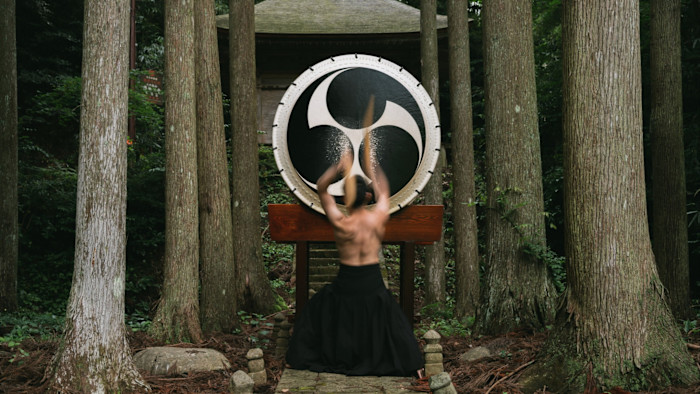
At the back of the stage, the o-daiko sat like Chekhov’s drum, waiting for the moment when Kodai Yoshida, stripped to a loincloth, bombarded it with two sticks, a central moment in any Kodo performance. “Although it is a loud instrument,” Hirata had mused earlier, “the beat of the drum and the subsequent resonance are very similar to the sounds of the heart and blood flowing that we hear in our mother’s womb before we are born. The most pleasing sound of all drums.”
European tour dates at kodo.or.jp, including the Royal Festival Hall, London on March 6 and 7
Find out about our latest stories first — follow FT Weekend on Instagram, Bluesky and X, and sign up to receive the FT Weekend newsletter every Saturday morning
Read the full article here