

Unlock the Editor’s Digest for free
Roula Khalaf, Editor of the FT, selects her favourite stories in this weekly newsletter.
The East Anglian village of Hesket has avoided dramatic change over the centuries. Its inhabitants live much the way their predecessors did, raising children, tending small plots, churchgoing, gossiping.
Blending ghosts, folklore and nature-writing, Hesket: A Norfolk Haunting by Sara Bayat (Corsair £18.99) explores the impact on this fictional small community of a housing development which will devour part of an ancient wood. Hesket still remembers the innocent women hanged on the site centuries before as witches. Even in the modern world there are fears about what will be released when the diggers move in.
Interlocking vignettes introduce the reader to the spooked villagers: the grieving couple for whom Spry Wood holds the spirit of their dead child; an elderly woman consumed with guilt at a small theft from a deceased neighbour; feuding local mediums taking advantage of the disquiet; the vicar who tries to calm talk of vengeful revenants. Pulling all the pieces together is a young journalist looking to poke fun at rural types, but becoming intrigued.
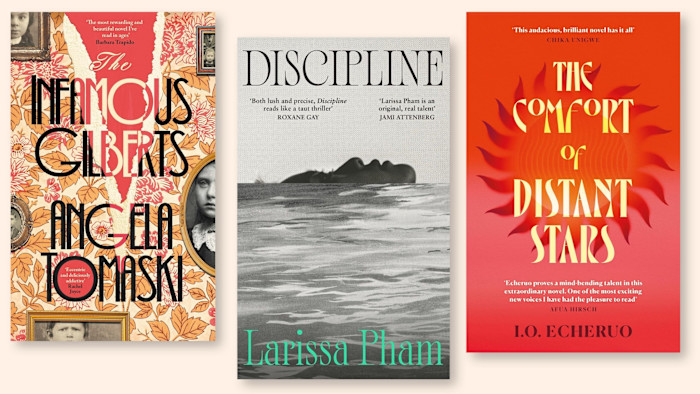
Also trying to control a narrative is Maximus in The Infamous Gilberts by Angela Tomaski (Fig Tree £16.99/Scribner $27), in this case about an aristocratic family in decline, their cavernous stately home having been sold to a hotel chain. The story of the five Gilbert siblings involves madness, greed, cruelty, deprivation, abuse, even murder. The narration is by a faithful character called Maximus and takes the form of a meticulous tour of the house (based on Tyntesfield, a Victorian gothic-revival manor owned by the National Trust) before the developers move in. “Look around. Feel free to explore,” he cajoles the reader. No item, be it a pine cone or shred of paper, is too small to prompt a gripping story. Not to mention the 1,000 empty jam jars.
Curiously, we don’t ever divine Maximus’s true relationship to the siblings or the nature of his obsession with them, but his pedantic narration gives a semi-comic flavour to their tribulations. For all their headstrong privilege, their plight is moving. It’s like Brideshead Revisited without the sanctimony.
Questions of how best to tell a story loom in Discipline by Larissa Pham (Serpent’s Tail £16.99/Random House $28), in which a fictional author, Christine, grapples with the fallout from her first novel. In it, she reframed the secret affair with her professor a decade prior that led to her losing confidence and flunking her art degree after he spurned her.
She has taken revenge in print by having her protagonist kill the fictional seducer. “Writing the book had felt necessary . . . like an exorcism,” she explains, but has she done enough to make it artful and distanced? When a one-line email arrives — “That’s not how I remember it” — she is plunged back into his grip for a final confrontation. Discipline coolly questions the ethics and processes of fiction and art, examining the toll they take both on the practitioner and anyone unlucky enough to be in their orbit.
Two competing stories underlie The Comfort of Distant Stars by IO Echeruo (Canongate £18.99). As a child in Nigeria the narrator is given the honorific title Ezeani, which thereafter becomes his name, marking him out as a tribal leader and acolyte of the Sun god Anyanwu. Growing up, Ezeani is fascinated by mathematics and science, moving to the US and becoming a world-renowned lecturer in quantum physics.
The only problem is, he still regularly receives visitations from Anyanwu, whether in the guise of a tramp or passer-by or in full tribal regalia. Ezeani, the god explains, is his last surviving worshipper and if he fails, Anyanwu will die. He has a long-running dispute with Jesus, whose status is much more secure with his millions of followers.
As Ezeani struggles to explain the universe by means of quantum theory he wonders, is an obstreperous Sun god really any less believable than matter that disappears when it’s not being observed? Echeruo’s dazzling bildungsroman throws out ideas like firecrackers.
“I believe in your physics. We are entangled,” Anyanwu insists, referring to quantum entanglement, the process whereby once particles interact they are forever linked. In the end, neither worldview proves much of a help to Ezeani when navigating human existence, but it’s quite a ride.
The frenetic world of professional table tennis is the background of EY Zhao’s Underspin (Doubleday £16.99/Astra House $27), a cautionary tale about the price paid for prodigious gifts. The novel opens with a sombre gathering around the casket of superstar Ryan, dead before his 25th birthday. Multiple perspectives from rival players and friends shed a bitter light on his rise and downfall, especially on his vexed relationship with Kristian, the brilliant but ruthless coach who has pushed Ryan and others to the brink of destruction.
Poignantly, despite their extraordinary talents, these are also typical teenagers. In its competing love and critique of the sport, Underspin is as zippy as an Olympic final.
Join our online book group on Facebook at FT Books Café and follow FT Weekend on Instagram, Bluesky and X
Read the full article here