

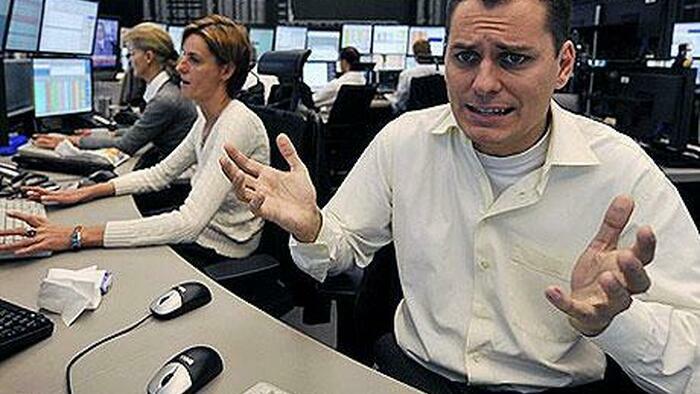
US equity futures are down sharply, along with all global markets, as the Iran war expands and escalates (attack on US embassy in Saudi Arabia; uncertainty over duration of Strait of Hormuz closure; targeting non-military infra / businesses) rattling markets and sending oil and the dollar surging. Global bonds also plunge on fears that Trump’s “whatever it takes” vow on Iran will fuel energy prices and inflation. As of 8:00am ET, S&P futures are down 1.4%, off session lows, as market odds for Fed rate cuts in the coming months slide on the spike in oil prices; Nasdaq futures tumble 1.9% with all Mag 7 names lower. Pre-market, only Energy and Aero/Def are up in absolute terms while healthcare and staples outperfom. European and Asian equity benchmarks headed for their worst two-day drop since April. While yesterday dip-buyers helped US stocks close little changed, they may have their work cut out for them today. WTI crude trades above $75, Brent touching $85 for the first time since 2024, and European gas futures up 70% over the last two days; after soaring on Monday, precious metals are smashed today as the USD rips. Ten-year Treasury yields climbed six basis points to 4.10% as expectations dimmed for a second Federal Reserve cut in 2026. A surprise acceleration in euro-area inflation added to bets that the European Central Bank could raise rates this year. The yield on two-year UK gilts surged 16 basis points. Currently, there is no defined off-ramp with initial timelines expanding from 1 week to one month; and now potentially longer and the US has not ruled out a ground war. Mercifully there is no macro events today.
In premarket trading, all Mag 7 names are sharply lower. Nvidia lags most peers as US officials are considering caps on the number of AI accelerators the semiconductor giant can export to any one Chinese company (Nvidia -2.2%, Alphabet -2.4%, Amazon -2%, Tesla -1.6%, Microsoft -1.4%, Meta -1.4%, Apple -0.7%)
- Banks and financial firms fall as bond yields climb on the prospect of a prolonged conflict and the inflationary effect of high oil prices.
- Energy stocks are set to extend Monday’s gains, while airlines are once again lower. Movers include APA (APA) +2%, Exxon (XOM) +1.6%, American Airlines (AAL) -2.8%.
- Archer Aviation (ACHR) falls 4% after the electric vertical takeoff and landing aircraft maker reported a fourth-quarter adjusted loss per share that was wider than analysts’ estimates
- Best Buy Co. (BBY) climbs 13% after posting fourth quarter results and providing guidance.
- Credo Technology (CRDO) drops 11% after the communications equipment company reported revenue for the third quarter that matched its preliminary results announced in February.
- LendingTree (TREE) rises 8% after the consumer finance company’s revenue forecast for the full year exceeded the average analyst estimate.
- MongoDB (MDB) drops 26% after the database software company gave weaker-than-expected forecasts for full-year revenue and first-quarter adjusted earnings.
- On Holding (ONON) slumps 9% after the athletic apparel company forecast net sales for 2026 that fell short of Wall Street’s expectations.
- Ouster (OUST) surges 16% after the lidar company’s first-quarter revenue outlook topped the average analyst estimate
- Sea Ltd. (SE) plummets 16% after its quarterly earnings missed analysts’ estimates, a sign that competition from deep-pocketed rivals is weighing on the e-commerce company’s profitability.
- Surgery Partners (SGRY) falls 24% after the health-care facilities operator reported adjusted earnings per share for the fourth quarter that fell short of Wall Street’s estimates. Adjusted Ebitda also disappointed.
- Target Corp. (TGT) climbs 3% after forecasting better-than-expected profit for the full year, indicating the big-box retailer’s turnaround plans are generating results.
In other corporate news, Fitch downgraded Paramount Skydance’s corporate and long-term borrower ratings to junk following the Warner Bros. Discovery deal. OpenAI’s CEO said the company’s rush to forge a deal with the Pentagon looked “opportunistic and sloppy.” And Blackstone is allowing investors to redeem a record 7.9% of shares from its flagship private credit fund, the latest sign of unease in the industry.
Stocks fell and bonds deepened losses as the war in Iran entered its fourth day with no sign of de-escalation, heightening fears of a lengthy disruption to energy markets and a surge in inflation. Futures accelerated their drop after reports on Monday evening of drones striking near the US Embassy in Riyadh, pulling Saudi Arabia into a widening conflict. Drone strikes also damaged three Amazon Web Services data centers in the Middle East in recent days, with the company warning of prolonged disruptions to its services. The dollar remained the haven of choice, rising 0.7%. Concern that energy prices could remain elevated pushed global yields higher for a second day.
“Geopolitics is difficult to trade,” wrote Mohit Kumar, chief strategist for Europe at Jefferies. “We are happy to be overweight cash right now, waiting for more clarity and then use market moves to buy the dip.”
After soaring 50% on Monday, European natural gas prices surged as much as 34% amid uncertainty over how long exports will be halted from the world’s largest LNG export plant in Qatar. Brent spiked as much as $85 a barrel to the highest since January 2025. The Trump administration has no immediate plans to release oil from the nation’s emergency reserve. Crude tanker rates are set to extend gains despite already surging 1,586% from a recent low, according to Bloomberg Intelligence.
“Sentiment is gradually drifting from an orderly selloff to a panic selloff,” said Joachim Klement, head of strategy at Panmure Liberum. “We are now starting to see overreaction by investors. This increased panic selling may last for a little longer, but will eventually open up buying opportunities.”
A key focus for traders is what happens in the Strait of Hormuz, a narrow waterway off the coast of Iran that carries about a fifth of global oil supply. According to JPM the magic number is 25: that’s how many days the world has before it is effectively starved of energy supplies that transit the strait. Attention is also turning to the region’s vast array of energy infrastructure, with a fire at a major storage hub in the United Arab Emirates underscoring the risk to supplies.
“There was definitely a degree of complacency in US equity market valuations at close yesterday, and a perception that military conflict in Iran was a self-contained geopolitical risk,” said Emma Moriarty, portfolio manager at CG Asset Management. “Comments from the White House yesterday suggest a will to make the conflict more durable and to do whatever it takes.”
In Europe, the Stoxx 600 down by 3.2% with all subindexes in the red. European Banks and insurers are now in negative territory for the year as rising bond yields weigh on valuations. Deutsche Bank AG and BNP Paribas SA slumped more than 5%. Here are some of the biggest movers on Tuesday:
- AJ Bell shares rise as much as 3.3% after the investment platform was upgraded by UBS, with analysts saying slower EPS growth is now fully reflected in the price.
- Deutsche Boerse shares rise as much as 3% following upgrades to buy from Kepler Cheuvreux and Jefferies, with analysts citing the exchange operator’s resilience in uncertain markets and its insulation from AI disruption.
- Beiersdorf shares fall as much as 18% after the German owner of the Nivea brand posted disappointing guidance for the year that is likely to lead to consensus cuts, according to Citi.
- Insurers, banks are at the forefront of a broad selloff in European stocks, with both sectors having now fallen into negative territory year-to-date. Their steep underperformance reflects rising bond yields as traders weigh the possibility of a prolonged conflict in the Middle East that drives up inflation.
- Schaeffler shares sink as much as 20% after the German auto parts supplier announced weaker-than-expected 2026 guidance, with analysts predicting downgrades to consensus estimates.
- Aberdeen Group shares fell as much as 9.2% following its 2025 results. While analysts said the earnings were in line with expectations, the stock pulled back from near its highest since 2023 on Monday amid a wide selloff in financial services.
- Intertek shares crater as much as 14% after the testing and inspection firm’s results gave bears “too much to get their teeth stuck into” this morning, according to RBC Capital Markets.
- Forbo shares drop as much as 7.5% after the Swiss linoleum maker revealed only a minor improvement in second-half results and issued cautious guidance for the year ahead, dashing hopes of a swift recovery.
- Fresnillo shares drop as much as 6% after analysts at RBC Capital Markets said the capital expenditure budget for this year is much higher than expected, which is stealing the show from the mining company’s strong annual results.
Asian stocks extended losses into a second day as mounting conflict in the Middle East intensified risk-off sentiment among investors.
The MSCI Asia Pacific Index dropped as much as 3.1%, setting the gauge on track for its worst two days in 11 months after US and Israeli strikes on Iran. One of the day’s most pronounced moves came in South Korea, which slumped 7.2% in its worst session since August 2024, as markets reopened after a holiday. Samsung Electronics and SK Hynix dropped more than 10%.
The volatility is forcing some investors to lock in year-to-date gains in hot markets and sectors like technology after a frenzy around all things artificial intelligence. Heavyweights Samsung Electronics, SK Hynix and TSMC were among the biggest drags on the regional gauge. Still, Korea’s Kospi and Taiwan’s Taiex Index are up 37% and 18%, respectively, this year, among the best performing gauges globally.
If transport disruptions persist in the Strait of Hormuz, that could continue to weigh on Asian equities that have been trading at record highs, said Dilin Wu, a research strategist at Pepperstone Group. “Any further supply tightening can quickly push up costs, squeeze corporate margins, fuel inflation, and weigh on risk assets.”
“The investment question is not primarily about Iran itself — it is whether the conflict leads to a larger value-at-risk episode driven by correlation into other markets,” said Nick Ferres, chief investment officer of Vantage Point Asset Management in Singapore. “My guess is that markets traded as though the conflict would be relatively short last night. However, that view might be too optimistic.”
Consumer stocks will be in focus in early trading with big-box retailer Target and a slate of consumer discretionary stocks due to report. Nivea maker Beiersdorf fell in Europe after saying challenging conditions in the skincare market will likely continue.
In FX, Bloomberg Dollar Spot Index up by 0.7% with Norwegian krone and Swedish krona underperforming.
In rates, treasury futures extend Monday’s slide, lifting yields by 4bp-8bp with short maturities rising most, flattening the curve. Bonds are under pressure with crude oil futures up more than 8% at highest level since June, stoking inflation expectations, as US military action continues for a fourth day. US front-end yields climbed as much as 10bp as traders priced in a more restrictive Fed policy path, flattening the 2s10s curve by nearly 3bp, 5s30s more than 4bp; 10-year is near 4.09%, about 6bp higher on the day, with UK and German counterparts up about 15bp and about 8bp respectively. UK gilts lead the global bond selloff, with front-end yields cheaper by about 17bp and curve spreads flatter. European bonds are plunging with the biggest decline at the short-end in the UK, with two-year yields spiking by 17 basis points. Yields higher across Europe as traders pull back their central bank bets and wager on the possibility of a hike by the ECB this year as Eurozone inflation comes hotter than expected. It’s not just Europe: globally, expectations for central bank easing are shifting further into the future based on rising inflation expectations; Fed swaps are price in around 40bp of easing by year-end vs 60bp at the end of last week. For ECB, swaps price in around 10bp of rate hikes by year-end while BOE contracts are priced for about 20bp of cuts. IG dollar issuance slate includes a couple of names. Nothing was done Monday as 15 borrowers — including one with a jumbo offering — that planned to sell new investment-grade bonds stood down. Syndicate desks had projected about $65 billion of high-grade issuance for the week.
In commodities, gold is missing out on any haven flows falling 2.9% after a four-day rally. It wa last trading around $5170. Base metals are also under pressure with copper falling over 2%, but aluminum spiking after QatarEnergy said it would stop output of the metal. Bitcoin sliding below $67,000.
US economic data slate empty for the session. Fed speakers include Williams (9:55am) and Kashkari (11:45am)
Market Snapshot
- S&P 500 mini -1.7%
- Nasdaq 100 mini -2.2%
- Russell 2000 mini -2.6%
- Stoxx Europe 600 -3.1%
- DAX -3.6%
- CAC 40 -2.8%
- 10-year Treasury yield +6 basis points at 4.1%
- VIX +4.8 points at 26.22
- Bloomberg Dollar Index +0.6% at 1203.44
- euro -0.7% at $1.1605
- WTI crude +6.4% at $75.77/barrel
Top Overnight News
- Prolonged war in the middle East and a persistent fall in oil and gas supplies from the region could cause a “substantial spike” in inflation and a “sharp drop in output” in the Eurozone, ECB chief economist warned. FT
- Brent hit $85 a barrel after news of a fire in Fujairah, a major UAE oil hub that lies outside the strait. QatarEnergy halted production of some downstream products and European natural gas surged again after the closure of the country’s LNG export plant yesterday. BBG
- The Trump administration will unveil a plan on Tuesday to combat the rise in oil prices triggered by the U.S. military strikes against Iran, Secretary of State Marco Rubio said Monday. Politico
- Two leading Republican senators are reportedly asking the Trump admin to pass a USD 200bln tax cut without congressional approval; GOP seeks improving its economic approval rating ahead of the mid-term elections. Two senators incl. Ted Cruz and Tim Scott. Aims to reduce some of the taxes paid on capital gains: WaPo
- Fresh market volatility triggered by the Middle East conflict has heightened the chance the Bank of Japan will hold off on raising rates in March, sources said, as policymakers need more time to gauge the impact on the economy. RTRS
- US and Chinese trade negotiators are slated to meet in mid-March, according to people familiar with the matter, signaling a planned summit between Donald Trump and Xi Jinping is pushing ahead despite American strikes against Iran. BBG
- The Bank of Russia is suing the EU over the indefinite freeze on assets blocked following the invasion of Ukraine, arguing that it’s being deprived of legal protections. BBG
- Fed chair-in-waiting Kevin Warsh’s path to rate cuts is narrowing amid elevated inflation, a stabilizing labor market and — now — surging oil. Traders pared rate-cut bets to price a 50% chance of a second quarter-point reduction this year. BBG
- Israeli Prime Minister Benjamin Netanyahu insisted the U.S.-Israeli joint military operation in Iran will not lead to an “endless war” in a Fox News interview on Monday in which he lavishly praised U.S. President Donald Trump’s role in leading the airstrike campaign. Politico
- Market ‘dispersion’ is hitting levels not seen in decades as investors sort AI winners from losers. While the S&P 500 has traded within a range of just 2.7% in 2026, the average company in the index has moved within a band that is about seven times as much. That ratio is the largest since at least 1994, signaling a market with unusually high divergence in returns between different companies. WSJ
Trade/Tariffs
- US Treasury Secretary Bessent and Chinese Vice Premier He Lifeng are expected to convene in Paris at the end of next week to discuss bilateral matters, according to Bloomberg.
- US and China trade negotiaters are to meet mid-March prior to the Trump-Xi summit.
A more detailed look at global markets courtesy of Newquawk
APAC stocks were pressured with risk appetite weighed down by geopolitics as the Iranian conflict entered a fourth day, and with US President Trump warning of larger strikes to come. ASX 200 was led lower by weakness in mining and materials, with broad weakness seen in nearly all sectors aside from energy and financials. Nikkei 225 slumped beneath the 57,000 level amid the Iranian conflict and global disruption, with sentiment also not helped by a rise in the unemployment rate and as higher energy prices stoked inflationary concerns, which could narrow policy space for the BoJ. Hang Seng and Shanghai Comp traded indecisively with price action initially rangebound, before eventually succumbing to the risk-off mood, while there was a fairly substantial liquidity drain by the PBoC, and participants continue to await China’s annual Two Sessions conclave.
Top Asian News
- Japanese PM Takaichi said chances of a supplementary budget are not zero.
- Japanese Finance Minister Katayama said sees large market volatility on the Middle East situation, while Trade Minister Akazawa said watching impacts on prices including energy and will take steps to ensure economic impact is minimal.
European bourses (STOXX 600 -3.4%) continue to selloff as risk tone remains sour, with participants using this opportunity to profit from the trend higher, which is also exacerbating losses. Banks remain the hardest-hit, affecting the FTSE MIB (-4.5%) and IBEX 35 (-4.7%) the most. The broader STOXX 600 has now dipped below the 50DMA at 611.7, the index closed at 633.9 only two days ago. Unlike Monday, in which Energy (-2.0%) was supported by the higher oil prices, all sectors are in the red. As stated above, Banks (-4.6%) and Insurance (-4.6%) are the worst performing sectors due to the effects of higher oil on growth and the increased war-risk claims. Surging Nat Gas prices have failed to support Utilities (-4.7%), due to the energy disruption caused by QatarEnergy (which accounts for nearly 20% of global LNG trade) stopping the production of LNG.
Top European News
- Two UK government aligned think tanks are reportedly working on the options to reform student loans, Politico reported citing sources.
FX
- DXY continues to extend higher, with the geopolitical environment remaining turbulent, and with recent US commentary suggesting no near-term solution to the war. In brief, the IRGC continues to threaten any ship attempting to pass through the Strait of Hormuz, whilst President Trump warned of larger strikes against Iran. (Newsquawk analysis on the war on the headline feed at 08:15 / 03:15 ET). For the time being, DXY resides at the upper end of a 98.43 to 99.22 range, and now trading at levels not seen since late Jan’26; another leg higher could see the retest of January 19 high at 99.47, and then the round 99.50 mark thereafter.
- EUR and GBP continue to remain pressured by the ongoing Iranian war – both are net-importers of energy, as such, have been considerably pressured in the past couple of session. Geopols aside, the EUR saw some very modest upticks on the hotter-than-expected HICP – this is a bit stale, given the ECB will likely have to consider the inflationary/growth impacts of higher energy prices. UK-specific traders will also be attentive of the UK’s Spring Statement – it is likely to be a “non-event”, though focus will remain on the OBR, DMO forecasts and the implied headroom for Chancellor Reeves. (A Newsquawk primer is on the headline feed at 09:01 GMT / 04:01 EST)
- CHF continues to underperform vs peers. As above, Switzerland is a net-importer of energy, with downside also exacerbated by reports that the SNB is increasingly prepared to intervene. This stems the haven-related strength, that would otherwise be expected during times of geopolitical turmoil. Sticking with havens, the JPY also continues to weaken against the USD. USD/JPY now trades around 157.82, and is gradually edging its head back towards the touted intervention zone of 158-160. Further upside would likely see the resurgence of jawboning via Japanese officials. This perhaps explains why the JPY is holding up better vs peers (albeit is still lower vs USD). Earlier, Japanese Unemployment ticked a touch higher in January, but had little impact on the currency.
Fixed Income
- Fixed benchmarks under pressure as energy prices continue to climb and bias yields higher. A narrative that is sparking a hawkish repricing for central banks, with the near-term odds of a BoE cut trimming significantly and ECB pricing implying a small chance of tightening by end-2026.
- Bunds are down by 88 ticks at most, to a 128.75 trough. If the move continues, we look to 128.03 from the week of February 13th before the figure and then a cluster of lows from the first few weeks of the year between 127.51 to 127.82. If those are taken out, the YTD base is 126.98 before the 126.75 March contract low.
- Gilts gapped lower by 54 ticks and then fell almost a full point lower to a 91.58 trough, lower by 143 ticks at worst. Pressure is a function of the energy narrative as discussed above. A point that has seen the odds of BoE easing in the near-term trim significantly, with pricing now less than a 50% chance of a March cut vs. c. 85% at the end of last week.
- For the UK, the docket is theoretically headline by the Spring Statement. Though, the expectation is firmly for Chancellor Reeves to be a non-event. Nonetheless, the forecasts and DMO remit will be of note; Newsquawk primer available at 09:01GMT.
- USTs are in-fitting directionally, though magnitudes are less pronounced than its UK or even German peers. Down to a 112-24 base with losses of c. 13 ticks. Ahead, the docket features a handful of data points before Fed speak from Williams and Kashkari (2026), with a text and Q&A expected from both. Though, of course, any fresh geopolitical escalation/moderation will dominate the narrative.
- Germany sells EUR 3.825bln vs exp. EUR 5.0bln 2.50% 2031 Bobl: b/c 1.19x (prev. 1.65x), average yield 2.43% (prev. 2.40%), retention 23.5% (prev. 23.8%).
Commodities
- WTI and Brent futures remain firmer within USD 70.41-74.19/bbl and USD 76.74-79.27/bbl, with prices underpinned as the Iran conflict entered a fourth day, with the IRGC threatening to attack any ship trying to pass through the Strait of Hormuz, while US President Trump warned of larger strikes against Iran (analysis on the Newsquawk feed).
- Nat Gas has been in focus amid the upside from the war, further exacerbated by Qatar’s shuttering of output yesterday. Qatar accounts for roughly one-fifth of global LNG supply. Analysts warn that every week of downtime removes 1.6-1.8mln tons of LNG from the global market. Dutch TTF currently trades +23% intraday at EUR 54.805/MWh vs around EUR 32/MWh on February 27th.
- Precious metals are trading slightly lower. Silver faces a steeper drop thus far, down 4.6%, whilst spot gold is down 0.4%. XAG and XAU trade within the narrow ranges of USD 5,284.62-5,292/oz and USD 84.84-85.13/oz, respectively. Continuous dollar strength continues to hamper gains in the precious metals space despite weaker global risk sentiment amid geopolitical tension between the US and Iran, which increases haven demand for precious metals. Some analysts also suggest that profit-taking has been the key driver behind the slight pressure on the yellow metal. That being said, BMI forecasts that gold should rise above USD 5,600/oz this week with further upside to USD 5,850-6,500/oz if the conflict lasts 2-3 weeks.
- Base metals are also lower, hampered by global risk sentiment amid geopolitical tension between the US and Iran. 3M LME copper trades within the lower range of USD 12.798-13.281k/t.
- IAEA confirms recent damage to entrance buildings of Iran’s underground Natanz fuel enrichment plan.
- US President Trump will meet with US Treasury Secretary Bessent and the Energy Secretary Wright at 14:00EST/19:00GMT on Tuesday.
Central Banks
- Fed Chair nominee Warsh’s attempt to shrink the Fed’s balance sheet would proceed only slowly as he would face resistance over his plan to scale back one of the Fed’s most powerful tools, according to FT.
- BoJ Governor Ueda said the BoJ will conduct technical experimentation on settlement using central bank money in the form of current account deposits on a blockchain-based system.
- ECB’s Stournaras said should the Iran war continue, then there will be an upward pressure on EZ inflation; no rush to change rates.
- ECB’s Villeroy said French economic exposure to tensions in the Middle East is limited, would be a mistake to predict a rate move in a hurry.
- ECB’s Lane warned that a prolonged war in the Middle East and a persistent decline in oil and gas supplies could cause a “substantial spike” in inflation and a sharp fall in output in the Eurozone, according to FT.
- RBA Governor Bullock said underlying demand in the economy is further from supply potential than they had assessed. A large part of the unexpected increase in inflation was sector specific. Policy is well positioned to respond if needed.
- Riksbank’s Thedeen said inflation is close to target, interest rates have come down and the labour market has started to improve. Core inflation may trail forecast in 2026.
- PBoC purchased CNY 50bln worth of sovereign bonds in February on the open market.
Geopolitics: Middle East
- Israeli defence forces announce that they did not deploy ground troops in Iran, Israeli source report.
- The IDF announces that they have struck Iran’s leadership compound in Tehran.
- IAEA confirms recent damage to entrance buildings of Iran’s underground Natanz fuel enrichment plan.
- Israel’s Home Front announce early warning after detection of rockets fired from Iran toward Israel, Al Jazeera reported.
- Israeli Military Spokesperson said it is not likely that Israel will deploy ground forces to Iran as it is not practical.
- IDF spokesperson said launches detected from Iran and alerts expected in the northern area from the Golan to northern Sharon.
- Iran’s military said it targeted the Al Udeid base with missiles.
- Iran’s IRCG said they targeted the aircraft carrier “Lincoln” with 4 cruise missiles; The aircraft carrier “Lincoln” headed towards the southeastern Indian Ocean , Al Arabiya reported.
- Member of Iran’s Assembly of Experts said choosing a successor to Supreme Leader Khamenei “won’t take long”, according to ISNA.
- Hezbollah said it targeted the Ramat David Air Base in northern Israel.
- US VP Vance said President Trump wants to make sure Iran never had nuclear weapons, adds the US has a lot of capacity in Iran.
- US President Trump held a call with Kurdish leaders in Iraq on Sunday to discuss the US-Israel war with Iran and what might come next, according to three sources with knowledge of the called cited by Axios.
- US is said to prepare for a ‘pickup’ of attacks in Iran during the next 24 hours, according to CNN.
Geopolitics: Ukraine
- Russian Kremlin spokesperson Peskov on Ukraine talks, said its hardly possible to talk about meeting, adding that there’s no certainty on venue or timing.
US Event Calendar
- 9:55 am: United States Fed’s Williams Gives Keynote Remarks
- 11:45 am: United States Fed’s Kashkari Speaks at 2026 Bloomberg Invest Conference
DB’s Jim Reid concludes the overnight wrap
Events in the Middle East cascaded across global markets yesterday, triggering some of the biggest moves in years across multiple asset classes. Most notably, Brent crude oil prices surged by +7.26%, their biggest daily jump since March 2022, lifting prices to $77.74/bbl. Meanwhile in Europe, front-end natural gas futures rose by +39.26%, the most since February 2022, after Qatar shut down liquefied natural gas production. And this morning the moves have continued, with Brent crude up another +2.55% to $79.72/bbl, whilst S&P 500 futures are down -0.72%.
The latest moves have come as the conflict has shown no sign of easing thus far. Indeed, overnight in Saudi Arabia, the US embassy in Riyadh was attacked by two drones, and Trump said to NewsNation “you’ll find out soon” what the retaliation would be. So events like that are adding to fears about a more protracted conflict. Trump himself hasn’t pointed to a fixed timeline either, saying that “we projected four to five weeks. But we have capability to go far longer than that.”
The other critical question is what happens in the Strait of Hormuz, a key chokepoint accounting for around 20% of global oil supply. Concern mounted yesterday after an adviser to the to Iran’s Islamic Revolutionary Guard Corps said that Iran “will set fire to any ship attempting to pass through the Strait”. However, Bloomberg have also reported overnight that China was pushing Iran to keep the Strait open, according to senior gas executives.
Unsurprisingly, the sharp moves in commodities drove a significant spike in sovereign bond yields. The 10yr Treasury yield rose by +9.7bps, surging back to 4.03% in its biggest daily jump since October. And this morning it’s up another +1.9bps to 4.05%. Meanwhile in Europe, equities also slumped, with the STOXX 600 (-1.61%) posting its worst day since November, and European equity futures are pointing to further losses today. Strikingly, however, the S&P 500 (+0.04%) was essentially flat, as gains for the Mag 7 (+0.41%) and energy stocks offset weakness elsewhere. S&P futures had been as low as -1.7% early in the London session, so there was a notable recovery through the US session. But this morning they’re down another -0.72% as the conflict has continued and oil prices have posted a further gain. And that’s been echoed across Asia as well, with sharp losses for the KOSPI (-5.67%) and the Nikkei (-2.65%). However, Chinese equities have seen a relative outperformance, with the CSI 300 (-0.14%) and the Shanghai Comp (-0.21%) only posting modest declines.
More broadly, it’s always tough to trade geopolitical shocks given what we know about their historical impact. We’ve often cited the work of DB’s Parag Thatte and Binky Chadha, who have long argued that such shocks have had an average negative impact of around -6% to -8% on US equities over a three-week period, but that markets tend to recover back to prior levels within another three weeks. Notably, over the past three years we haven’t even seen such mild drawdowns when geopolitical shocks have hit, as with events over Venezuela and Greenland in January. So that raises the question of whether markets have begun to internalise this pattern as geopolitics becomes more important and we’re more used to dealing with it, or whether complacency has simply increased.
For me, much will depend on the price of oil. Any sustained spike would undoubtedly trigger a more meaningful risk-off move, but without that, markets are likely to revert fairly quickly to focusing on macro data and AI-related themes. It’s hard to know the ultimate aims of the US administration. With midterm elections around eight months away, there is likely a desire to show momentum in approval ratings. The cost of living is a key factor here, and a prolonged spike in oil prices would clearly be unhelpful. In addition, a Reuters/Ipsos poll on Sunday showed that only 27% of the American public supported the strikes, while 43% disapproved. That makes a prolonged mission seem less likely, although uncertainty remains very high. In a sign that the administration is wary of the oil price impact, Secretary of State Rubio said yesterday that a programme to mitigate energy costs would begin today.
We also heard a few other comments from US officials, including President Trump’s first White House remarks since Saturday’s strikes. The President said he took the decision to launch the war as it was “our last, best chance to strike” and eliminate the threats posed by Iran’s regime, though he did not refer to regime change as an objective. Before the US open, Pete Hegseth had similarly stated that the current situation in Iran was “not a regime-change,” though adding that the “regime did change.” However, Hegseth had signaled more clearly that a prolonged conflict is not currently envisaged, saying “this is not an endless war.”
Turning back to yesterday’s moves, we saw the biggest jump for Brent crude oil since March 2022. But interestingly, it only ranks as the 56th biggest daily move going back to 1990, something I looked at in my CoTD yesterday (link here). So while the move is large, it doesn’t yet compare with the extreme swings seen around the GFC, the Covid turmoil, or even some other geopolitical events such as the Gulf War in 1990–91. For reference, to enter the top 20, 10 and 5 daily moves, prices would need to rise by +9.6%, +13.6% and +13.9% respectively.
There were also signs that investors are still pricing the conflict as temporary rather than protracted. In particular, it has mainly been the front end of energy curves that have seen sharp spikes, while longer-dated contracts have moved much less. For example, when news broke that QatarEnergy would halt LNG production, after its facility was targeted by an Iranian drone attack, front-end futures rose by as much as +50% intraday, while the 1yr-ahead contract (+7.12%) saw a far more muted increase.
While yesterday’s dominant market story was clearly oil, there was little surprising about the direction or magnitude of moves in fixed income. Treasury yields rose across the curve, led by the 5yr (+10.8bps), with the 2yr (+9.8bps) and the 10yr (+9.5bps) seeing similar moves. While Middle East developments were the main driver, the moves were exacerbated by the February ISM manufacturing release, which surprised to the upside at 52.4 (vs. 51.5 expected). Notably, the prices paid component surged to 70.5 (vs. 60.0 expected), its strongest reading since June 2022. So that reinforced geopolitical inflation concerns and raised questions about whether the Fed will still be able to cut rates as markets had been pricing. The amount of Fed cuts priced by year-end fell by -9.2bps to 52bps. Note that on page 32 of my new pack (link here) we show US data surprises and 2yr yields. On this basis there is no need for a rate cut. Something needs to give to justify one.
Those yield moves were echoed in Europe, where investors rapidly priced out the chance of an ECB rate cut this year. The implied December probability fell from a 55% chance of a cut on Friday to a 17% chance of a hike by yesterday’s close. As a result, yields rose sharply, with 10yr bunds (+6.8bps), OATs (+7.2bps) and gilts (+7.5bps) all moving higher. Front-end yields were up around 8-12bps.
US equities, however, were relatively resilient. The S&P 500 (+0.04%) posted a modest gain, supported by strength in information technology (+0.91%) and energy (+1.95%) stocks. That said, there was significant sector-level churn, with airline stocks down -2.40%, while aerospace and defence (+2.52%) outperformed. Meanwhile, the VIX rose by +1.58pts to 21.44 but remains below its YTD highs from last month even if it did spike above it at 25.24 early in the London session.
By contrast, European equities saw more uniform weakness, with the CAC 40 (-2.17%), DAX (-2.56%), STOXX 600 (-1.61%) and FTSE 100 (-1.20%) all slumping. All the major STOXX 600 sector groups except energy were lower on the day, with consumer discretionary stocks (-3.98%) most hit. There were some notable advancers amid defence stocks, including BAE Systems (+6.11%) and Leonardo (+2.50%). And given that Europe is more exposed to the energy shock than the US, the euro weakened sharply against the dollar, falling -1.05% to $1.1688. (See our European economists’ latest take here for how events will affect the European economy.)
Finally, away from the Middle East, there were several other noteworthy developments, as Treasury Secretary Bessent announced that Anthropic would lose all its contracts with the Treasury following Trump’s direction for agencies to cease use of its technology. Meanwhile on tariffs, a US appeals court rejected the administration’s bid to pause the next steps in the fight over tariff refunds, sending the case immediately back to the Court of International Trade that had first ruled against the IEEPA tariffs back in May 2025. And in a sign of the headwinds in credit markets, we saw Bloomberg data showing that US leveraged loan issuance declined by nearly 80% in February compared to January.
Looking to the day ahead, we’ll see US February total vehicle sales, France’s January budget balance, Eurozone February CPI and Italy CPI. Central bank speakers include the Fed’s Williams and Kashkari, and the ECB’s Kocher and Sleijpen. Notable earnings include CrowdStrike, Thales and Target.
Loading recommendations…
Read the full article here