

Unlock the Editor’s Digest for free
Roula Khalaf, Editor of the FT, selects her favourite stories in this weekly newsletter.
Dassault Aviation on Wednesday warned of potentially irreconcilable issues over a flagship €100bn Franco-German defence project and said it would be “dead” unless Airbus dropped its disagreements with the French fighter-jet maker.
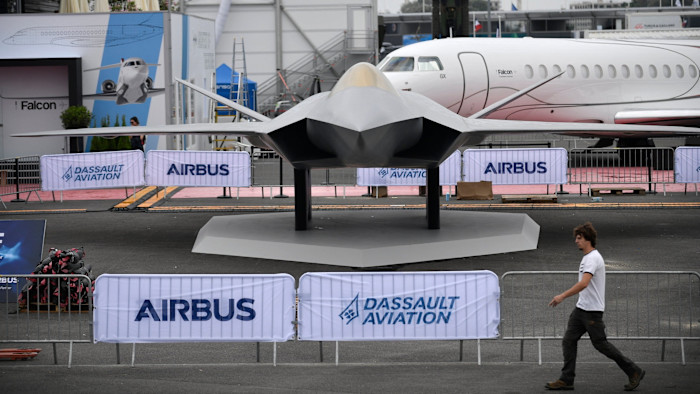
In the works since 2017, the Future Combat Air System (FCAS) project has been bogged down by virulent disputes between Dassault and the German arm of Airbus over how to split the share of work on the project’s central pillar — a fighter jet meant to take to the skies from 2040 and underpin Europe’s efforts to boost its own defence industry.
Dassault chief executive Éric Trappier laid bare the extent of the dispute as he blamed Airbus, which represents Germany and Spain’s interests in the project, for blocking progress and not accepting the French company’s leadership on the jet.
“If Airbus maintains its position of not wanting to work with Dassault, the matter is dead,” Trappier said. He added that the project was in “real difficulty”, saying: “What appears irreconcilable is that Airbus does not want to work with Dassault.”
He said that Dassault was open to partnering with other countries if FCAS with Germany fell apart, but that any decisions on partners would be made by the French government.
French President Emmanuel Macron, in particular, has sought to keep the project afloat, insisting again last month that Europe needed the FCAS, which was agreed with former German chancellor Angela Merkel.
But German Chancellor Friedrich Merz recently poured cold water on French hopes by saying the two countries simply had different needs for the specifications of the jet and that these would be difficult to overcome.
FCAS was to be an integrated system centred on a next-generation fighter jet, which would be accompanied by drones, advanced sensors and communications, all connected by software known as a combat cloud. Dassault and Airbus were to work together on the jet, France’s Safran and Germany’s MTU on the engine, while other companies were tasked on other parts.
Germany has floated the idea of splitting off from France to build its own fighter jet, while potentially moving ahead together still for other aspects of the programme.
Macron opposed the idea. “It would be absurd to have a French standard and a German standard for sixth-generation combat aircraft,” he said in an interview last month.
Trappier said France “could not stand the idea of pursuing two planes”.
The FCAS spat comes as Dassault’s business is flourishing because of increased export demand for its flagship fighter jet, the Rafale.
The jet is the backbone of the French army since it can carry the nuclear bomb and operate from France’s aircraft carrier, the Charles de Gaulle.
Macron said on Tuesday that he was deploying dozens of Rafales, several frigates and the Charles de Gaulle to the eastern Mediterranean and the Middle East to defend French bases and those of allies. France has defence pacts with the United Arab Emirates and Qatar — which both operate the Rafale, — so Macron said France had a responsibility to help them repel Iranian attacks.
Dassault’s sales rose 19 per cent last year to €7.4bn, with 26 Rafales delivered, one more than planned, and 37 Falcon business jets. The group said it aimed to increase that pace in 2026, with 28 Rafales and 40 Falcons, and reach revenues of €8.5bn.
Dassault has struggled, however, to increase production as Rafale orders flood in, and remains far off its goal of producing three aircraft per month instead of two today. At the current pace, it would take Dassault more than eight years to deliver on its order book.
The family-controlled group is in talks over a record contract with India for 114 Rafales, which would for the first time have a major “Made in India” component with final assembly lines set up locally.
Airbus declined to comment on Trappier’s remarks on FCAS. Asked last month whether the lines of communication with Dassault were broken, chief executive Guillaume Faury said: “Bridges are not burned, and this shouldn’t be turned into a personal matter. It isn’t. What is certain is that we are struggling to find a way forward.”
Faury separately said that on the next-generation fighter there was “a deadlock that is linked to expectations on the governance that differ between partners, on what leadership means, what co-operation means”.
German labour unions IG Metall and the German Aerospace Industries Association have advocated for Germany to go it alone on the jet, criticising the stalemate on FCAS as bad for Europe.
Read the full article here