

Stay informed with free updates
Simply sign up to the Life & Arts myFT Digest — delivered directly to your inbox.
The poet Percy Bysshe Shelley wrote a sonnet called “Ozymandias”. It tells of a desert kingdom that succumbs to the ravages of time, until not much more is left than “Two vast and trunkless legs of stone” in the sand.
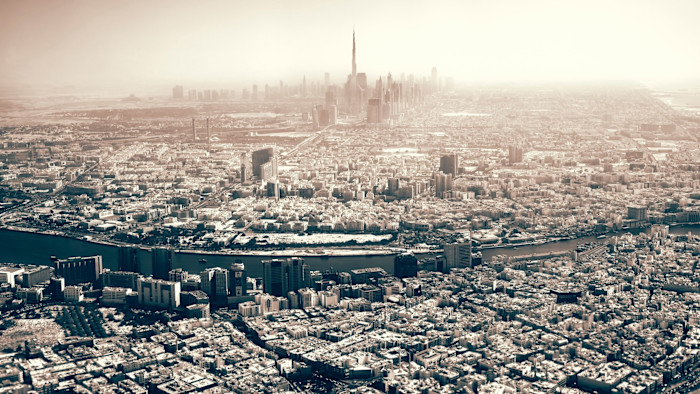
Looking down at Dubai from a circling plane last month, I had a spooky vision of all its towers and highways as ruins in a not-so-distant future. I ascribed this to the melatonin-and-wine diet that I tend to observe on long flights. A few days later, Iranian ordnance struck the emirate.
Count the ways in which Dubai is precarious. It is caught between the desert and the ever-fraught Gulf. Besides Iran, its neighbours include an ambitious Saudi Arabia and an anarchic Yemen. It relies on the hard power of the erratic US, whose Fifth Fleet patrols those unquiet waters. Dubai is not even the sovereign centre of its own state, which is Abu Dhabi. It has little oil. In the home peninsula of a world religion, it allows a degree of hedonism that some might regard as a profane incitement.
London can withstand anything: the Great Fire, the Blitz, the films of Richard Curtis, the pandemic. Dubai is a house of cards. So why, even as expats flee it, do I expect it to keep standing?
In the end, a world of dispersed wealth and power — a “multi-polar” world — needs a convening point. It needs a node. Dubai is the likeliest candidate. Even the most open of the major western cities have a foreign-born percentage of not much more than 40 per cent (as does Singapore). With people chafing against immigration, it is hard to see how that figure can go up much. In Dubai, the foreign-born are 90 per cent. There is no competing with the Gulf’s porousness to outsiders, and little desire to try.
It matters that Dubai is somewhere near the effective centre of the world. A large share of humankind lives within a flight time of single-digit hours. If the north Atlantic were to become the undisputed seat of economic and political power again — one can dream — Dubai would be in trouble. But the world is what it is.
There is another, bleaker point that has got somewhat lost during the past week. If the Gulf isn’t safe, where is? Western Europe is putting itself on a war footing. Singapore is well aware that it is in a contested region, tugged this way and that by the US and China. Outside of the Antipodes, havens are scarce. The US is one of them (all that protective water) but it is too powerful, too much of its own thing, to be the world’s neutral space.
And there’s the core of the issue. Dubai-knockers have it down as an airhead’s paradise. But it is the very shallowness and sterility that equips the place for node status. The newly middle-class Indian, the sanctions-avoiding Russian, the Uzbek barista, the white-collar economic migrant from a slow-growing Britain or France: none of them has to adapt to much there. A “thicker” local culture would need more navigation. It is why Istanbul, for all its pedigree as an east-west hinge, can’t really replace Dubai. Nor, despite the Saudi government’s overtures to expats, could Riyadh.
It is not quite true that Dubai was magicked out of nothing. That becomes obvious around the Creek, with its older and less polished street life. (Try Al Ustad Special Kabab.) But the bit the world tends to see might be the closest thing on Earth to a blank slate. Those who need more texture in their home of choice — I’m one — might underestimate how many people just want to forget themselves for a while.
The room for them is growing. The emirate is building what should be a 725-metre tall skyscraper called Burj Azizi. The structure will rhyme with the existing and even loftier Burj Khalifa. Will these two vast and trunkless legs of steel still shimmer at the end of the century? Or become stumps in a landscape of almost lunar desolation? If the first scenario transpires, it will be for sheer want of alternatives to Dubai as the world’s unofficial centre: its crossroads. If the second, a poet of the future could not have a more vivid metaphor for the transience and futility of all human doings.
[email protected]
Find out about our latest stories first — follow FT Weekend on Instagram, Bluesky and X, and sign up to receive the FT Weekend newsletter every Saturday morning
Read the full article here