

“My mind drives me to speak of forms changed to new bodies.”
At the start of Metamorphoses, Ovid promises his readers the world: the transformations wrought by gods and men “from the first creation of the cosmos to my own times”, and shaped by his poetic imagining. In these myths of love and fate, seduction and danger, beauty and deception, nature and death, came literature’s richest inspiration to visual art. Throughout the Rijksmuseum’s spectacular exhibition Metamorphoses, assembling some of the greatest artists’ inventive and erotic responses to the poem, Ovid is the gift that is still giving after 2,000 years.
“Danaë” bejewelled on plump pillows, rapturously awaiting her divine lover’s shower of gold, is the first of Titian’s “Poesie” sextet, based on different scenes from the poem, which took secular painting to unrivalled expressive heights.
Correggio’s “Jupiter and Io”, dramatising Book 1’s foundational tale of lust and deceit, depicts the god as a dark mist, intangible yet a physical presence, enveloping an ecstatic nymph. Trembling between abstraction and figuration, the god-cloud becomes corporeal only where touching Io’s body: face surging to grab a kiss, smoky hand on her hip.
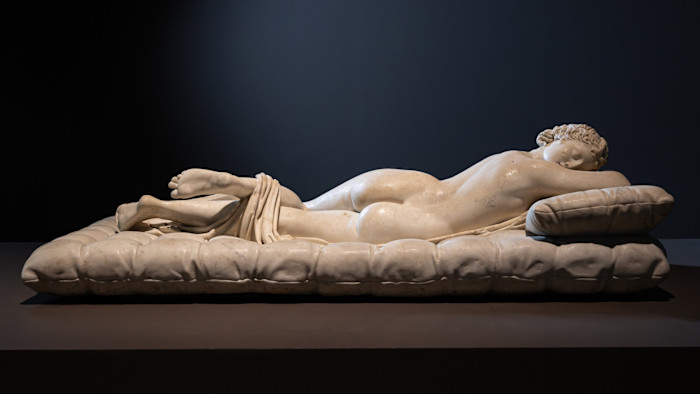
Bernini placed an antique “Hermaphrodite” on the most lifelike mattress ever made in marble, and invited us to circle around it watching girl become boy. Rodin cast himself as the sculptor in love with his own creation, breathing her into existence from rough stone, in “Pygmalion and Galatea”. Brancusi’s luminous ovoid “Prometheus”, face mere eyebrow and nose, evokes the light-bearing Titan forming the human race from clay.
As sexy as it is erudite, and by turns tragic and comic — alone together in one gallery, Luca Giordano’s brutal rendering of Ovid’s cruellest tale, the satyr flayed alive “Apollo and Marsyas”, hangs with René Magritte’s “The Red Model III”, a pair of boots becoming feet, leather returning to skin — the exhibition celebrates antique models, Renaissance and baroque masterpieces, and surprising modern reworkings of tradition.
One radiant grouping includes Caravaggio’s psychologically intense “Narcissus”, the infatuated youth kneeling at the pool enclosed with his reflection in an oval shining from dark ground; a Roman marble adolescent head, tousle-haired, languid eyelids, pensive — Ovid’s Narcissus “looks in speechless wonder at himself and hangs there motionless . . . like a statue carved from Parian marble”; a 15th-century “Millefleurs Tapestry with Narcissus”, set in a teeming garden heralding the youth’s transformation into a flower; and, in a burst of northern winter, surrealist Kor Postma’s jagged “Narcissus” by a frozen lake, face reflected in broken ice.
In another gathering, a magnificent flight of Zeus-as-swan sculptures begins in 2nd-century Rome with a marble Leda in gossamer chiton welcoming the bird on to her lap, and concludes in 1942 with Isamu Noguchi’s translucent veined alabaster “Leda”, rounded abstract forms flowing together, her plump body fused with his soft plumage. Rubies, black pearls, sparkling eyes flicker across Michele Torsini’s mannerist painting “Leda” as the blushing girl twists to the bird’s kiss. Hard-edged as marble relief, Michelangelo’s painted version was so explicit — wings between the girl’s legs, long neck at her breasts, beak pecking lips — that Anne of Austria had it destroyed, though imitations kept circulating. Leonardo’s sublime sinuous “Leda”, clasped in the embrace of the importuning bird while tending their twins, also disappeared; it is here in the most refined copy.
For painters, the dynamic potential of a moment of physical transformation has proved endlessly appealing, while sculptors across millennia relished the challenge of merging and emerging forms. Transformation is enacted in the show’s mise-en-scène, too: pictorial stories flow into other stories just as Ovid spins them through the fabric of the poem in “carmen perpetuum”, unbroken song.
Full of pathos, a 1st-century Roman “Minotaur” — downcast bull’s head, S-shaped curve of a human body — stands with Koen Vanmechelen’s pink marble “Seduction” (2021), parodying the “Crouching Venus” by attaching an outsized fluffy bull’s visage. This alludes to Jupiter’s disguise as a white bull to kidnap Phoenician princess Europa; with the sculptures hangs Laurent de La Hyre’s Gobelins tapestry “Europa on the Bull” (1650), wool and silk wonderfully evoking the soft, cuddly animal. Exactly this scene was woven by Arachne, chronicling Jupiter’s sexual misdeeds in her tapestry contest with Minerva — who promptly turned her into a spider. Juxtaposed with the tapestries, Tintoretto’s “Arachne and Minerva” shows the goddess jealously observing the young girl’s skill. Giordano’s version illustrates the instant Arachne’s fingers become arachnid legs. Hovering over them is Louise Bourgeois’s “Spider Couple” (2003).
“Nothing is constant in the whole world. Everything is in a state of flux”, Ovid writes, and that includes his poem: interpretation alters with each century, generation. In 1554, Ovid’s monster-slayer hero in Benvenuto Cellini’s “Perseus with the Head of Medusa” — the exquisite gilt bronze model is here — symbolised the triumph of Florence’s Medici rulers. Today, the focus is wronged Medusa. “Renowned for her loveliness”, she was turned into a gorgon, her luxuriant locks becoming “repulsive snakes” as punishment for being raped; in Juul Kraijer’s unnerving film “Spawn” (2019) reptiles crawl across her, a victim of disfigurement.
Metamorphoses describes 50 rapes, and countless injustices casually meted out by the powerful to the powerless. Actaeon is turned into a stag, then devoured by his hounds, merely for glancing at goddess Diana: goldsmith Jeremias Ritter’s “Goblet in the Shape of Actaeon”, fashioned as a man’s body, stag’s head and topped with coral antlers, a blood red omen, sublimates tragedy in 17th-century decorative virtuosity. Daphne is transformed into a laurel tree for fleeing god-rapist Apollo; Bernard Salomon’s rendering, where her legs, “lately so swift”, fuse into a trunk and her arms spurt into leafy branches, was among the immensely influential woodcuts in the French illustrated Metamorphoses of 1557.
Ovid was writing in authoritarian Augustan Rome, from where he was banished in 8AD shortly after finishing the poem (another work, Ars Amatoria, was probably the direct cause). But, born 43BC, the poet grew up during Rome’s civil war and turbulent transition from republic to empire, and Metamorphoses’ shape-shifting subversions, unpredictability and random terror reflect the political and social volatility of his age. The most-read secular text during the Renaissance, another epoch of tremendous change and questioning, the poem surged in popularity in the 20th and 21st centuries. As an exploration of change itself, the flux of human experience, Metamorphoses and the art it provokes are timeless.
This show is co-produced with Rome’s Borghese Gallery, where it will travel in somewhat altered form — Rome gains Titians and Berninis, especially the Borghese’s showpiece “Apollo and Daphne”, but loses the modern works. In divisive times, the exhibition is a model of European collaboration and cohesion, and of joy in difference. How marvellous, for example, to pair southern and northern renderings of the Europa myth: Giuseppe Cesari’s crystalline Mediterranean scene of abduction, Europa vainly glancing back to the seashore as the bull gallops away, versus Jacob Jordaens’ exuberant baroque Flemish pastoral of naked nymphs and herds of cattle.
Metamorphoses’ final word is “Vivam” — “I will live!” While time has “power over my body,” Ovid writes, “wherever Rome’s influence extends, over the lands it has civilised, I will be spoken, on people’s lips.” On my visit last weekend, the show was packed, couples lingering at the love paintings, parents photographing children by Renaissance cupids. Upbeat, intellectually stimulating, democratically appealing, it is an outstanding homage to one thing that doesn’t change: art’s eternal, sustaining pleasure.
Rijksmuseum, Amsterdam to May 25, rijksmuseum.nl; Borghese Gallery, Rome, June 23 — September 20, borghese.gallery
Find out about our latest stories first — follow FT Weekend on Instagram, Bluesky and X, and sign up to receive the FT Weekend newsletter every Saturday morning
Read the full article here