

Stay informed with free updates
Simply sign up to the Work & Careers myFT Digest — delivered directly to your inbox.
Last week, I emerged from the depths of the Tube in central London for a day that would once have been unthinkable.
First, I bought a morning coffee to fortify myself for a battery of work meetings lurking ahead. A few hours later, I went out for a dull but edible box of sushi. On the way back to the office, I dropped into a mini-supermarket to buy some of the Earl Grey tea bags that get me through the afternoon.
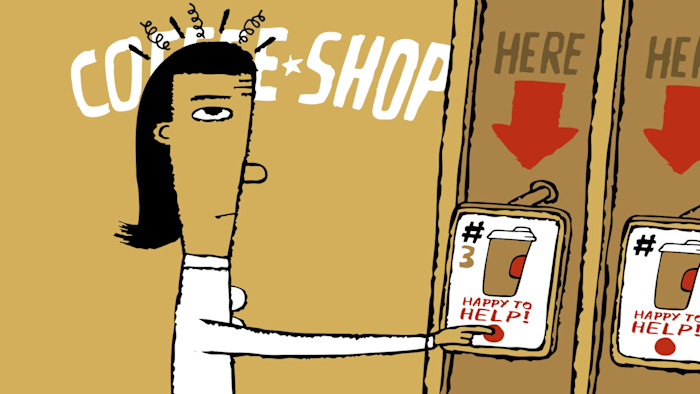
Each time, I had minimal or zero contact with a human. Instead, I ordered and paid for everything by jabbing at one of the ever more inescapable touchscreens that now pepper public life.
Looking back, I find it hard to remember the last time I bought a burger or a train ticket or a bag of groceries in London entirely from a person. Even doctors’ reception rooms have what the touchscreen industry likes to call self-service “kiosks”.
The business rationales are obvious.
A screen does not merely curb the need for people, with all their whiny demands for decent pay and working conditions. And it does not just cut queues so you can serve more customers. If you believe the industry, it also encourages us to buy more stuff.
We’re allegedly drawn in by tempting food photos and the fact that a screen does not judge you for ordering three jumbo servings of cheese and bacon fries. Research from the UK restaurant software group Vita Mojo shows 61 per cent of customers would spend more at a kiosk than a till. As Vita Mojo says: “Kiosks never forget to upsell with sides, meal deals and targeted promotions.”
I believe claims that customers often prefer the ease and speed of touchscreens. Whizzing through people-free passport checks after a long flight is a joy. I watch in awe at stores such as Uniqlo, where you drop a T-shirt into a tray that somehow instantly knows exactly what you’re buying and what it costs.
And frankly, not all human interactions are a seamless delight.
For all that, I still prefer going about in a world with more messy, time-consuming people than machines.
It’s not just that so many machines are not up to it, though this remains a mystery considering how many years they have been in places like my local Tesco, where it is still a great day to get through the self-service checkout without needing human intervention.
Simply finding a human can be thrilling, which is why I was so surprised during a recent trip to Brazil when I went into a local Grupo Lider supermarket.
There were so many staff — on the checkout lines, in the aisles, upstairs in the homeware section — that I took a photo and a video to show people back home. Not one but two men helped me buy an umbrella, after much discussion of which one would be most suitable.
The experience was so novel, and pleasing, that I was not surprised to learn some European retailers have begun to boost such human interaction.
Seven years ago the Dutch supermarket chain Jumbo introduced a slower so-called chat checkout to let customers take their time and talk with cashiers. It proved so popular the company decided to expand it to around 200 stores, especially in places where loneliness was a big problem.
About one in six people worldwide suffers social isolation and loneliness, which cause health problems similar to what you get from smoking up to 15 cigarettes a day.
So it was cheering to see the UK’s Leon fast-food chain announce recently it had begun to swap digital screens for “the human touch” in some outlets.
“Personally, I’m not a huge fan of screens and a lot of customers aren’t either,” Leon’s co-founder John Vincent told me. Plenty of people do like the convenience of screens, and they can be more viable financially, he added. But the technology must work and human options should be there too. I agree, not least because of AI.
Earlier this year I spoke to Rebecca Winthrop, an education expert at the Brookings Institution think-tank, who said software engineers were starting to report a “huge morale problem”, not because they feared being replaced by AI, but because they were increasingly lonely. Instead of asking colleagues for help, they were asking AI, and felt ever more disconnected as a result.
I find this easy to imagine. The existence of technology can lead us down many paths. That does not mean all should be taken.
Read the full article here