

Stay informed with free updates
Simply sign up to the Climate change myFT Digest — delivered directly to your inbox.
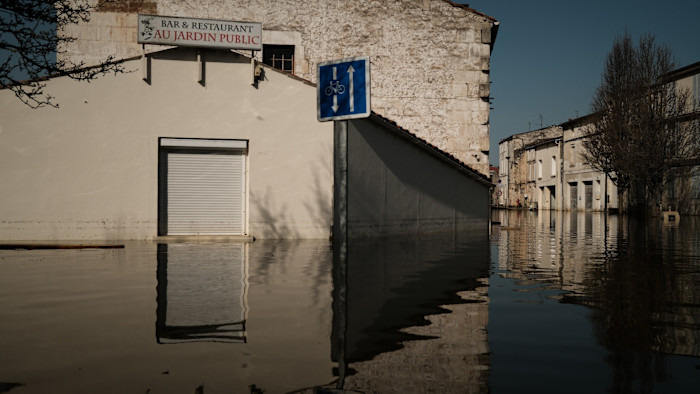
“Exceptional” atmospheric rivers that brought record rainfall and widespread flooding to western and southern Europe in February should draw more attention to climate change, said the EU earth observation service.
The run of intense storms affecting France, Spain, Portugal and Morocco in particular stood in contrast with unusual dryness in the rest of the continent, said Copernicus.
Elsewhere in the world, the pattern of extremes was repeated. Wetter than usual conditions swamped Australia, Mozambique and Botswana, while the dry spell affected the southern US and northern Mexico, easternmost China, parts of South America and south-east Africa.
Samantha Burgess, deputy director at the EU’s Earth observation service Copernicus, said February’s events should draw attention to the “pressing need for global action” on climate change.
Global temperatures reached 1.49C above pre-industrial levels for the month, putting it in the top five hottest on record for the month. This was a fraction below the 1.5C level that scientists believe, if sustained over a period of more than two decades, would lead to irreversible changes to the planet.
The temporary effect of the Pacific Ocean cyclical cooling phenomenon known as La Niña, which is expected to dissipate later this year, has damped the long-term global temperature rise.
Climate change drives more erratic and intense rainfall because increased evaporation as a result of heat drives more frequent and intense storms, while also helping dry out some land area, according to the US space agency Nasa. A warmer atmosphere holds more water, with every 1C temperature rise associated with 7 per cent more moisture.
The narrow bands of very moist air known as atmospheric rivers that provided the European deluge put strain on its winter growing regions and disrupted fruit and vegetable supplies.
Farmers in the UK warned of crops rotting in the ground, after February proved to be 23 per cent wetter than average. England itself recorded 70 per cent more rain than its long-term average, the Met Office has said.
Land temperatures across Europe also varied sharply by region last month, with western, southern and south-east Europe experiencing above-average temperatures, while the Scandinavian peninsula, the Baltic states and north-west Russia had cold conditions.
Outside Europe, parts of the world including the US, north-east Canada and the Middle East were warmer than average, with cold conditions across Alaska, northern Canada and Greenland.
The pace of long-term global warming may be accelerating, according to a paper published on Friday in the scientific journal Geophysical Research Letters.
Researchers, including Stefan Rahmstorf, a climate scientist at the Potsdam Institute for Climate Impact Research in Germany, found a “statistically significant” acceleration of global warming since 2015.
Average sea surface temperatures of 20.88C last month made February the joint second-highest value on record. Sea ice in the Arctic was 5 per cent below average and the third-lowest level for the month.
Read the full article here