

This article is part of FT Globetrotter’s guide to Venice
It was Giuseppe Maffioli, the Venetian actor, writer and gastronome, who compared Venice to a magpie. The floating city, he observed, hoards every glittering thing it fancies. This acquisitive nature can be observed in the city’s pantry, where the global reach of the Republic is evidenced by Indonesian spices, Norwegian stockfish and Turkish coffee. Yet these international ingredients find a hyperlocal counterpoint in the homegrown flavours of the lagoon and its marshlands. It’s this enduring meeting of the foreign and familiar that has come to define Venetian cuisine, a harmony neatly compressed in the city’s staple snacks: cicchetti.
Taking their name from the Latin ciccus (meaning “small thing”), these bite-sized appetisers are the quintessential street food of modern Venice. Inside its labyrinth of crooked alleys, you can’t go far without passing brightly lit shop windows packed with these colourful nibbles. For Venetians, cicchetti are not merely a snack but a way of life, a shared ritual that connects people just as much as the bridges that link this impossible archipelago. Whatever the time or weather, you’ll find students, nonne (grandmothers) or off-duty gondoliers perched along the canal or packed inside a backstreet bacari (Venetian wine bars, the traditional home of cicchetti) for a flavour-packed pick-me-up.
From as early as the 14th century, the ritual of cicchetti was followed — and perhaps even necessitated — by another Venetian favourite: wine. The accompanying small glass of vino (be it a crisp Soave or bold Raboso) is poetically referred to as an ombra, a local term literally translating as “shadow”. This name is rooted in a legend about Piazza San Marco street vendors who would move their stalls into the shade of the Campanile to keep their pours cool. Consequently, cicchetti evolved as an endurance strategy — a tasty safeguard against the effects of a third glass of prosecco. Back then, cicchetti were simple and economical, designed to ensure nothing went to waste. Sellers utilised every scrap of food, from humble hard-boiled eggs to fried offal rolled up as rudimentary meatballs and little cuts of boiled octopus.
Like most traditions, cicchetti have evolved. Today, they have become synonymous with crostini — a small piece of bread loaded with various toppings. This raises an almost philosophical question: if the umbrella of cicchetti allows for everything from hard-boiled eggs to cuts of spleen, and the modern definition favours bread, what is the unifying principle? Nursing an ombra outside the All’Arco bacaro (see box below) one afternoon, I tease this out with my Venetian friends. A cicchetto, we agree, should be small enough to eat in one or two bites. Meatballs and fried pumpkin flowers easily pass the test, but a tramezzino (another Venice staple that is a crustless sandwich) even at its dinkiest, has our four-person jury shaking their heads. “The real cicchetti is not bread with something on top,” says Venetian restaurateur Andrea Lorenzon (who owns Pietra Rossa — see below). “But today, if you make something different in a traditional bacaro, it will stay on the shelf.”
Today, this profitable, bread-based formula has largely usurped the original cicchetti in the popular imagination, but there are still places daring to do things differently. “It’s interesting to see how many restaurants are now paying real attention to authentic cicchetti,” adds Lorenzon, “while the same authenticity is often missing in the very places that should be their natural home.”
For Venice’s new bacari owners, tradition is never something fixed but a starting point from which to rethink the ritual with fresh techniques, more vegetable-driven ideas and a deeper connection to local producers. “Reinterpretation allows us to respect tradition without repeating it,” says Lorenzon. Food in Venice has always told a story, and if the cicchetti new wave is anything to go by, it’s one that’s still unfolding.
These five spots are charting cicchetti’s new frontiers, reinventing the city’s street food one bite at a time.
Pietra Rossa
Sestiere di Castello 2877, 30122 Venice
Rooted in the history of the Castello sestiere (district), Pietra Rossa’s philosophy focuses on zero-kilometre ingredients, with most sourced from Sant’Erasmo, the rural island known as Venice’s kitchen garden. This is evidenced in the restaurant’s five-course La Bocconata menu, which merges two Venetian specialities: cicchetti and seafood-forward antipasto misto. The menu is divided into five small, focused courses — warm, seasonal and built like miniature dishes. Think oil-drizzled vegetables followed by butter-slathered Caorle scallops sprinkled with ground lamb. Opening times: Thursday-Tuesday, 1pm-2.30pm and 6.30pm-10.30pm. Website; Directions
Giorgone da Masa
Calle Larga dei Proverbi 4582A, 30121 Venice
Okayama-born chef Masahiro Homma nods to the harmonious pairing between Italy and Japan in his 30-seat Japanese-Venetian osteria, Giorgone da Masa, which is hidden on a quiet street in the city’s Cannaregio district. Homma’s exciting katei ryori (home-cooked) fare combines izakaya precision with the simplicity of a backstreet bacaro. His tasting menu, which features an ode to cicchetti, includes inventive creations like cabbage and daikon marinated with katsuobushi (fish flakes) or fried shiitake mushrooms served with sesame mayo. Opening times: Friday-Tuesday, 12.30pm-2.30pm and 7pm-10pm. Website; Directions
Anice Stellato
Fondamenta de la Sensa 3272, 30121 Venice
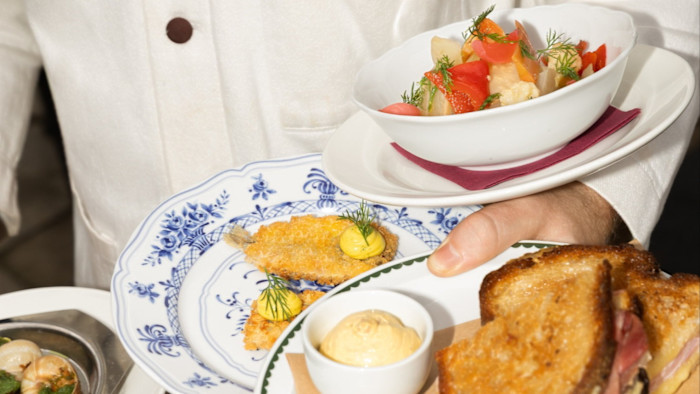
In the city’s lesser-trodden northern pocket, Anice Stellato is a laid-back osteria dedicated to super-seasonal ingredients. Old-school hospitality is the order of the day here, with an engaged and passionate team running the show, but the offering is distinctly of the present. On the daytime Merenda (snack) menu you’ll find small plates like fried sardines and wild-fennel mayo, nervetti salad and yoghurt-drenched falafel — all of which are listed liberally under the title of cicchetti. Purists may protest, but time, much like politics, is a horseshoe, and pairing thick-cut french fries with a natural Lambrusco is arguably a modern echo of the old potatoes-and-red-wine combo. Opening times: Tuesday-Sunday, 12.30pm-10pm (Merenda menu, 2.15pm-6.30pm). Website; Directions
Ai Do Leoni
Piazza San Marco 355, 30124 Venice
On the whole, gourmands seeking an authentic bite are better off heading away from the tourist trail, but Ai Do Leoni may well be the exception. A relative newcomer to the Serenissima’s cicchetti scene, this trendy little bacaro is hidden in plain sight, right opposite the city’s headline act: the hulking, gilded Basilica di San Marco. Its modernist interiors are more Italo disco than Italo-Byzantine, and the cicchetti offering is just as groovy. Moving beyond tradition, the windows here are filled with unusual pickings like cacao-baked bread with seaweed butter and anchovies, proving that even in the most historic of squares, tradition can be radically reinterpreted. Opening times: daily, 10am-1.30am. Website; Directions
Estro Pane e Vino
Fondamenta dei Ormesini 2831, 30121 Venice
The canalside stretch of Fondamenta della Misericordia perfectly encapsulates the changing face of cicchetti. A crawl from one end to the other transports you from classic Venetian favourites like polenta topped with baccalà mantecato (creamed white cod) to twiddly smoked-salmon and wasabi bites at the other. On the same side of the canal, on Fondamenta dei Ormensini, you’ll find Estro Pane e Vino, a tiny though trendy bacaro that wouldn’t look out of place in east London. It was founded by the wine-loving Spezzamonte brothers, who pair contemporary cicchetti with biodynamic wines from local small-batch producers. Opening times: Wednesday-Monday, noon-11pm. Instagram; Directions
Where have you enjoyed cicchetti at their most delicious in Venice? Share your tips in the comments below. And follow us on Instagram at @ftglobetrotter
Read the full article here