

Unlock the Editor’s Digest for free
Roula Khalaf, Editor of the FT, selects her favourite stories in this weekly newsletter.
This article is part of FT Globetrotter’s guide to London
For chefs and industry insiders, Impala, a north African charcoal-grill restaurant opening in Soho later this month, is set to be one of London’s most eagerly anticipated launches this year. It is the latest venture from Super8, the restaurant group behind Smoking Goat, Kiln, Michelin-starred Brat and Mountain that not only ignited the trend for buzzy open-fire restaurants in London, but also continues to set the benchmark.
Another reason Impala is generating so much heat is because it’s the solo debut restaurant of Kiln head chef and co-owner Meedu Saad, a chef’s chef with a generous following who started at Smoking Goat in 2017 before taking the helm at the northern Thai-inspired Kiln in 2019. While he continues as executive chef at Kiln, Impala represents an altogether more personal and ambitious venture, featuring dishes inspired by his Egyptian heritage and one of the most impressive open-fire kitchens in town.
Saad grew up in north London, but his father comes from Egypt. During his childhood, he spent summers in the Sinai with family, and the dishes he encountered shaped his ideas about food. He recalls eating river fish baked in bran around the community ovens of Ismailia, on the west bank of the Suez Canal, and clams opened over fires along the beaches of the Red Sea. Impala takes its name from the cherry-red 1964 Chevrolet Impala he and his cousins drove around Egypt as teenagers. “We couldn’t keep the car because it was too long for my dad’s garage,” says Saad. “But I remember a couple of summers driving through the Sinai desert, camping and fishing.”
In 2022, Saad did a two-month residency at the erstwhile P Franco in north London to trial an Impala-like concept. “I had just had a son and it was a nice opportunity to learn more about my culture,” he says. “But I had way more experience cooking Thai food than food from Egypt and north Africa.” What followed were a couple of years of research and development in which Saad not only dug into personal recollections and travelled to cities that excel at fire cooking such as Cairo, Istanbul, Tokyo and Athens, but also looked at what was happening around him at home in north London. “I’m surrounded by Cypriot grill houses and mangals,” he says. “Game birds — quails and partridge — cooked on grills rather than in ovens. The birds take on a unique smokiness, reminiscent of those in Egypt [and] are grilled close to the coals to finish and crisp the skin.”
A menu of dishes started taking shape. “The first piece of equipment we bought for the restaurant was a duck press, so we knew things were going in a weird direction,” says Saad of a roast duck dish inspired by a childhood memory. “I remember visiting a friend’s mango farm just outside Ismailia, near the Great Bitter Lake, where my dad is from. The day was spent harvesting mangoes alongside prickly pears and dates. By evening, ducks were roasted in the oven with molasses and dry spices, bathed in buffalo butter, and served with the fruit gathered that morning.” With a training in classic French cooking, Saad was also familiar with dishes like duck à la presse, for which sauce is made by pressing the bones and blood of the bird through a medieval-looking contraption. He wondered if that could be incorporated too.
The resulting dish on Impala’s menu may be the best roast duck you ever try. The bird is brined and aged, stuffed with molasses and black lime and hung over a grill (its juices drip into a pot for use in the sauce, which also contains the pressed bone and blood, called sauce au sang de canard). It’s then crisped up in the oven, carved and served with sun-dried figs, Persian lime and that thick, meaty sauce.
The menu teems with similarly diverse, idiosyncratic recipes. “I’m a second-generation immigrant,” says Saad. “I’m not looking for authentic recipes. I’m looking for an expression of what’s authentic for me.” There’s langoustine kibbeh wrapped in perilla leaves; grilled featherblade tip with smoky Djerba harissa and pickled pears; barbecue morels with wild garlic; sweetbreads with sauce bordelaise and “kebab shop” onions (ie, salted and raw). The spiced oxtail with “bird’s tongue” pasta (the Egyptian name for orzo) has the silky consistency of risotto and the same warm-blanketing effect. The molokhia or slow-cooked shoulder of cull yaw sheep (older ewes) with braised jute leaves — “[based on] something my dad makes”, he says — feels like home cooking at its earthy best, despite an intense greenness of flavour that may divide opinion. As for sweet options, there is only one (for now): an elegant pistachio and date dish that is part custard tart and part baklava pudding with a topping as brightly green as AstroTurf.
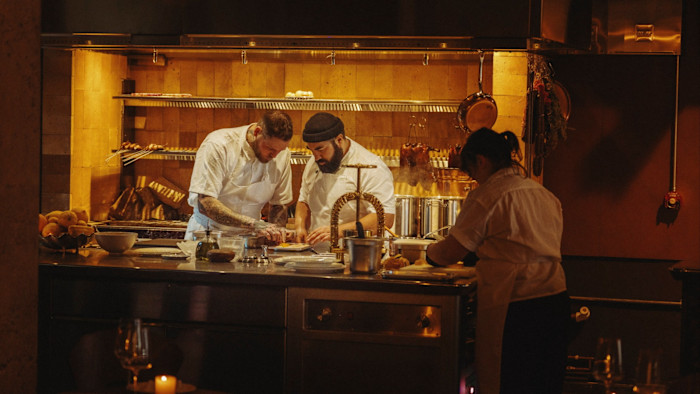
Jumping away from its north African roots, the restaurant pays homage in its design (overseen by Super8 co-founder Ben Chapman and designer Dan Preston) to modernist Italian architects Carlo Scarpa and Carlo Mollino, and is sexily furnished and beautifully lit. There’s a bar near the entrance and dining areas to the front and rear (for up to 90 covers), with an extensive grill and wood fire oven in the middle that has been custom-built to facilitate key dishes. “The height of the grill, for instance, is higher than usual so I can hang the ducks,” says Saad. “And the oven is based on community ovens in Egypt. There are counter seats and four stools on the pass. We want people really close to the action.”
Super8 restaurants are known for the energy of their rooms and precision of their cooking, and this newest addition to the stable promises no less.
“What makes Impala unique are the recipes,” Saad adds, “but it’s also the combination of cooking. The grilling of skewers over coals and fish in bran directly on wood. The baking of rice in big pots in the oven. The hanging of ducks over logs. It’s different kinds of smoke and different kinds of heat. A spectrum of tastes on the table at once that you won’t find anywhere else in London.”
From March 26. Impala, 13-14 Dean Street, London W1D 3RS. Website; Directions
Do you have a favourite open-fire restaurant in London? Tell us in the comments below. And follow us on Instagram at @ftglobetrotter
Read the full article here