

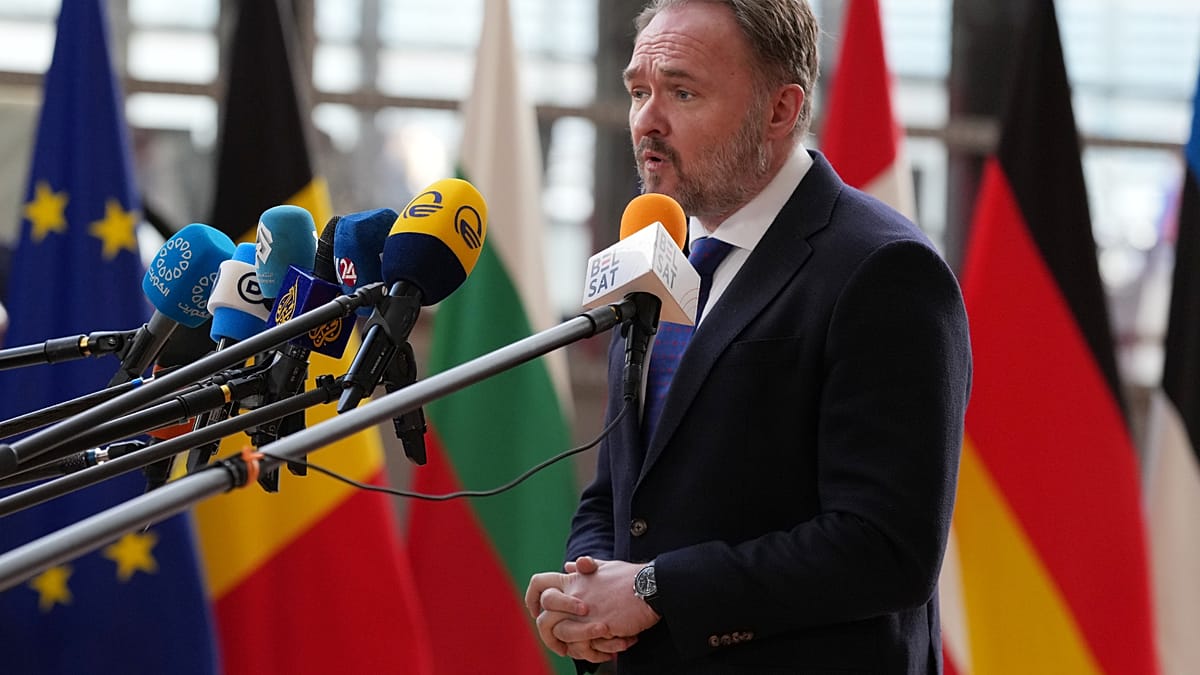
European Commissioner Dan Jørgensen has urged EU capitals to outline measures to reduce oil and gas use, particularly in transport, as the EU27 braces for potential supply disruptions in the Strait of Hormuz amid the conflict with Iran.
ADVERTISEMENT

ADVERTISEMENT
A letter dated 30 March, seen by Euronews, asked energy ministers to report on current market capacity and propose practical actions to curb demand.
The call comes as ministers gather on Tuesday for an emergency session to address a global shortage of 11 million barrels of oil per day and over 300 million cubic metres of liquefied natural gas (LNG) daily.
G7 energy and finance ministers said on Monday they are closely monitoring the impact of the Iran conflict on energy and overall economic stability, and are prepared to take “any necessary measures” to ensure market security.
While no concrete steps, such as a release of strategic reserves, have been agreed, the discussions set the stage for today’s EU assessment.
Rising prices are already making transport more expensive, Jørgensen said, urging EU capitals to coordinate to keep diesel and jet fuel available and affordable.
While overall oil supplies appear manageable for now, concerns are growing over diesel and jet fuel, where Europe remains heavily dependent on imports from Saudi Arabia and Kuwait. Around 20% of diesel consumed in the EU and UK comes from the Gulf region, according to commodity trading company Alkagesta.
Less road travel, fewer planes to save energy
The European Commission has voiced concern over the EU’s reliance on the Gulf region for diesel and jet fuel, limited alternative suppliers, and insufficient refining capacity within the bloc.
A letter seen by Euronews advises EU countries to postpone maintenance on oil refineries to maintain production and suggests considering biofuels as an alternative.
Data from S&P Global Commodities at Sea shows Europe’s jet fuel and kerosene imports reached 1.064 million metric tonnes in March, down from 1.111 million in February.
A Europe-based aviation source warned: “If this goes on, in the summer we’ll all be in trouble – flight cancellations will be the only way.”
EU governments were also urged to ensure adequate gas storage for the upcoming winter without triggering price spikes or market disruptions. Jørgensen highlighted that an effective closure of the Strait of Hormuz — a vital route for around 25–30% of global oil and 20% of LNG — is putting significant pressure on international markets.
Despite the scale of potential disruption, the EU’s immediate energy supply “remains contained,” European Commissioner Dan Jørgensen told ministers.
However, Brussels is urging capitals to “make timely preparations” in anticipation of a “potentially prolonged disruption.”
The EU relies on global fossil fuel markets, competing directly with other consumers. With the current tight oil and gas market, heightened competition is creating greater price and supply volatility, prompting several LNG tankers bound for Europe to divert to Asia for higher returns.
The conflict has already pushed Brent crude to $119 per barrel, up from around $70 before the war, with analysts warning prices could surge to $200 under unpredictable scenarios.
Natural gas prices could also rise to levels seen during the 2022 energy crisis, when the bloc lost around 44–45% of its Russian imports following Moscow’s invasion of Ukraine.
Andreas Guth, secretary general of trade association Eurogas, said it is “critical for Europe’s future” to remove unnecessary delays and uncertainties in accessing new supplies under EU rules.
Preparedness and mitigation measures
European Commissioner Dan Jørgensen told EU ministers that the bloc is “relatively prepared” thanks to storage rules and contingency plans.
On 20 March, capitals were instructed to lower gas storage levels to avoid panic buying, allowing current 90% levels to be refilled to as low as 75%.
The EU maintains 90 days of emergency oil stocks and diversified global supply chains. Europe’s oil reserves, including those of the United Kingdom and Switzerland, total roughly 100 million tonnes—equivalent to about a year of Germany’s consumption.
On 11 March, the International Energy Agency (IEA) coordinated the release of over 400 million barrels of emergency stocks, with EU countries contributing around 20% of that total.
The Commission stressed the importance of unity, warning that uncoordinated national policies could disrupt the EU’s internal energy market.
Measures that increase fuel consumption or restrict cross-border trade could exacerbate supply issues, Jørgensen said. He urged EU countries to act as a single system and actively coordinate supply monitoring to counter market volatility.
Read the full article here