

The most visible weapon in the wars across Eurasia, from Ukraine to the Middle East, is the low-cost one-way attack drone. It has forever changed the economics of war and how war is fought on the modern battlefield by enabling swarm strikes at a fraction of the cost of traditional air-delivered munitions. Ukraine and Russia both proved this, and the last five weeks of the U.S.-Iran conflict have really confirmed it.
In many ways, the war in Ukraine accelerated what could very well be warfare of the 2030s, driven by the hyperdevelopment of low-cost consumer technologies that can be dual-use or easily weaponized. From FPVs and AI-enabled kill chains to drone boats, ground robots, and one-way attack drones, the modern battlefield has been transformed by low-cost, scalable, and increasingly autonomous war machines. It is an emerging threat we warned readers about right before the Gulf conflict, because countermeasures against drones are lacking at scale and are unaffordable.
In the Gulf theater, Iran has used these low-cost drones to strike data centers, U.S. military installations, and civilian infrastructure. In a prolonged war of attrition, mass-produced, cheap drones are increasingly likely to prevail over low-production, very expensive interceptor missiles in the long run. The Trump administration has smartly woken up to this new era of warfare and, secretly through the Department of War, deployed its own Iranian-style kamikaze drones (we reported in the first week of the conflict).
Military strategists around the world are now taking notes and copying the drone playbooks being written in real-time by active players in both Eurasian conflicts. As we noted the other week, China has likely already ramped up mass production of Iranian- and Russian-style one-way attack drones.
Taken together, the speed at which these drones are proliferating across battlefields is very alarming, and yet another country appears set to begin mass production: India.
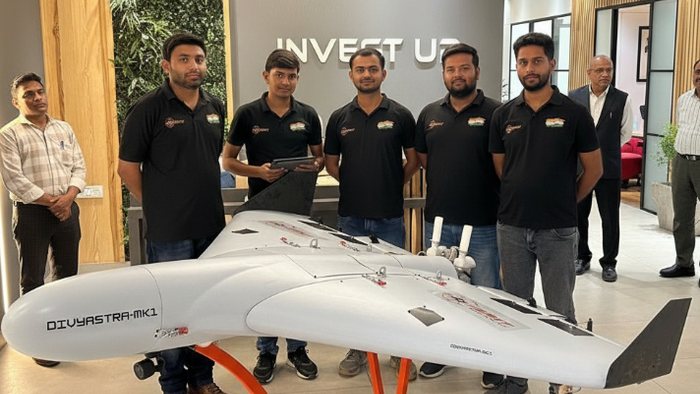
Indian defense news website Indian Defense Research Wing reports that startup HoverIt has developed DIVYASTRA MK2, an advanced long-range strike drone.
“With an operational range projected between 1500 to 2000 kilometers and a flight endurance of 8 to 12 hours, the platform is designed to operate deep inside adversary territory, enabling both persistent surveillance and precision strike missions without immediate reliance on forward bases,” Defense Research Wing wrote in the report.
India’s own attack drone is here! 🇮🇳🔥
The Divyastra MK1, with a massive 500 km range, is a true nightmare for Pakistan. #DivyastraMK1 #IndianArmy #MakeInIndia #DefenceNews #DroneTech pic.twitter.com/Tcf03TnaL3
— NewsMatrix (@PabanSingh82441) March 29, 2026
The report added, “The UAV is expected to incorporate advanced AI-driven swarm intelligence, enabling coordinated operations with multiple platforms for saturation attacks, distributed surveillance, and adaptive mission execution.”
Every serious country with a proper defense manufacturing base will be retooling some production lines for these cheap drones. The problem emerging is that the rapid pace of development and deployment has left much of the world unprepared.
Read the full article here