

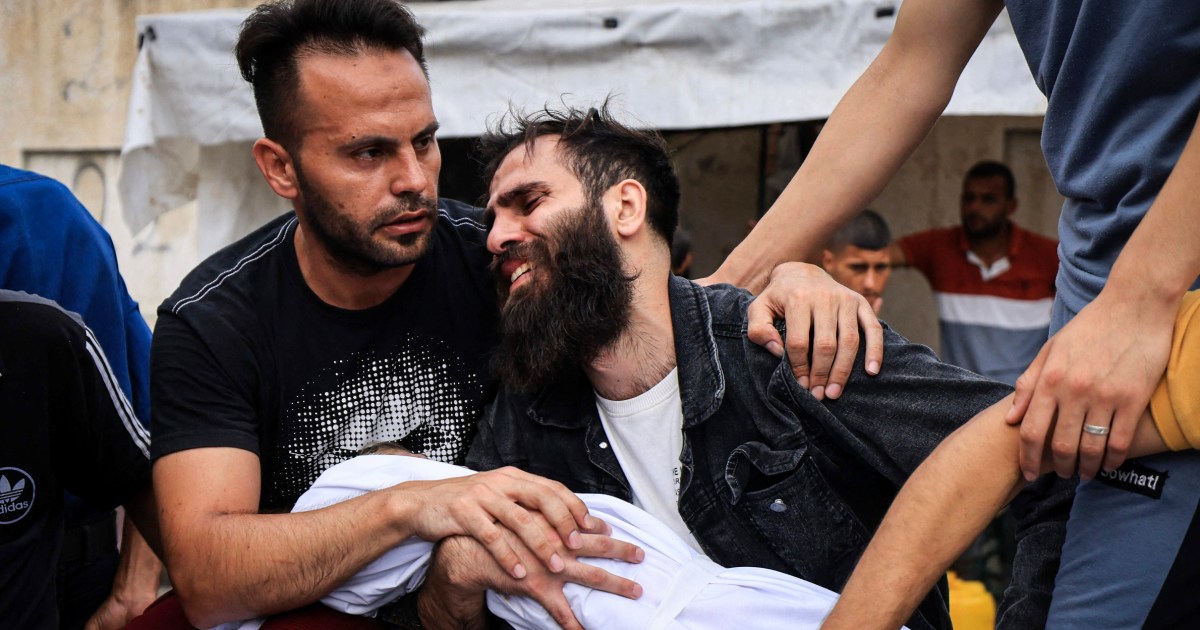
Israeli human rights groups urge international community to stop ‘wave of settler violence’ in West Bank
A coalition of 30 human rights groups and NGOs in Israel pleaded for the international community to stop a wave of Israeli settler violence against Palestinians in the West Bank.
Today’s statement said the violence is leading to “the forcible transfer of Palestinian communities in the West Bank.”
Since the Oct. 7 incursion, Israeli settlers have been “exploiting the lack of public attention to the West Bank” to “escalate their campaign of violent attacks in an attempt to forcibly transfer Palestinian communities,” the statement said. It comes as much of the war has focused public attention on the Gaza Strip.
So far, 13 herding communities have been displaced and seven Palestinians have been killed by settlers since the war began, the statement said.
“With grave concern and with a clear understanding of the political landscape, we recognize that the only way to stop this forcible transfer in the West Bank is a clear, strong and direct intervention by the international community,” the statement, signed by groups including Rabbis for Human Rights, Amnesty International Israel and the Association for Civil Rights in Israel, said.
Iran and its proxy forces loom over Israel-Hamas war
HAIFA, Israel — While concern over the humanitarian crisis in the Gaza Strip mounts, another undercurrent of alarm is growing in Washington and other Western capitals: Israel’s bombardment could spread into a wider regional war — one involving regional superpower Iran or its proxy forces.
On Sunday, Iranian President Ebrahim Raisi said on X that Israel had “crossed the red lines, which may force everyone to take action.”
Many experts believe there is little desire in Washington and Tehran for a regional conflict. But the scope for miscalculation is huge, and the intensity of Israel’s bombardment of Gaza, which, according to Palestinian health officials, has killed more than 8,000 people, including thousands of civilians and children, could easily push the situation spiraling out of control.
“There’s a real risk of escalation,” said Sanam Vakil, the director of the Middle East and North Africa program at Chatham House, a London-based think tank.
Read the full story here.
Pregnant women in Gaza given primitive ‘emergency delivery kits’
With ambulances and hospitals running out of fuel, pregnant women in Gaza have been given primitive “emergency delivery kits” for when they go into labor.
Laila Baker, United Nations Population Fund regional director for Arab States, said the international agency is pushing for humanitarian access to be able to help women and other civilians.
“Put yourself in the shoes of any woman who should be experiencing one of the most joyous moments of her life, and instead she’s in fear of death,” Baker said.
Leaflets in Gaza instruct people on how turn themselves in to IDF
The IDF is distributing leaflets in Gaza instructing people on how to turn themselves in to the Israeli military.
“Hamas leaders are exploiting you. They and their families are in safe places while you die in vain,” the leaflets said.
The instructions say to “remove all military gear,” “raise your hands,” “wave white rags” and “not to bring food or water with you, we will take care of that.”
Norwegian prime minister criticizes Israel’s response to Hamas
HELSINKI — Norway’s prime minister says Israel’s reaction to Hamas’ attack exceeds the rules of international law on proportionality.
“It says in international law that (reaction to such an attack) must be proportionate,” Norwegian Prime Minister Jonas Gahr Støre told public broadcaster NRK today.
“Civilians must be taken into account, and humanitarian law is fully aware of that. I believe that the line has now been far exceeded” by Israel, he said, adding that his primary concern is that emergency aid is not getting into the Gaza Strip.
Norway on Friday voted in favor of the United Nations resolution calling for a “humanitarian truce” leading to a cessation of hostilities in Gaza.
“It’s a catastrophic situation, and I believe it is clearly in violation of what we call the rules of war or humanitarian law,” he said.
Israeli ministers advance bill to designate individuals as ‘terrorists’
Israel’s Ministerial Committee for Legislation has advanced an amendment to the country’s terror laws that will allow the state to designate individuals, not just organizations, as “terrorists.”
Minister of Defense Yoav Gallant and Minister of Justice Yariv Levin said in a statement that the amendment was designed to “thwart the financing of individuals operating in various organizations, and in particular the Hamas terrorist organization.” The bill will also “address the issues of recruitment, financing, and the transfer of funds for terrorist purposes,” the statement added.
The expansion is proposed as an update to a 2016 counterterrorism law that human rights groups have warned is routinely used to shut down Palestinian civil society groups, as well as militant organizations.
Thailand evacuates thousands of workers from Israel as it awaits answers on hostages
TEL AVIV — As the war rages, Thailand’s Embassy is racing to evacuate thousands of citizens, mostly agricultural workers, while it pushes for answers about the dozens of Thai nationals feared taken hostage by Hamas.
“Thailand doesn’t have anything (to do) with this conflict, but we got affected a lot,” Pannabha Chandraramya, Thailand’s ambassador in Israel, told NBC News on Sunday. At least 24 Thai nationals were killed on Oct. 7, and at least 19 have been confirmed to have been taken hostage — with the number feared to be higher.
Much of Israel’s agriculture sector relies on labor from Thai workers, with Chandraramya saying that at least 6,000 people, mostly workers, have already been evacuated. The goal is to evacuate as many as 30,000 people, with two to three flights running daily, she said.
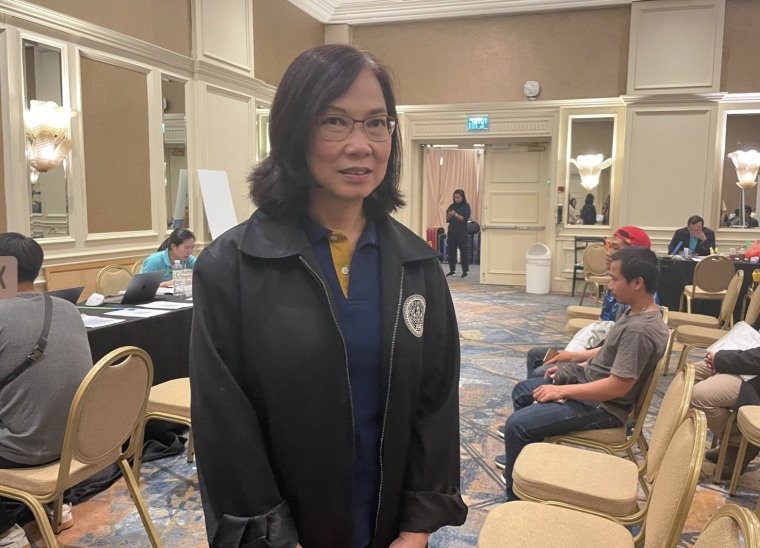
One worker waiting for a flight to Thailand at a makeshift outpost for the Thai embassy said he had no plans to return to Israel after the war. He said he was too “scared” to come back and will find work elsewhere.
Chandraramya said the evacuations could have a serious impact on the agricultural industry in Israel. “In the peaceful times, we always say that all the vegetables and fruit that you eat pass through the hands of Thai workers,” she said.
Rep. Jayapal: ‘There are racists within the Netanyahu government’
Rep. Pramila Jayapal, D-Wash., says the human toll of the war is behind her call for a cease-fire. This morning on “Meet the Press,” she said that failing to call out violations of international law during Israel’s siege of Gaza is a double standard and will diminish the United States’ moral authority.
“There are racists within the Netanyahu government, and there are racist policies that Israel has been carrying out,” Jayapal said. “I think it is important for us to recognize that we need to be able to criticize the policies of Israel’s government and not be called antisemitic.”
Pope Francis renews calls for hostage release, cease-fire
Pope Francis this morning called for a cease-fire in the war between Israel and Hamas and renewed an appeal for the release of hostages held in Gaza.
“Let no one abandon the possibility of stopping the weapons,” he said at his weekly blessing in St. Peter’s Square.
Referring to “the grave situation in Palestine and Israel,” he said “in Gaza, in particular, let there be room to guarantee humanitarian aid and may the hostages be freed immediately.”
He added: “We say ‘cease-fire, cease-fire.’ Brothers and sisters, stop! War is always a defeat, always.”
Some internet connectivity in Gaza resumes
Some internet connectivity in Gaza has resumed after a near-total telecommunication blackout Friday.
Netblocks, a U.K. company that tracks global internet access, said last night that some internet providers were back online, though general connection speeds there are far below normal.
Paltel, one of the largest providers in Gaza, said on its Facebook page this morning that it had been hastily repairing infrastructure that had been destroyed by Israeli bombing Friday.
Husam Mekdad, a telecommunication worker in Gaza, told NBC News that phone and internet access had somewhat resumed in southern Gaza but that it was limited in the north.
Palestinian Red Crescent: 10 aid trucks make way into Gaza
Ten aid trucks with food and medical essentials from the Egyptian Red Crescent have passed into Gaza through the Rafah crossing, the Palestinian Red Crescent confirmed to NBC News.
Fuel has also been allowed to enter the strip for the first time since Israel announced a full blockade in the coastal enclave.
Before the war, 200 aid trucks were received in Gaza per day.
Electricity and production are limited in Gaza, which has been under blockade by both Israel and Egypt since 2007.
Palestinians skeptical of Israeli assurances they will be allowed to return to north Gaza
RAMALLAH, West Bank — Despite assurances from IDF spokesperson Daniel Hagari yesterday, many Palestinians remain anxious about Israel’s assertions that those who evacuate north Gaza will be able to return eventually.
Mustafa Barghouti, a member of the Palestinian Legislative Council, said he believes Netanyahu’s original plan was to evict Gazans into the Sinai Peninsula. When Egyptian leaders began to push back, Barghouti believes a “plan B” was embraced to annex north Gaza once residents fled south.
“Did Israel ever allow anybody back? Did they allow any of the Palestinian refugees who have been ethnically cleansed in 1948 back? None,” Barghouti said.
Israel has a “very clear record of not allowing people to come back home,” he added.
In renewing the push for Palestinians to move south, Hagari yesterday called the move “a temporary measure.”
“Moving back to northern Gaza will be possible once the intense hostilities end,” he said in a video on X.
2nd U.S. aircraft carrier group moves into Mediterranean
The USS Dwight D. Eisenhower aircraft carrier and its strike group has moved through the Strait of Gibraltar, putting two American carriers in the Mediterranean Sea, a rare sight in recent years.
The USS Gerald R. Ford Carrier Strike Group is already in the eastern Mediterranean, part of a buildup of forces as the U.S. supports Israel in its war against Hamas.
The Eisenhower sailed into the Mediterranean on Saturday and is slated to move through the Suez Canal to the U.S. Central Command region as the American forces expand their presence in the Middle East to deter Iran and its proxy militant groups from trying to widen the war.
U.N. peacekeeper injured after mortars hit base in Lebanon
A peacekeeper is in stable condition after a mortar hit a base near the village of Houla in south Lebanon last night, according to the U.N. Interim Force in Lebanon (UNIFIL).
The agency said it was attacked twice yesterday, once at 10 p.m. at the Houla base and earlier in the day when a shell hit UNIFIL headquarters in Naqoura.
“UNIFIL expresses serious concern over these two attacks on our troops who are tirelessly working 24/7 to restore stability in southern Lebanon and de-escalate this perilous situation,” it said.
An investigation has been launched into both incidents. UNIFIL did not assign blame to anyone but did note that attacking peacekeepers is a crime.
“We strongly urge all parties involved in the conflict to immediately cease fire,” UNIFIL said.
What is Israel’s main objective with its new ground offensive?
Retired Adm. James Stavridis breaks down Israel’s ground operation in Gaza and weighs in on the risk of escalation.
Read the full article here