
Some home sellers are offering to pay their buyers’ mortgages. What’s the catch with ‘seller financing’?

The housing market has become so expensive that some sellers are offering to help pay their buyers’ expenses, including their mortgage.
With mortgage rates at a 23-year high and home prices staying put, housing affordability has declined to its lowest point since 1985, when home-loan rates were in the double digits. Sales of previously owned homes are on track to end the year at a pace that’s the slowest since 2008, during the so-called Great Recession.
The housing market, in turn, has responded with innovations aimed at making homes more affordable — with some sellers advertising assumable mortgages and lenders allowing buyers to put as little as 1% down.
Homeowners are also turning to “seller financing” as yet another tool to lower financial barriers for prospective buyers.
Seller financing refers to a financial arrangement where the home buyer pays the home seller directly in installments, rather than using a mortgage from a bank or a lender. The buyer still has a monthly payment, but that payment, rather than going to a loan servicer, goes straight to the property seller.
“Owner or seller financing has always been around as a niche option for some types of properties that might be difficult to get a mortgage for, or some buyers who may not qualify for a traditional mortgage,” Chen Zhao, economics research lead at Redfin, told MarketWatch.
There is evidence that, while seller financing is still rare, it’s growing in popularity. As of this September, just 1.11% of all U.S. active listings mentioned some type of private financing — but that’s the highest share since January 2017, according to an analysis by Realtor.com. The September figure is the third-highest in Realtor.com’s series, which dates back to 2016.
News Corp
NWS,
NWSA,
parent company of MarketWatch publisher Dow Jones, also operates Realtor.com.
“As of September, the share of listings that mentioned private financing was only 1.11%, but that was the highest share in nearly seven years.”
High mortgage rates are prompting homeowners to seek creative ways to make homes affordable
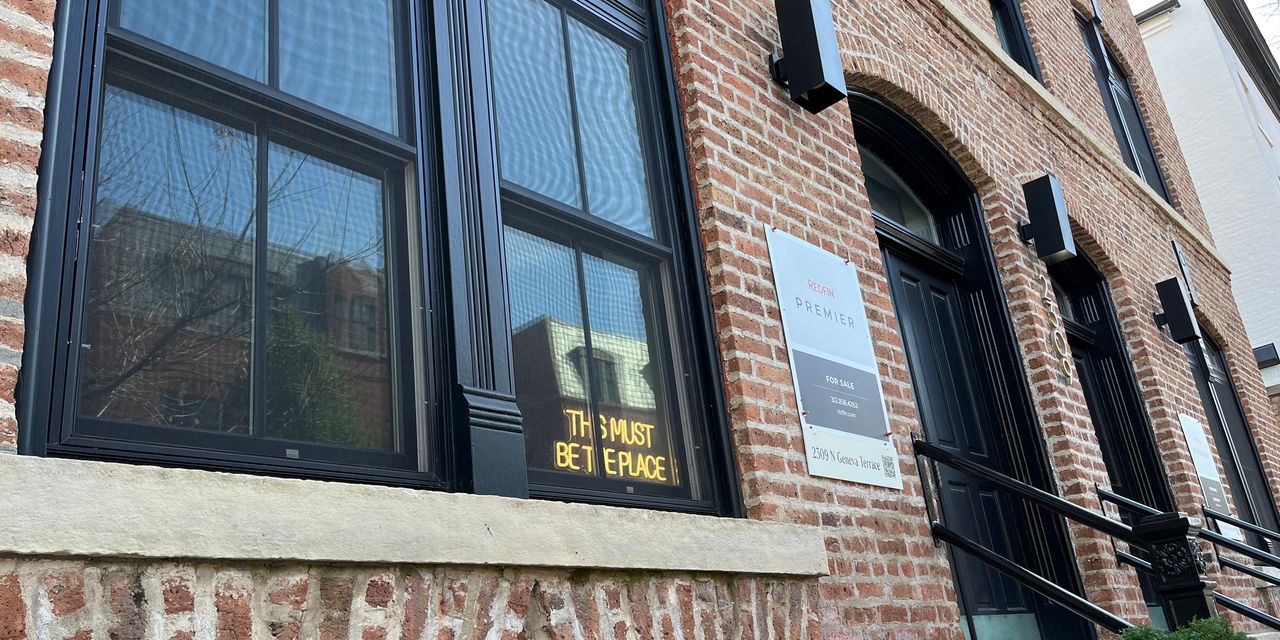
A recent listing on Redfin stated that the current owner of a $3.1 million home in Chicago’s Lincoln Park neighborhood was offering seller financing and to make the monthly principal payment for three years.
The owner wanted to offer the buyer the chance to pay just the interest on the loan, at 4%, half the current 30-year mortgage rate of 8%, until rates theoretically come down. That puts the monthly payment at around $15,000, the listing stated, which includes the $7,700 in interest, as well as property taxes and homeowners insurance.
See: Demand for adjustable-rate mortgages jumps 10% as U.S. mortgage rates stay stubbornly high
At the end of the three years — or sooner, if rates drop — the buyer can refinance into a conventional mortgage to pay off the home seller and begin making monthly payments to a more traditional loan servicer. The buyer also could pay cash at any point to buy the house.
The seven-bedroom, 8,000-square-foot house — the building had previously been multiunit — has been off and on the market for “quite some time,” Dan Close, the Chicago-based listing agent with Redfin, told MarketWatch. “And when I was speaking to the seller and we were building a strategy to sell the home, he said, ‘What about seller financing?’ ”
The homeowner was keen on trying something new. The home was built in the 1900s, and came into the owner’s family’s hands in the early 1990s. An extensive renovation and other updates to the home had since been carried out. The current owner, who inherited the home, renovated it again, with a mind to sell it.
It came on the market some 20 months ago with an asking price of nearly $4 million.
Close asked whether the homeowner was aware of the risks that come with seller financing, which include the possibility of the buyer defaulting on the payments or even ghosting the homeowner, or deciding not to go through with the purchase after the first three years of reduced payments end. “He and I had a thorough conversation because it’s my job to make sure he’s fully informed and can really make an educated decision,” Close said.
Benefits and drawbacks of seller financing
Close’s Chicago listing is not alone.
In Denver the owner of an $862,000 home is offering seller financing at a “rate as low as 5.5%.” In Spokane, Wash., a corner house worth $150,000 in a 55-and-over community was on the market with “owner financing” listed as an option to entice interested but financially constrained buyers.
Gurbeer Singh Sangha, a Fresno, Calif.–based real-estate agent who has experience with seller financing, said the arrangement is more common with investors who are looking to buy land or multifamily units, or even commercial properties.
“It’s hard to find in single-family homes, because the average seller wants to get their money right away,” Sangha told MarketWatch.
Sangha, who offered seller financing when he sold a property, said that, generally, the financing arrangement is handled by the listing agent.
Once a buyer agrees to purchase the home and expresses an interest in having the seller help with the financing, the buyer may have to go through a process similar to that of a mortgage application by providing a credit check, proof of income and other financial background information.
The buyer will then have to sign a promissory note that spells out the terms of the payment agreement, according to SmartAsset. The document will state the purchase price, interest rate, when the payments will be made by the buyer to the seller, consequences of the buyer defaulting and other details.
See: U.S. home prices rose for the sixth month in a row, Case-Shiller says
In some cases, seller financing is being advertised as synonymous with “rent to own,” according to a listing for a Durham, N.C., home that recently went into contract. In Ruskin, Fla., one homeowner is also offering buyers an opportunity to rent and eventually own the property, by essentially acting as a bank. “Wait for interest rates to go down before you sign a 30-year mortgage. Why rent when you can own?” the listing states.
There are potential pros to seller financing in a real-estate market such as today’s where inventory is at a historic low and rates are at multidecade highs: Buyers can afford to rent or pay interest until they have the ability to own; they can save on closing costs; and they may not need to put any money down, if the seller is amenable.
“Interest has been very healthy, and certainly interest about this financing is almost always the first question we get,” Close, the Chicago agent, said. “It certainly draws more people to see the house.”
Still, in many ways, seller financing is a risky proposition.
Zhao warned that, even though seller financing may seem like a way to lower buyers’ monthly costs in the immediate future, they may inadvertently end up paying more in interest in the long run if they take into account the total expenses — fees, interest, etc. — that would be paid over the life of the loan.
“The rate associated with this type of borrowing would usually be higher than getting a loan from a traditional lender because [buyers] cannot benefit from the same factors that allow a traditional lender to offer lower fees,” Zhao said. Sellers, for instance, can’t offer the same terms as conventional or government-backed mortgages that are sold to government enterprises Fannie Mae
FNMA,
and Freddie Mac
FMCC,
“‘The rate associated with this type of borrowing would usually be higher than getting a loan from a traditional lender because individuals cannot benefit from the same factors that allow a traditional lender to offer lower fees.’”
So “the risk profile is likely higher,” she added.
Buyers considering a seller-financing arrangement should also consider what would happen if the seller were to end the financing arrangement. For instance, with Close’s Chicago listing, after the initial three years, the buyer should be prepared for the monthly payment to increase and potentially become unaffordable. Buyers should be aware of the medium-term changes they may have to deal with.
In seller-financed transactions, buyers should also ask if the seller will hand over the title to the property to the buyer at closing — as with a traditional mortgage — or plans to hold on to it until the loan is repaid.
Buyers may also not have the same level of consumer protections that they would be entitled to if they purchased a home with a traditional mortgage.
Hence, said Zhao, “I don’t think of this as a good way to get around higher rates for buyers.”
Read the full article here