

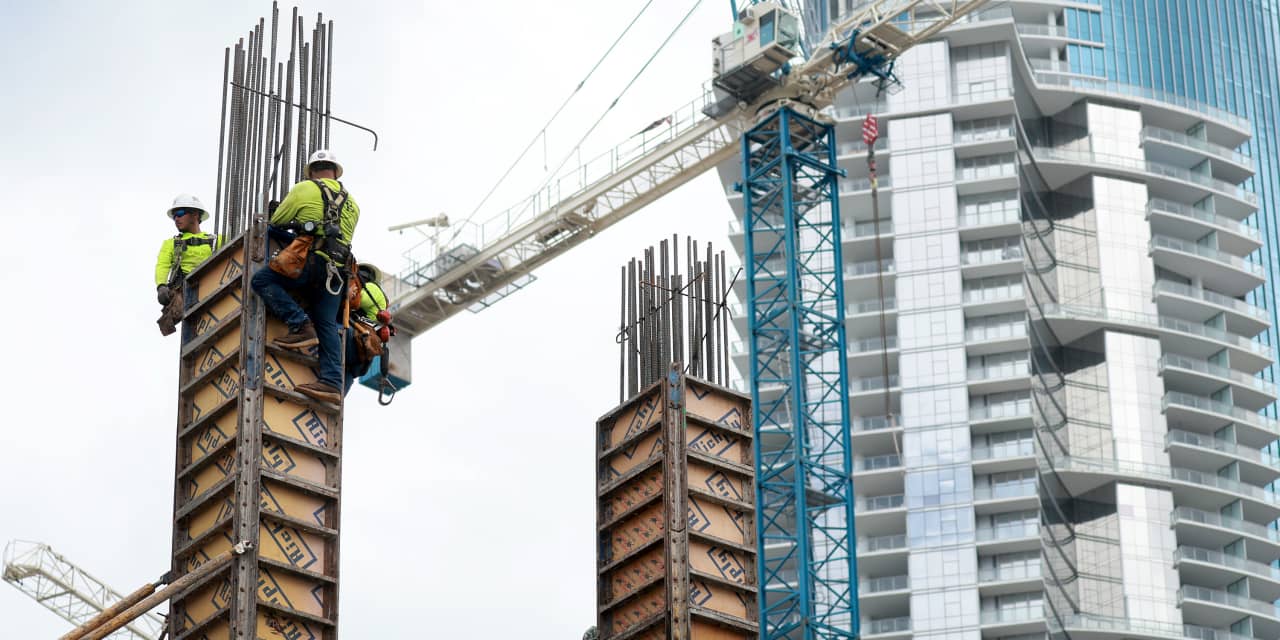
Home builder stocks have been on a tear this year as the grim market for existing homes pushed buyers to new construction.
D.R. Horton
‘s solid earnings and 2024 outlook on Tuesday is adding fuel to the stocks’ fire.
D.R. Horton’s fourth quarter and full-year earnings came in stronger than expected. What’s more, the company’s revenue estimates for 2024 outpace Wall Street’s expectations. D.R. Horton’s earnings and guidance are positive omens for other home builders that demand will continue even as costs for buyers increase.
D.R. Horton (ticker: DHI) shares were up 2.9% on Tuesday, and have gained roughly 36% so far this year. The
iShares U.S. Home Construction
(ITB) exchange-traded fund, which tracks builders and related companies, was 1.4% higher.
The industry ETF has gained about 33% this year—with some home builders, such as small-caps
Beazer Homes
(BZH) and
Hovnanian Enterprises
(HOV), the mid-sized
M/I Homes
(MHO), and the large
PulteGroup
(PHM) having risen 80% or more.
It hasn’t all been smooth sailing. The stocks pulled back as mortgage rates climbed toward 8% earlier this year. After slumping for several weeks from their summer peaks, shares tracked by the iShares U.S. Home Construction ETF began to rebound at the end of October. The turnaround began after September’s new-home sales figures came in strong, despite higher mortgage rates.
A drop in the 10-year Treasury yield, with which mortgage rates often move, intensified the gains through last week. The ETF last week had its best week last week since May 2020, according to Dow Jones Market Data.
Investors may feel more positive about builder stocks, but consumer sentiment has soured as a limited supply of previously owned homes have sent broader home sales lower. Existing-home sales in September dwindled to their lowest seasonally-adjusted annual rate in nearly 13 years.
Fannie Mae
‘s October housing market temperature check revealed that 85% of respondents said it was a bad time to buy a home—a high since at least 2010, when Fannie Mae began posing the question to consumers.
Nearly seven in 10 respondents said their incomes are about the same at they were last year—an indication that would-be buyers feel prices have risen faster than their purchasing power, Fannie Mae chief economist Doug Duncan said. “We expect this tightness in household finances, along with high home prices and elevated mortgage rates, to prolong the affordability challenges facing many would-be home buyers,” Duncan said.
The cost of buying a home has skyrocketed as mortgage rates and existing-home prices have both gained. At a recent 7.79%, primary and interest payments on the median home purchase would eat up over 40% of a buyer’s income, according to the ICE Mortgage Monitor—the lowest level of affordability since 1984.
More than half of D.R. Horton’s customers are first-time buyers, executives said on a Tuesday earnings conference call—a group that is typically more susceptible to pricing pressures than repeat buyers.
“Our buyers are focused primarily on affordability,” said Michael Murray, the company’s chief operating officer. Mortgage rate buy-downs are one way the company makes monthly payments more palatable: about 60% of the company’s closings come with a mortgage rate buy-down, CEO Paul Romanowski said on the call, with a typical rate “probably in the 6-ish range.”
D.R. Horton is far from the only builder offering buy downs, survey data suggests. Of the respondents to the National Association of Home Builders’ October survey, 29% said they were using mortgage rate buy-downs to boost sales or reduce cancellations.
That’s not the only step D.R. Horton is taking to reduce cost on buyers. The builder is also introducing smaller floor plans—an option it expects buyers will seek next year to control costs.
Incentive costs have increased recently with mortgage rate gains and volatility, the company said on the earnings call—a potential headwind to margins in the first quarter of next year. Despite the cost, the company expects gross profit margin on home sales revenue to be in a range of 23.7% to 24.2% in the first quarter—slightly higher at its midpoint of roughly 24% than the 23.8% analysts expected, according to FactSet.
“We are focused on consolidating market share by supplying more homes that are affordable price points to meet home buyer demand while maximizing the returns and capital efficiency in each of our communities,” David Auld, the home builder’s executive vice president, said on the call.
D.R. Horton says it expects 2024 revenue in a range of $36 billion to $37 billion, and 86,000 to 89,000 home closings, up from 82,917 homes closed in 2023. At its midpoint of $36.5 billion, D.R. Horton’s revenue guidance beats Wall Street expectations, which is about $36.1 billion. It also expects to repurchase about $1.5 billion in shares.
Write to Shaina Mishkin at [email protected]
Read the full article here