

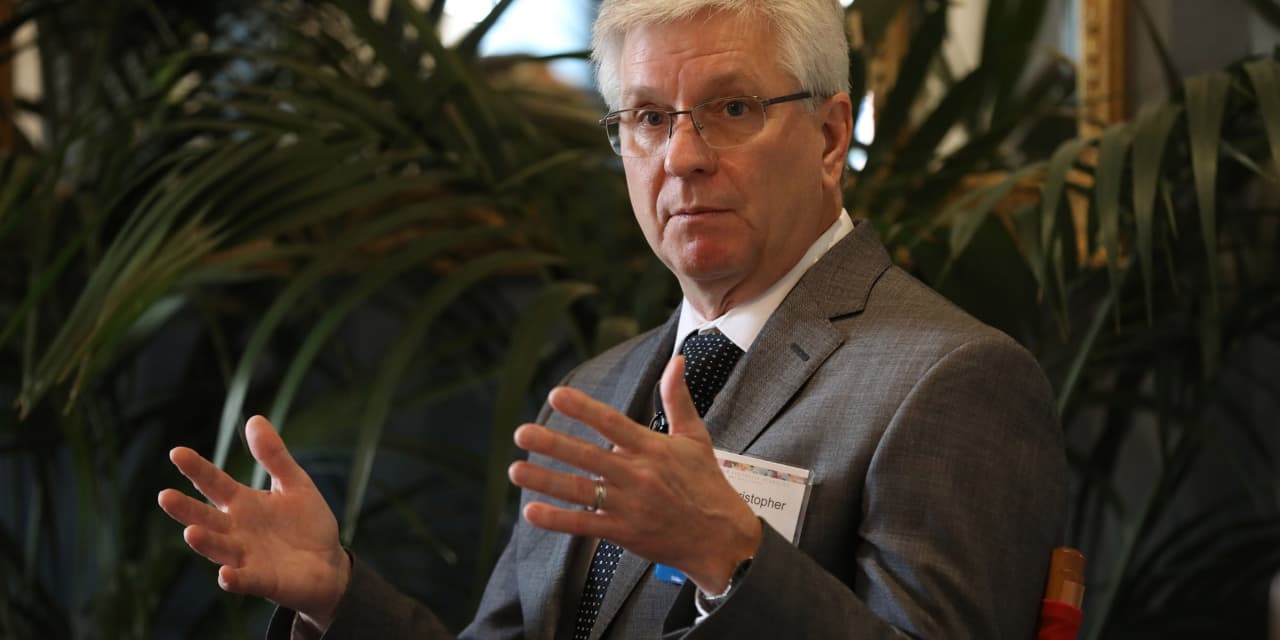
Federal Reserve Gov. Christopher Waller said Tuesday that he sees slowing momentum in the economy, which central bank policy makers have been attempting to achieve in order to bring inflation back to their 2% target.
In remarks titled “Something Appears to Be Giving” and prepared for delivery at the American Enterprise Institute, Waller said that recent economic data indicate the U.S. is finally starting to experience a cooling labor market, slowing consumer spending, and a significant moderation in economic activity. Those are key signs that the Fed’s restrictive monetary policy is working appropriately and that inflation is continuing to move in the right direction, albeit gradually.
“I am encouraged by what we have learned in the past few weeks—something appears to be giving, and it’s the pace of the economy,” said Waller. He is a member of the Federal Open Market Committee, which makes decisions about interest rates for the central bank.
Last month, he said the “torrid” pace of economic growth experienced during the third quarter indicated that something had to give in order for inflation to continue falling. “If it did not cool off, then it was likely that progress on inflation would stop or even reverse. So, what remained to be seen was whether the economy would cool or inflation would heat up,” Waller noted.
And while Waller sees room for optimism, he noted that inflation is still too high and that it was too early to say for sure that the recent, cooler economic trends will be sustained.
“There is still significant uncertainty about the pace of future activity, and so I cannot say for sure whether the FOMC has done enough to achieve price stability. Hopefully, the data we receive over the next couple of months will help answer that question,” he said.
Not every FOMC member is quite as optimistic, however. Gov. Michelle Bowman took a more hawkish tone Tuesday, noting in remarks to the Utah Bankers Association and Salt Lake Chamber that while she supported the FOMC’s decision to hold the benchmark federal-funds rate at 5.25% to 5.50%, she continues to expect that the Fed will need to increase it.
“I remain willing to support raising the federal-funds rate at a future meeting should the incoming data indicate that progress on inflation has stalled or is insufficient to bring inflation down to 2% in a timely way,” she said.
Yet investors and economists are betting that the Fed is done with rate increases. The odds that Fed officials will choose not to raise rates after the next two-day meeting of the FOMC, which ends Dec. 13, increased to 94.1% on Tuesday, according to the CME FedWatch Tool.
Before that meeting, the latest personal-consumption expenditures price Index will be released on Thursday, while the consumer price index for November will arrive on Dec. 12. Next week, the Bureau of Labor Statistics will release October data on job openings and the November employment report.
So far, October’s economic data has indicated an easing in economic activity, Waller said, adding that forecasts for the fourth quarter show a level of moderation that is “more in keeping with progress on lowering inflation.” While October PCE inflation is set to be released on Thursday, Waller noted that rough, early estimates suggest headline inflation was 3% over three months and 2.5% over six months.
But will inflation continue to trend downward? Waller sees some encouraging signs, including the fact that housing services inflation, based heavily on rent, has slowed from its peak last year. Additionally wage growth has moderated in recent months, though Waller said he doesn’t believe there is enough evidence yet to be sure it will continue.
Normalizing prices for goods have played a major role in the slowing of inflation as pandemic-era supply-side problems eased, but Waller said they probably won’t be contributing much more. Instead, he expects progress to come from services excluding housing, which account for about half of the PCE price index. Inflation hasn’t moderated in this area as much as in other categories, and Waller believes there will have to be some improvement there for overall inflation to reach 2%.
Bowman said one of her concerns is that Americans’ higher consumption of services could keep inflation elevated. “With too few workers to fill the number of existing job openings, a continued increase in the demand for services may contribute to persistently high core services inflation,” she said. “Additionally, a lack of fiscal restraint could further contribute to inflationary pressures.”
Waller also touched on the tighter financial conditions that have resulted as the Treasury has increased the amounts it is borrowing since the summer. He noted that while the October rise in yields for 10-year Treasuries did tighten financial conditions, he believes that going forward, monetary policy will have to do the work in getting inflation back down to 2%. Waller specifically noted that on bond yields, the recent loosening of financial conditions served as a reminder that “policy makers must be careful about relying on such tightening to do our job.”
Bowman also cautioned that the effects of the Fed’s rate hikes are still making their way through the economy. “We don’t yet know the full extent of the effects of tighter monetary policy and financial conditions on economic activity and inflation,” she said, but noted she is focusing on the risks associated with “prematurely declaring victory” in the fight against inflation.
Waller said he is looking forward to coming data releases to confirm that the moderating demand and easing price pressures that will help move inflation back to 2% are a consistent trend, rather than a short-term blip.
“As long as we don’t get any big shocks, I am reasonably confident that we can pull off this soft landing,” in which inflation comes down without a recession, Waller said, acknowledging that he tends to be an optimist. He said that while he believes the unemployment rate will tick up above its current 3.9%, there is no reason that a soft landing is out of reach.
Write to Megan Leonhardt at [email protected]
Read the full article here