
U.S. stocks rebound from two sessions of losses after weaker-than-expected private-sector jobs report

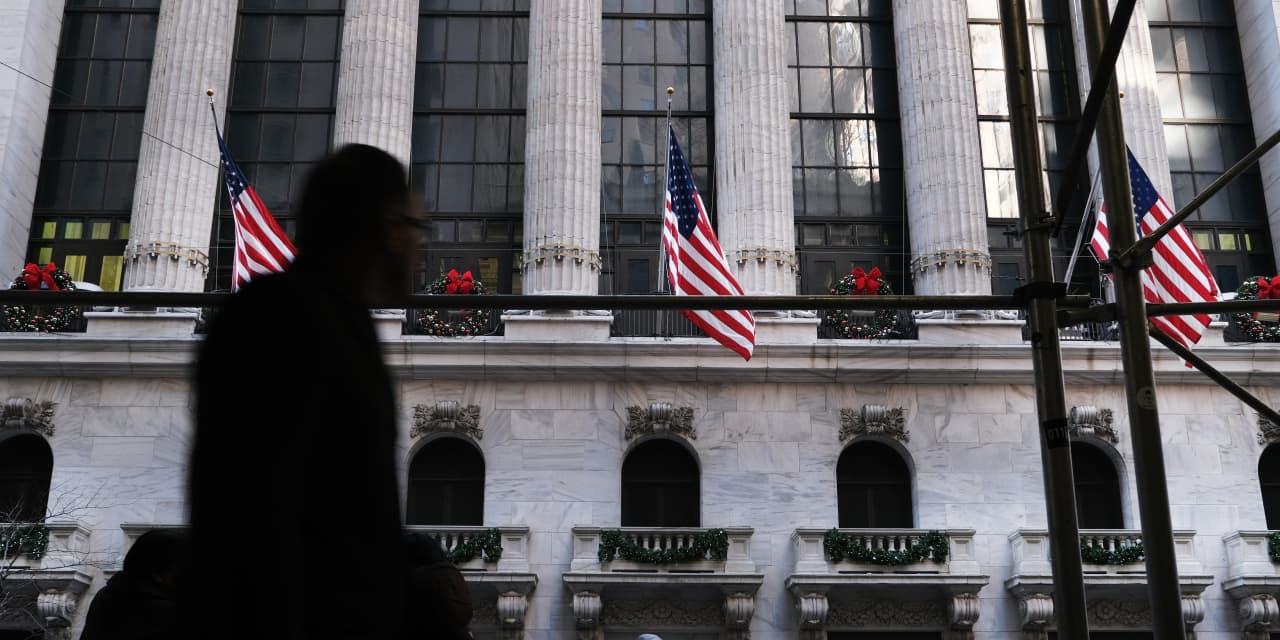
U.S. stocks were rising on Wednesday, a day after the S&P 500 and Dow Jones Industrial Average booked back-to-back losses despite more relief from Treasury yields, as investors cheered weaker-than-expected private labor-market data that showed moderate growth in hiring in November.
What’s happening
-
The Dow Jones Industrial Average
DJIA
was rising 59 points, or 0.2%, to 36,182. -
The S&P 500
SPX
was gaining 9 points, or 0.2%, to 4,575. -
The Nasdaq Composite
COMP
was increasing 40 points, or 0.3%, to 14,270.
On Tuesday, the Dow industrials fell 0.2%, to 36,125, the S&P 500 declined less than 0.1%, to 4,567, while the Nasdaq gained 0.3%, to 14,230. The S&P weakness did mask a stronger day from the so-called Magnificent Seven group of megacap tech stocks, including Apple
AAPL,
whose shares advanced by 2%.
What’s driving markets
U.S. businesses added 103,000 new jobs in November, paycheck company ADP said, in another sign of slower hiring and a softer U.S. labor market. That was below the 128,000 consensus forecast from economists polled by Dow Jones.
The ADP payroll estimate is usually not a reliable predictor of the U.S. Bureau of Labor Statistics’ more comprehensive and closely-watched employment report, which comes out Friday at 8:30 a.m. Eastern, but both surveys have signaled a deterioration in the jobs market that could support the soft-landing narrative for some Fed officials and investors.
The U.S. is expected to report 190,000 jobs added in November after a 150,000 increase in the prior month, according to economists polled by Dow Jones. The percentage of jobless Americans seeking work is forecast to stay the same at 3.9%, leaving it at the highest level since the beginning of 2022.
Investors will also monitor jobless claims numbers on Thursday, which could also provide hints about the state of the economy and whether higher interest rates are having their desired effect in cooling the economy.
“Employers were scrambling for workers over the last few years, but demand has cooled and staffing levels are higher across most of the economy,” said Bill Adams, chief economist at Comerica Bank. “The softer turn of recent labor market releases reduces the risk that inflation pressures revive due to wage-price issues, making it easier for the Fed to pivot to rate cuts in 2024.”
The yield on the 10-year Treasury
BX:TMUBMUSD10Y
was falling 3 basis points to 4.16%, after an 11.5 basis-point decline on Tuesday after data showing job openings declined to a 28-month low. The benchmark 10-year yield has declined for 10 of the last 13 trading days, which reflects slower growth and inflation in the fourth quarter and more confidence that the Fed will reduce rates in 2024, Adams said in emailed commentary on Wednesday. Yields move in the opposite direction to prices.
In other U.S. economic data, the U.S. trade deficit rose 5% in October to a three-month high of $64.3 billion due to a decline in exports, according to government data published Wednesday. Meanwhile, imports inched up 0.2% in October to $323 billion, mostly because of higher demand for computers and equipment to drill for oil.
The evidence that a soft landing will allow the Fed to cut rates sooner-than-expected in 2024 has supported the recent rally in equities and bonds despite stocks taking a breather in the previous two trading sessions.
Markets were pricing in a 12.1% chance of a rate cut as early as January, and the chance of at least a 25-basis-point rate cut by March is seen at nearly 55%, up from 20.3% a month ago, according to CME FedWatch Tool.
“This looks too optimistic to us,” said Solita Marcelli, chief investment officer Americas at UBS Global Wealth Management. “As a result, we believe the upside for the S&P 500 is now relatively limited, with the index likely to end the year around 4,700 versus 4,567 at present.”
Marcelli and her team think as growth slows, investors should consider high-quality stocks from companies with strong returns on invested capital, resilient operating margins, and relatively low debt on their balance sheets.
Markets are also listening to the testimony of top bank CEOs including JPMorgan Chase’s
JPM,
Jamie Dimon, who will be in front of the Senate Banking Committee. In prepared comments, Dimon said mortgages will be more expensive, saving for retirement will be harder and consumer prices will rise if proposed capital increase rules are enacted.
Companies in focus
-
Brown-Forman Corp.’s
BF.B,
-9.66% BF.A,
-9.27%
stock was sliding 9.5% Wednesday, after the parent to Jack Daniel’s whiskey posted weaker-than-expected fiscal second-quarter earnings and said a challenging operating environment has it tempering its expectations for the year. -
Campbell Soup Co.’s stock
CPB,
+6.76%
was up by 7% after the company said it may outpace analyst estimates for 2024 earnings per share.
Read the full article here