

Hello from Yifan in Silicon Valley, your #techAsia host this week.
I had to leave warm sunny California for cold snowy New York last week to moderate a panel. It has been a while since I experienced New York in winter after relocating to the San Francisco Bay Area to cover technology for Nikkei Asia from NYC.
The trip was a reminder of how great that decision was. In addition to being the centre of the AI revolution, the Bay Area is blessed with mild winter weather that rarely drops below 10C during the day.
But the panel discussion at the Asia Society was worth suffering a New York winter again. The panellists shared some great insights often missed in the discussions here in the US, such as how Southeast Asian countries fit into the global AI race.
At the end of the night, one attendee asked a question that stuck with me: What is the end game of AI?
As we approach the conclusion of 2025, many are trying to create a scoreboard of which countries led the AI race, which companies made the most money from AI (Nvidia, obviously) or which large language models show the most potential. But at the end of the day, what does all that mean to everyday people?
At Nikkei Asia, we’re trying to figure out the answer to that question through our series on how AI is reshaping jobs, supply chains, the environment, education and society at large — and where most of us fit into this fast-moving future.
If you’re curious about the answer like I am, follow Nikkei Asia for our ongoing, deeply reported coverage across the region.
Stop blaming AI for job cuts
You might think jobs typically outsourced to Asia — low skill, low pay and easy to standardise — would be the first to be replaced by AI. After all, Silicon Valley has laid off over a hundred thousand tech workers this year, so why wouldn’t the same thing happen overseas?
The reality is quite different, Nikkei Asia’s Sayan Chakraborty and Yifan Yu report. In many parts of Asia, work tied to training, testing and deploying AI systems is expanding rapidly, meaning that artificial intelligence is actually a boon for job markets in countries like India and the Philippines.
But that raises the inevitable question: How long will this last?
Asia’s boom in AI jobs also comes amid scepticism about how capable the technology really is. Jokes about how AI really stands for “actually Indians” have gone viral on social media platforms like Reddit and Blind, while start-ups Builder.ai and Nate, both collapsed amid claims of “AI washing”.
Beijing’s seal of approval
China has put domestic artificial intelligence chips on its official procurement list for the first time, ahead of Donald Trump’s decision to allow Nvidia’s cutting-edge semiconductors to be sold in the country, writes the Financial Times’ Zijing Wu.
AI processors made by Huawei and Cambricon have been added to a government-approved list of suppliers, according to two people familiar with the matter.
The step is designed to encourage the use of Chinese-made chips by public sector groups and could be worth billions in sales to local chipmakers.
Beijing’s move came before the US president announced he would lift export controls to allow Nvidia to ship its advanced H200 chips to ‘approved customers in China’.
However, putting locally made AI chips on to the Information Technology Innovation List — known as Xinchuang in Chinese — is seen as part of Beijing’s determination to wean the country away from US-made hardware.
The rise of humanoids
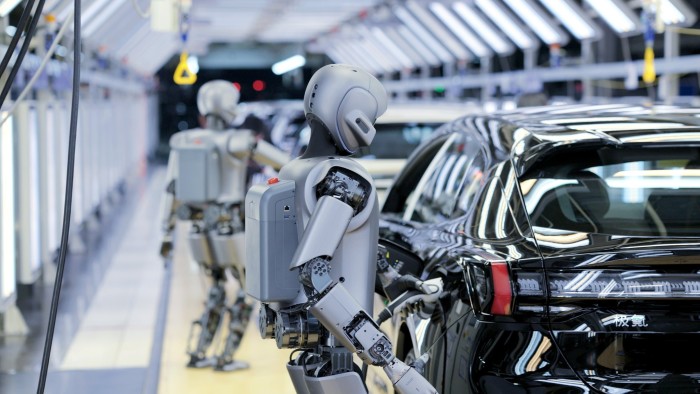
Goldman Sachs and BofA Global Research estimate that shipments of humanoid robots will reach about 18,000 to 20,000 units in 2025. The figure for 2024 was only about 3,000, meaning any manufacturer capable of producing even a few thousand of the products is already making a meaningful impact on the market.
Chinese companies are taking the lead in this nascent industry, racing to produce humanoid robots for fields ranging from entertainment to retail to smart manufacturing, even as technical hurdles and price issues remain to be conquered, Nikkei Asia’s Cheng Ting-Fang writes.
Shanghai-based robot maker AgiBot, backed by Chinese tech giants Tencent, BYD and Baidu, said on Monday it has reached a milestone of producing 5,000 humanoid robots at its flagship factory since it was founded in 2023. The figure places the start-up among the world’s biggest producers of such products by shipments.
Nuclear is hot
Japanese start-up Helical Fusion has signed an energy deal with a supermarket chain, in a first for Japanese nuclear technology that aims to replicate the power of the sun, Nikkei Asia’s Shotaro Tani reports.
The deal with Aoki Super marks the first power purchase agreement (PPA) signed by a Japanese fusion start-up and comes as the government signals further support for the industry amid increasing international competition to commercialise the technology.
As energy demand spiked globally amid AI data centre build-outs, nuclear energy has attracted attention from private companies and governments alike.
Case in point: Japan’s Hokkaido Electric Power is on track to restart a reactor at its Tomari nuclear plant, a move expected to boost the northern region’s appeal to industry much as the southern island of Kyushu has attracted chipmakers and data centres with cheap energy, writes Nikkei’s Masatoshi Ida.
Suggested reads
-
Australia’s world-first social media ban for children kicks in (Nikkei Asia)
-
China set to limit access to Nvidia’s H200 chips despite Trump export approval (FT)
-
Indian ecommerce platform Meesho rises 46.4% in trading debut (Nikkei Asia)
-
Kai-Fu Lee: China’s open-source AI is a national advantage (FT)
-
Japan’s Kioxia to make next-gen memory chips for AI data centres in 2026 (Nikkei Asia)
-
SK Hynix eyes US listing as AI chips demand more investment (Nikkei Asia)
-
Airwallex plots Silicon Valley expansion after securing $8bn valuation (FT)
-
Chinese chipmaker Hygon calls off merger with top shareholder (Nikkei Asia)
-
Chinese phonemakers seize on Apple’s AI struggles (FT)
-
Chinese challenger to Nvidia surges 425% in market debut (FT)
#techAsia is co-ordinated by Nikkei Asia’s Katherine Creel in Tokyo, with assistance from the FT tech desk in London.
Sign up here at Nikkei Asia to receive #techAsia each week. The editorial team can be reached at [email protected]
Read the full article here