

Unlock the Editor’s Digest for free
Roula Khalaf, Editor of the FT, selects her favourite stories in this weekly newsletter.
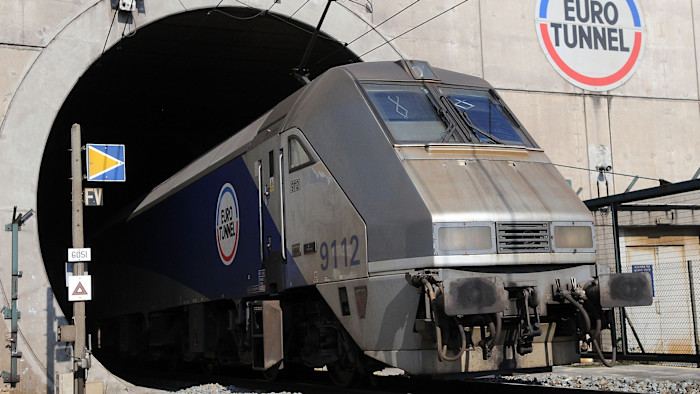
Freight trains carrying the equivalent of more than 100,000 lorries a year will be able to pass through the Channel Tunnel after the government took control of the UK’s only major cargo terminal that can handle European wagons.
Ministers hope that the deal, which will see state-owned Network Rail invest £15mn into the Barking Eurohub terminal in east London, will displace thousands of lorries from Britain’s roads, easing congestion and reducing emissions.
They also want the project to attract more rail freight companies to the UK to help meet long-term targets that form part of the government’s sweeping nationalisation of the rail network.
Network Rail will take control of the Barking site from owners Legal & General through its Platform4 property company, and will make changes including extending sidings to allow 700-metre long freight trains to use the terminal.
The terminal “has been an underused asset ever since it was constructed,” rail minister Lord Peter Hendy told the FT. “There’s a nascent market for full-length freight trains through the tunnel . . . when you get to the other end you have the whole of the European rail network.”
He said that having a neutral operator — rather than DB Cargo, the rail freight division of Deutsche Bahn that currently manages the terminal — would also encourage other freight companies to use the site.
Increasing freight trains will ease congestion on major motorways from ports as well as on the M25 around London. So-called intermodal containers can be moved directly from Channel Tunnel trains at Barking on to other trains or lorries for distribution across the UK.
Network Rail estimates that trains using the site will replace the equivalent of about 140,000 lorries a year.
While shuttle trains bring some cargo through the Channel Tunnel, there have been no freight trains running on the high-speed line to London since 2024, according to St Pancras High Speed, the company that runs the line.
Last year, tunnel operator Getlink — which runs part of the Barking site — said it had cancelled plans to invest in the terminal as it braced for an expected rise in UK business rates. At the time, the company said it had “frozen” all UK investments.
Hendy said the government had chosen to intervene in part because of the Getlink decision. “If they’d chosen to go ahead with it, maybe we wouldn’t have done it.”
Network Rail is also taking ownership of other freight operations that are not being fully used by their current owners, Hendy said, as part of an effort to increase the attractiveness of rail freight compared to road haulage.
Under the Railways Bill, which will create “Great British Railways” to manage both the train lines and the track, ministers want to see a 75 per cent increase in freight carried on the network by 2050.
Freight operators have expressed concern that the new rail structure may make it harder for them to operate because decisions about track access will be decided by GBR, the same body that runs passenger services.
Jeremy Westlake, chief executive of Network Rail, said the Barking deal is “more evidence that we’re really serious about growing rail freight”.
Read the full article here