

Unlock the Editor’s Digest for free
Roula Khalaf, Editor of the FT, selects her favourite stories in this weekly newsletter.
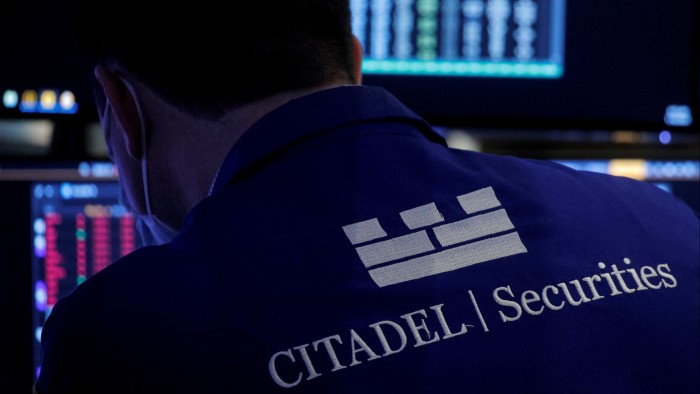
When two of Wall Street’s fiercest fighters lock horns, it is worth watching. Investors Exchange (IEX), the scrappy trading platform whose creation was chronicled by Michael Lewis in his 2014 book Flash Boys, is facing off with billionaire Ken Griffin’s Citadel Securities in a skirmish that both sides reckon could reshape US markets.
IEX has applied to the Securities and Exchange Commission to add options to its existing stock exchange. No surprise there. Options trading is booming in the US, with volumes having tripled since 2019. About 61mn contracts now change hands daily, according to Bloomberg Intelligence, and interest has been supercharged by the popularity of super short-term “zero day” products used to navigate daily market shifts.
To stand out from the existing 18 platforms, IEX is offering something novel. Its system could automatically delay, cancel or reprice quotes from market makers if its software detects that the best price is about to change from that quote. That feature could ease fears that the very fastest traders would spot the change first and profit from taking the market maker’s now-stale quote — a practice called latency arbitrage.
The plans have sparked a flurry of comment letters to the SEC, including three involving Citadel. Broadly speaking, the company’s objections centre on the fact that, under rules designed to ensure investors get the best price available, all market makers will have to route trades to IEX when its price looks the best — even if they believe its software may cancel or tweak the trade before it can be completed.
Some traders, on the other hand, support IEX’s plan, including Citadel rival Virtu and CTC. Most focus on the goal of levelling the playing field and reducing latency arbitrage.
Options markets are more complex than equities. A listed company might have just one kind of stock, but hundreds of options with varying prices and expiry dates that need constant monitoring and updating. But the debate around IEX’s options platform is essentially a new riff on an older debate around high-speed share trading and its utility.
For groups such as Citadel and its trading allies, which have spent hundreds of millions of dollars building the trading equivalent of a supercar, measures that help rivals catch up must feel like the sudden imposition of a 30mph speeding limit.
But markets are a public good that help to spread risk and direct capital. Such aims are not obviously served by shaving further milliseconds off blink-and-you’ve-missed-it trading times — a fight already so tough that big banks are out of the game. Morgan Stanley, the last remaining one with a big electronic options market-making unit, sold it in July to Citadel.
This isn’t Citadel’s first fight with IEX. It twice previously opposed the exchange’s equities plans and lost — in one case losing on appeal, too. Yet IEX’s previous innovations, also targeting latency arbitrage, didn’t reshape equity markets as opponents had feared. If IEX wins, its customers should too — but that doesn’t mean Griffin and his allies will necessarily lose.
Read the full article here