

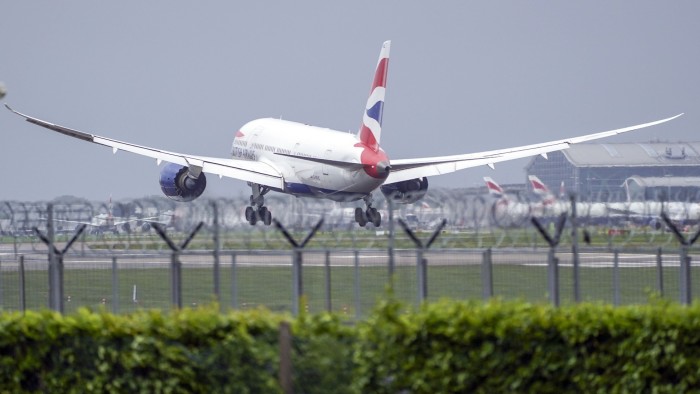
Heathrow airport must overhaul the way it operates before proceeding to build a third runway as part of its £49bn investment programme, the UK’s Civil Aviation Authority has said.
The regulator, which has spent the past six months studying the airport’s business model, published its early assessment earlier this week after the UK government backed Heathrow’s proposals for expansion.
“The scale and complexity associated with the forthcoming expansion at Heathrow airport means it is a particularly important time to consider whether the current regulatory model is effective in protecting the interests of consumers,” the CAA said in a 91-page report.
Its team looked at airports around the world — from New York and Paris to Saudi Arabia and Singapore — as well as other major infrastructure projects, to get inspiration for what a new regulatory model could look like.
What is wrong with Heathrow’s current system?
For now, Heathrow has to sign off its five-year budget under the “regulated asset base” or RAB model. This allows it to recoup money invested from airlines, its principal customers, through landing fees. Significant projects, such as the third runway proposal, require additional sign-off.
If costs overrun, Heathrow is liable for 25 per cent of the overspend — but airlines say this is not enough to incentivise the airport’s owners to remain disciplined. The proposal for a third runway, which involves moving the M25 motorway, has raised concerns from airlines.
Heathrow is already one of the most expensive airports in the world for carriers, which it blames in part on local energy and construction costs.
Airlines warn that if fees becomes too expensive, it will hamper Heathrow’s competitiveness and passengers will opt to fly via Amsterdam, Paris or Frankfurt.
The CAA conceded that “it is not straightforward” to compare costs, but said that fees at Heathrow did “appear high compared to other airports that are subject to a greater degree of competition”.
It found “There is sufficient evidence to warrant revisiting the current regulatory model to determine whether it can be improved or whether an alternative model can better serve the interests of consumers.”
What are the alternatives?
In total, the CAA drew up nine alternatives, ranging from minor tweaks to a radical overhaul.
Options could include giving airlines a veto over projects, rather than their current advisory role. Increasing the amount Heathrow has to repay if it overspends was another possibility — although the CAA warned this might disincentivise risk and make it harder for the airport to raise money in the future.
Another suggestion was extending the time over which it can claw back spending through charges to airlines — a proposal being considered at Charles de Gaulle airport in Paris.
“There are benefits from providing comfort to investors that the regulatory framework will not be inappropriately amended once capital has been committed,” the CAA said.
Airports such as Istanbul in Turkey, Newark in New Jersey and Changi in Singapore require the airport owners to tender to third parties for some design and construction work.
Heathrow could also be forced to contract out the running of its operations, as is the case with both London’s Elizabeth Line, and a system used by UK water regulator Ofwat to commission new infrastructure projects.
“Consumers would benefit from competition from third parties putting forward bids reflecting their lowest possible costs and/or highest possible service quality terms,” the CAA said.
However, a more radical example is the JFK model used by New York’s central airport.
What is the ‘JFK model’?
JFK, which is owned by the Port Authority of New York and New Jersey, has one of the world’s most competitive airport regulation models.
Though the airport was publicly owned, each terminal building was run by rival companies that awarded leases based on the quality of their bids, the CAA said.
“Operators compete to attract airlines and passengers”, it added, which kept prices lower
At Heathrow, Terminal 5 is run by British Airways. Arora group, which had its rival runway proposal rejected this week by ministers, is keen to build its own independent terminal at Heathrow.
The UK government has indicated it is open to such competition.
However, there is a problem. “Service quality at JFK has historically been criticised when compared to global peers,” the CAA found.
This was a result of “passenger congestion and a lack of cohesion between terminals when being run by different operators”.
What happens next?
Heathrow Reimagined, a campaign group supported by British Airways owner IAG and Virgin Atlantic, welcomed the CAA’s review.
“Fundamental reform will deliver better value for money for passengers and UK plc,” it said. “Better approaches exist at other airports globally.”
A consultation on its findings will run until January 20.
The CAA noted that modest changes to Heathrow’s regulatory model “will be more straightforward to implement” as radical options could require new legislation — although people with knowledge of the process say this can be sped through the system by government if required.
There is political pressure to hasten the project: Rachel Reeves has made clear she wants “spades in the ground” by 2029, the expected date of the next election.
The CAA concluded that examples from other airports “demonstrate that challenges with competitive models are surmountable but require parties, including [Heathrow], to work together to achieve the intended outcomes”.
What does Heathrow think about all of this?
The airport has chafed at the CAA’s process, warning it risks further delaying the goal of having a third runway operational by 2035.
“It’s been 10 months since the Chancellor said Heathrow must be expanded to drive growth for the economy and lower airfares for consumers and the CAA is only just now launching a six-month sequence of consultations on complex regulatory models for Heathrow expansion,” Heathrow told the FT.
“This will be another six months of delay to private investment in the UK economy and the realisation of UK-wide benefits.”
Data visualisation by Jonathan Vincent
Read the full article here