

Unlock the Editor’s Digest for free
Roula Khalaf, Editor of the FT, selects her favourite stories in this weekly newsletter.
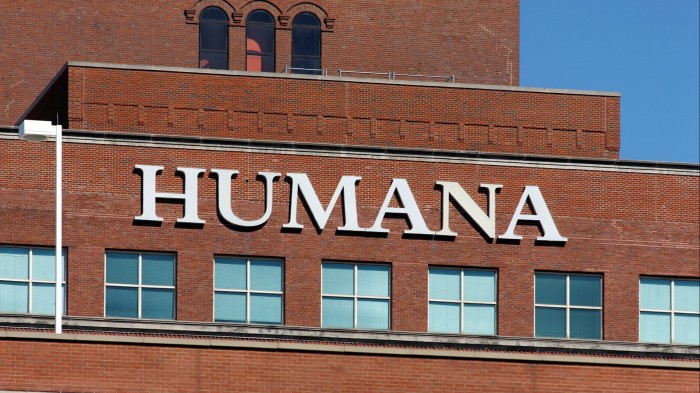
Health insurer Humana is fighting the US health department in court over three disconnected phone calls to the company’s customer service line, a dispute that could cost it billions of dollars.
Customer calls are part of the rating system that allocates from one to five stars to insurers offering coverage through the Centers for Medicare & Medicaid Services, which provides health coverage to more than 160mn Americans.
The ratings, closely watched by Wall Street, influence access to lucrative bonus payments, and as CMS prepares to release its 2026 stars early next month, insurers are scrapping to preserve their standing. In October 2024, when CMS last announced its star ratings for insurers, Humana’s shares sank 12 per cent after the company disclosed disappointing results.
Capstone, a policy firm that covers health insurers, and Wells Fargo, have estimated Humana’s disappointing stars results could wipe out $3bn in revenue for the company.
“It underscores the Byzantine nature of the star ratings system that you can have billions of dollars riding on whether a single call is dropped,” said Matthew Gillmor, director of equity research at KeyBanc. Taxpayers, he said, might prefer that cancer screening rates or other health outcomes carry greater significance than dropped calls.
Humana sued the government over its rating in October 2024. CMS included foreign-language assistance for customer callers in its stars metrics. To receive five stars on the call centre metric, CMS required a 100 per cent success rate for foreign language calls. Three Humana test calls involving a third-party connecting an interpreter did not work, hurting Humana’s overall star rating.
In court filings, CMS said: “Humana hung up on all three callers,” adding: “This lawsuit is Humana’s attempt to have a court absolve it of responsibilities for its own shortcomings in providing the barest minimum of customer service to Medicare beneficiaries.”
Humana, which has about 17mn Americans in health plans, declined to comment. The company has asked for a ruling in its case by October 15.
A vestige of president Barack Obama’s Affordable Care Act, the star ratings — ranking companies from one to five — are intended to help people vet their insurance options for certain Medicare plans, which provide coverage for the aged and disabled. But with about three dozen metrics going into calculating the ratings, its complexity can be confusing — and insurance companies use such convolutions to fight for higher ratings in court.
Medicare plans with higher stars earn more federal dollars, which are intended to cut costs for patients or expand services. These ratings for various Medicare plans resulted in $12.7bn in government bonus payments to insurance companies this year, more than four times the amount the government doled out in 2015, according to KFF, a non-profit health policy research group. An increasing number of people are enrolled in four- or five-star plans, which pay out more.
“Star ratings play a more consequential role in the payments for [insurers] plans than they do in beneficiaries’ decisions about which plans to enrol in,” said Jeannie Fuglesten Biniek, an associate director on Medicare policy at KFF.
“Having a higher star rating allows you to have more dollars to spend on those benefits, and that seems to be a strategy that insurers have in terms of thinking about their competition in the market.”
Health insurance companies also use their star ratings to compete with each other over supplemental benefits such as dental and vision care, Fuglesten Biniek said. But with so many four- or five-star plans on the market, the programme does not always help people determine quality, she said.
In November 2024, UnitedHealth won a court fight over CMS that hinged on a single test phone call. The company disputed CMS’s claim that one of its test calls was dropped. A judge ordered CMS to recalculate its 2025 star rating without considering the dropped call.
UnitedHealth’s shares jumped 8 per cent on one day earlier this month after the company disclosed that about 78 per cent of its members are expected to be in four-star or higher plans next year. Its shares are down 33 per cent so far this year.
“The [companies] are using the complications in order to achieve the higher stars through the courts,” said David Mohler, a vice-president at Capstone.
The Paragon Health Institute, a conservative-leaning think-tank with ties to the Trump administration, has recommended eliminating the star system.
“Given the tenuous relationship between star ratings and actual quality, quality bonus payments should be eliminated,” Paragon said in a 2024 report.
Read the full article here