

Stay informed with free updates
Simply sign up to the Airlines myFT Digest — delivered directly to your inbox.
Emirates plans to restore all its routes from Dubai “in the coming days” as Middle Eastern airlines increase services despite conflict across the region’s airspace.
The Dubai carrier said it was now operating flights to about 60 per cent of its destinations. “The airline anticipates a return to 100 per cent of its network within the coming days, subject to airspace availability and the fulfilment of all operational requirements,” it added.
Emirates said it carried about 30,000 passengers out of Dubai on Thursday.
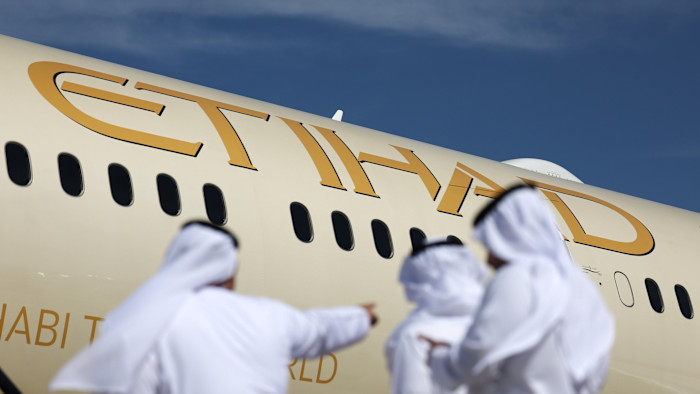
Etihad said it would resume a limited service from Abu Dhabi from Friday, in a further sign that air travel across the region was slowly resuming after a week in which tens of thousands of flights were cancelled.
Global travel has been upended by the closure of airspaces across much of the Middle East, with millions of passengers worldwide hit by the cancellations.
The returning schedules come as German carrier Lufthansa said it had seen a sharp increase in demand for its long-haul routes to Asia and Africa by passengers avoiding flying through the region, which remains in the grip of conflict even as air travel returns.
An Air France flight on Thursday repatriating French citizens had to turn back after missile fire over Dubai, while Qatar’s airspace remains closed.
Both Etihad and Emirates have been running some repatriation flights in the past days but normal services have remained suspended because of closed airspace and the conflict.
Etihad “will resume a limited commercial flight schedule from March 6 2026, operating between Abu Dhabi and a number of key destinations”, it said on Friday.
“The decision has been taken in co-ordination with relevant authorities following extensive safety and security assessments,” it added.
Emirates said earlier on Friday that it was also restarting some scheduled services to take passengers through Dubai to other flights, rather than just repatriating stranded passengers.
“Customers transiting in Dubai will only be accepted for travel if their connecting flight is operating,” it said. “Please do not go to the airport unless you hold a confirmed booking for these flights.”
Air traffic at Dubai airport is back to a quarter of its capacity before the US-Israeli strikes on Iran, as travel out of the region begins to pick up after almost a week of disruption.
Some 310 planes took off or landed at the airport on Thursday, according to data from Flightradar24. This was almost double the 161 on Wednesday, and a quarter of 1,257 last Friday, the day before the attacks started.
Qatar Airways, which has been running a limited number of flights from Oman, is still unable to fly from its Doha base because airspace remains closed.
About one-third of journeys between Europe and Asia involve changing at Gulf airports.
On Friday, Lufthansa warned the war in the Middle East had shown that the high volumes of flights through Gulf hubs was a “geopolitical Achilles heel” for the airline industry.
The German carrier is exploring plans to lay on more flights to destinations such as Singapore, India, China and South Africa in response but warned that the conflict had increased uncertainty for the industry.
“The war in the Middle East proves once again how exposed air traffic is and how vulnerable it remains,” said chief executive Carsten Spohr.
Spohr, who has previously chafed at perceived unfair competition from Gulf-based airlines, said the conflict “makes it even more important not to further disadvantage European airlines and hubs”.
He is among airline executives who have lobbied the European Commission to scrap an aviation deal with Qatar amid corruption allegations against a former senior EU official.
Lufthansa on Friday reported record revenues in 2025 of €39.6bn, up from €37.6bn in the previous year. The group’s net income fell slightly to €1.3bn from €1.4bn in the previous year. Earnings were expected to significantly increase again this year, despite greater uncertainty.
Read the full article here