

Good morning and happy Thanksgiving. In today’s newsletter:
-
Bowman prepares to unveil new bank lending rules
-
JPMorgan unveils plans for new London office
-
Trump’s fixer-in-law
-
And how weight-loss drugs changed Thanksgiving
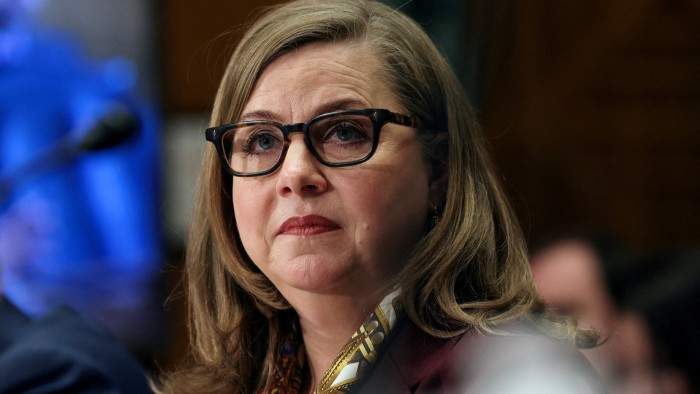
Banking is in Michelle Bowman’s blood. Her great-great-grandfather was the first president of the 143-year-old Farmers & Drovers Bank, one of the oldest lenders in Kansas. She was appointed the US Federal Reserve’s vice-chair of supervision by President Donald Trump in June and has launched one of the most significant reversals of financial regulation for decades. Early in the new year she is expected to present new capital requirement rules for US banks.
Here’s what we know: The new rules, known as Basel III, will implement reforms to bank capital requirements first agreed a decade ago in response to the 2008 financial crisis. An earlier version of the rules, dubbed the “Basel Endgame”, has been ditched. Bowman’s version is expected to be broadly capital-neutral for US banks and more acceptable to Wall Street.
However, some US banking executives and lawmakers want Bowman, who is seen as a potential successor to Fed chair Jay Powell, to go further. They believe there is unnecessary duplication between the Basel III rules and buffers imposed by the US central bank. Members of the Senate banking committee wrote to Bowman and Powell this month, calling on them to avoid “overcapitalisation of risks” that have already been accounted for by US rules.
Why it matters: Wall Street banks are likely to be the biggest winners from Bowman’s reforms. Alvarez & Marsal, a consultancy, estimated in a recent report that deregulation would free up almost $140bn of capital for US lenders, boosting their return on equity by almost 6 per cent. However Bowman’s critics warn that watering down much of the US financial rule book, just over two years since several mid-sized US banks collapsed, will encourage excessive risk-taking by banks. It will also expose customers to more wrongdoing and losses and even plant the seeds of the next financial meltdown, they say. Read the full story by our financial regulation editor Martin Arnold.
Here’s what else we’re keeping tabs on today:
-
Central banks: The European Central Bank publishes the minutes of the October monetary policy meeting of its governing council.
-
Papal trip: Leo XIV travels to Turkey and Lebanon in his first foreign trip as pope.
-
Thanksgiving: Americans celebrate the national holiday. US financial markets are closed.
Join FT experts tomorrow at 1pm London time to analyse how the autumn Budget will affect the UK economy. Subscribers can sign up here for this exclusive event.
Five more top stories
1. President Donald Trump vowed a wide-ranging crackdown on millions of immigrants in the US as he said an Afghan national was the suspect in the shooting of two members of the National Guard in Washington. Trump called the shooting “an act of terror” and vowed his administration would “re-examine every single alien who has entered our country from Afghanistan”. Read more on the attack that has rattled the nation.
2. JPMorgan Chase has said it will build a 3mn square-foot tower in Canary Wharf in a boost for the financial centre in London’s Docklands. The US bank said the new building, located at its Riverside development in Canary Wharf, would house up to 12,000 staff and serve as the bank’s UK headquarters and would be its “most significant” presence in Europe, the Middle East and Africa. Here’s more on the plans.
3. November’s Beige Book released yesterday reflected a step up in the deterioration of the US labour market that preceded the Federal Reserve’s decision to start cutting interest rates again in September. It makes a cut at next week’s meeting of the Fed’s rate-setting committee even more likely, says the FT’s Monetary Policy Radar.
4. US food company Campbell’s has dismissed an executive who was recorded criticising its food as made for “poor people” and saying that its Indian employees were “idiots”, according to a lawsuit filed in Michigan. Martin Bally was a vice-president in Campbell’s information technology department.
5. Top Chinese companies are training their artificial intelligence models in data centres across south-east Asia as they seek to access Nvidia’s chips and bypass US efforts to block their development of the powerful technology. Read the full report.
News in-depth
At least 55 people have died and 279 are missing in a blaze that has devastated several large apartment buildings in Hong Kong. The fire broke out yesterday in Wang Fuk Court, a typical Hong Kong residential complex with apartment blocks more than 30 storeys high, and quickly spread to seven of the estate’s eight towers. Zijing Wu and William Langley in Hong Kong have the latest on the deadliest fire in Hong Kong since 1962.
We’re also reading . . .
-
Neighbourhood opposition: Data centres are facing resistance in some US communities over the “monstrosities” spoiling the local scenery as well as potentially higher utility bills.
-
Nigeria abductions: The country’s problem is not that it fails to protect its Christians, but that it fails to protect anyone of whatever faith, according to the FT View.
-
Trump’s fixer-in-law: Ukrainian ministers were surprised to see Jared Kushner at last weekend’s peace talks in Geneva. But the US president has often turned to his son-in-law for the most difficult diplomatic missions.
Join senior FT editors on December 3 for a discussion on what will shape the year ahead. Register for free today.
Chart of the day
UK chancellor Rachel Reeves has soothed markets with a promise to meet her fiscal rule with far more room to spare than before. But her Budget was characterised as a “spend now, pay later” announcement as many of the personal tax measures don’t kick in until 2028. Sam Fleming and Delphine Strauss assess the state of the UK’s public finances after Reeves’ second Budget.
Take a break from the news . . .
Weight-loss drugs such as Wegovy or Ozempic are changing Americans’ relationship to food — and to the festivals like Thanksgiving where “eating too much is part of the ritual”. Patti Waldmeir spoke to users as they prepared for the holiday.
Read the full article here