

As rumours of job cuts swirled at the Washington Post in recent weeks, critics of Jeff Bezos zeroed in on the newspaper’s owner as the archetype of a disconnected billionaire.
While staff pleaded online for him to “Save the Post”, posting photos from war zones, he was photographed at Paris Fashion Week parties with his wife, former journalist Lauren Sánchez.
The tension crystallised this week when the newspaper fired about 300 of its roughly 800 journalists, one of the largest single-day cullings at a US news organisation in recent memory.
It was a hammer-blow moment for a newspaper steeped in history but imperilled by financial losses and, staff argue, strategic failures by Bezos and chief executive Will Lewis.
Marty Baron, editor-in-chief when Bezos bought the Post for $250mn in 2013, blamed the Amazon founder for much of the paper’s recent trouble.
Bezos’s behaviour and “cozying up to Trump” had “damaged the brand of the Washington Post”, Baron said in an interview.
Bezos had a prime seat at Donald Trump’s swearing-in last year, while Amazon gave $1mn to the president’s inauguration fund and paid $40mn for a film about Melania Trump.
“People are disgusted by it,” Baron said. “No matter how great the reporting is, when people see [Bezos] up there with Trump, when they see Amazon paying a ridiculous price for a ridiculous documentary by Melania Trump, no matter what you’re doing, a lot of readers are going to say: ‘I don’t trust this guy.’”
A person close to Bezos said he remained committed to the Post and had no plans to sell it. The person did not respond to criticism that Bezos’s decisions contributed to the paper’s losses, or questions about his involvement in strategic decisions.
People familiar with the thinking of the paper’s leadership said that even a billionaire owner had grown weary of absorbing losses at the Post. “They want to stop losing money and everything they have tried has failed,” one person said, arguing that drastic cuts were unavoidable as audiences for some parts of the paper continued to shrink.
The newspaper’s management found areas such as its well-regarded sports desk, enterprise journalism and the paper’s extensive foreign bureaus were not being well read, another added. “Long form, 2,000-word sports reports on a local basketball team are not wanted any more.”
The Post does not disclose financial figures. People familiar with the matter said it was losing about $100mn a year.
People close to management said the newspaper was aiming to break even by the end of the year, which could then unlock fresh funding from Bezos, more willing to back a self-sustaining business. “It’s a clear path now to break even this year and to get fresh capital to grow,” one person said.
Baron said he had heard Bezos had received multiple overtures from potential buyers for the Post in recent years but had rejected them.
Another described the challenge more bluntly: costs were “out of control”, adding that both staff productivity and audiences have halved over the past five years — an unsustainable combination.
Former and current staff dispute that diagnosis, arguing that management decisions have deepened the paper’s woes and question the need and wisdom of the latest in a series of newsroom overhauls since Lewis took over in 2023.
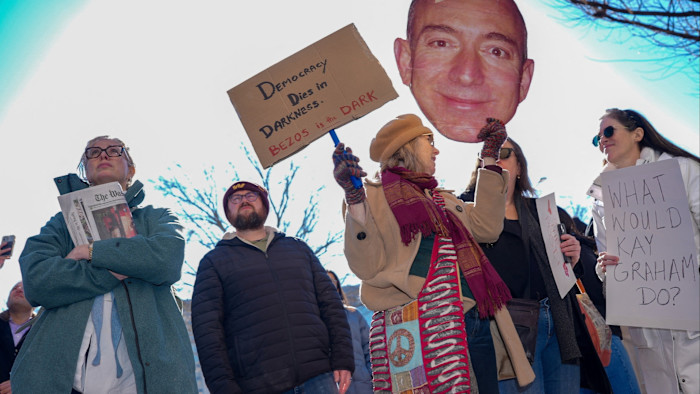
A day after the Washington Post Guild accused Bezos of abandoning the mission that had defined the paper “for generations”, protesters rallied outside the newspaper’s downtown Washington headquarters, one holding a sign that said “What the F Jeff?!”.
When journalists, including correspondents in Ukraine and Pulitzer Prize winners with decades-long tenures, received news of their firing over email, many turned to social media to describe the impact of the job losses.
Caroline O’Donovan, a technology reporter, noted the irony of being laid off after years of covering Amazon for a newspaper owned by its founder. Lizzie Johnson, a Kyiv-based correspondent, said she was dismissed while reporting from a war zone.
When Bezos acquired the Post from its previous owners, the Graham family, who oversaw the outlet when it published its Watergate investigation in the 1970s, he said “the paper’s duty will remain to its readers and not to the private interests of its owners”.
But after a renaissance period during the first Trump administration, the Post struggled to keep up momentum. The paper has been hit hard by industry headwinds, such as declining web traffic as social media platforms pulled back from news and Google introduced AI summaries. Executive editor Matt Murray said search traffic had nearly halved over the past three years.
Bezos faced a torrent of criticism in late 2024, after the newspaper pulled its endorsement for a presidential candidate just days before the US election. A reported 250,000 subscribers cancelled their subscriptions in the days after the decision. “It’s really hard to get hundreds of thousands to subscribe in the first place, and to lose them overnight was devastating to the Post,” Baron said.
The next year, Bezos came under fire again when he intervened in the newspaper’s opinion section to focus it on two topics: “personal liberties and free markets”.
Baron said he believed that Bezos had “alienated loyal readers” and brought them to “abandon” the paper.
The tumult at the Post has raised questions about billionaire ownership of news organisations — a practice that has become increasingly common in the US over the past decade and a half. Over that period billionaires have bought the newspapers of US cities including Los Angeles, Boston, Salt Lake City and Minneapolis.
“This is not a strategy for news, it’s more like a dying prayer,” said Gabriel Kahn, a journalism professor at the University of Southern California Annenberg and former Wall Street Journal bureau chief.
“People initially embraced billionaires because they thought they could withstand financial and political pressures,” Kahn added. “That turned out to be wrong on both counts. We’ve seen billionaires being the first to cave.”
Not all American newspapers are struggling. On the same day the Post announced its lay-offs, the New York Times reported a 10 per cent rise in revenue and 450,000 new digital subscribers to 12.2mn in its latest quarter, underscoring their diverging fortunes.
Bezos and Lewis are betting that making the most difficult decisions now by focusing the venerable newspaper on core reporting around national politics and security while building on its digital and video platforms will bring in new readers.
One person close to the management pointed to the popularity of its personalised, AI-generated news podcast as an example, but added: “The scale of the challenge is significant.”
Read the full article here