

Good morning. A scoop to start: Brussels is planning a new antitrust investigation into Meta over the rollout of artificial intelligence features within its WhatsApp messenger, according to officials briefed on the plans.
Yesterday, the European Commission unveiled its plan to construct a loan of up to €210bn for Ukraine backed by immobilised Russian state assets, with a controversial legal workaround. But does the daring scheme breach the EU’s own laws?
Today, Laura hears Luxembourg’s criticism of Germany for clogging up their shared border crossings in a bid to catch irregular migrants, and the EU’s financial services commissioner tells our correspondent why she wants to make the bloc’s central markets supervisor more powerful.
Border brawl
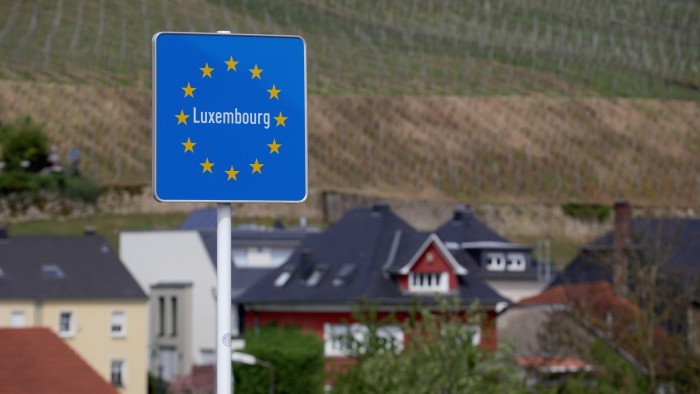
Luxembourg’s home affairs minister Léon Gloden has hit out at Germany for continuing to patrol their joint border to catch migrants, as well as the European Commission for not doing anything about it, writes Laura Dubois.
Context: Germany is among ten Schengen countries that have reinstated checks along their borders. The Schengen area of free movements includes 29 countries, and recently celebrated its 40th anniversary.
“Schengen is — next to the introduction of [the] euro — the greatest achievement within Europe,” Gloden told the Financial Times. But he added that Luxembourg had been “facing, now for a few years, border control in particular with Germany”.
“We have no problems with our neighbours from France and Belgium because they have no fixed control points, but they do intelligent, flexible controls,” Gloden said.
Gloden said that around 52,000 commuters were regularly being held up by the checks, and that businesses had also complained about delays and operational restrictions.
“They always tell us that they do everything in order not to hinder the traffic of commuters between our two countries. But in practice, it’s different,” Gloden said of the German government.
Meanwhile, irregular immigration to Germany has halved, according to its interior minister Alexander Dobrindt. Gloden said that, for this reason, “we consider that these border controls are not legitimate anymore”.
He also lashed out at the commission for not enforcing the Schengen rules properly. “The European Commission has completely failed in this file,” Gloden said. “Unfortunately, they didn’t act at all . . . They should have performed unexpected monitoring [of the border] controls, which has not been done.”
“I deplore that,” Gloden said.
The commission said that it: “shares Luxembourg’s objective of maintaining a fully functioning area without internal border controls”, and that it had initiated a “consultation process”.
“We remain aware that challenges persist, and we will continue to monitor the situation closely,” the commission added.
The German interior ministry did not immediately respond to a request for comment.
Chart du jour: Ready for take-off
Europe’s low-cost airlines are preparing to re-enter Ukraine as soon as a peace deal is signed, as they predict a boom from “catastrophe tourism” and people returning.
Top down
Brussels wants to beef up the European Securities and Markets Authority (Esma) and give it direct supervision over financial players, writes Paola Tamma.
Context: The bloc’s fragmented financial infrastructure — with over 35 stock exchanges, 17 clearing houses and 28 central security depositories — has been criticised for high trading costs and limited scale. Supervision is split among member states’ regulators.
“We have some examples of one single entity reporting to over 20 national competent authorities. And this is not efficient,” EU commissioner for financial services Maria Luís Albuquerque told the FT.
She said: “All these barriers that member states . . . continue to maintain, and the lack of trust that often exists [between national regulators]” stood in the way of greater integration.
The European Commission is seeking to address this in a “markets integration package” to be adopted today.
The most controversial proposal is to give Esma supervision of more than 100 new entities, including the largest stock exchanges — Euronext, Nasdaq and Deutsche Börse — as well as connected clearing houses, central security depositories and all crypto assets service providers.
Esma will also be able to settle disputes between national regulators and have the last word on supervising large asset managers.
The proposal is controversial, because financial centres such as Luxembourg and Ireland fear that giving up oversight would run counter to their national interests.
But the commission argues it’s time to heed calls from EU leaders to better integrate capital markets.
“If we don’t address this by making it fundamentally different, we cannot get to a fundamentally different outcome,” Albuquerque said.
What to watch today
-
EU transport ministers meet in Brussels.
-
Cyprus President Nikos Christodoulides visits Kyiv.
Now read these
Read the full article here