

Welcome back.
A new twist in the Trump tariff saga came yesterday, when the US president announced a 100 per cent levy on imports of patented drugs, unless their producers are building plants in the US.
This swipe at Big Pharma comes as Trump wades into one of the thorniest ethical debates in modern business: over the prices that should be charged for drugs that can save or transform lives, but cost companies large sums to develop.
Action is long overdue on US drug prices, which are far higher than elsewhere, with dire consequences for the health and financial security of millions of Americans. But Trump’s proposed solution may end up pushing up prices in other markets, rather than lowering them at home.
Big Pharma vs Britain
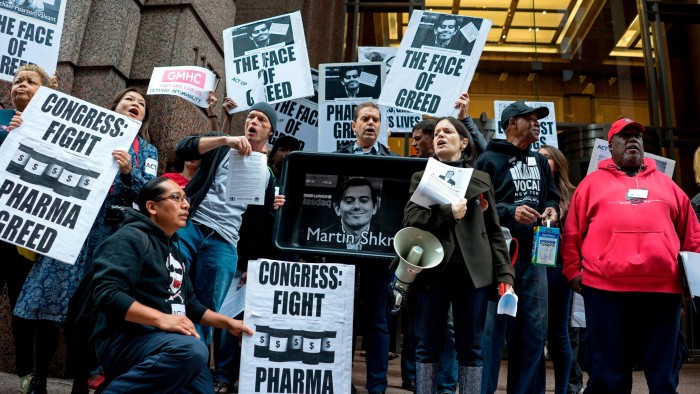
“My shareholders expect me to make the most profit. That’s the ugly, dirty truth,” Martin Shkreli told a healthcare conference a decade ago. “No one wants to say it. No one’s proud of it. But this is a capitalist society, capitalist system and capitalist rules.”
Shkreli is more pantomime villain than typical pharma executive. In 2015 he became a national hate figure in the US when his company bought the rights to a cancer and HIV drug and increased the price overnight by 5,000 per cent. Three years later he went to jail for fraud.
But Shkreli’s blunt words are a fair description of the financial imperatives facing major pharmaceutical companies as they lobby the UK government to increase its spending on medicines.
This week, the chief executive of US pharmaceutical company Eli Lilly told the Financial Times that the UK was “probably the worst country in Europe” for drug pricing, and warned that it would not “see many new medicines” if it didn’t change tack.
This was the latest salvo in what one senior UK government official called a “pretty sinister” pressure campaign by Big Pharma. Eli Lilly, Merck and AstraZeneca all have cancelled or paused planned investments in the UK amid a stand-off over the UK’s pricing regime.
Soon after the Eli Lilly broadside, science minister Lord Patrick Vallance told the FT that the government wanted to “fix the commercial environment” — and that this “means probably for medicines, we need to pay a bit more for some of them”.
Looked at in isolation, the sudden intensity of the pressure on the UK from Big Pharma might seem odd. Some criticism of the UK’s unusually arcane system is justified. Instead of negotiating drug prices directly with manufacturers like other major markets, UK authorities rely heavily on a steep “clawback” tax on sales over a certain level in order to restrain spending. (Drugs must also pass a cost-effectiveness review in order to be recommended for use in the National Health Service.) The clawback rate has climbed to almost 23 per cent, putting it at the centre of the current stand-off.
The drugmakers have been tolerating this system for years, however. While they receive much lower prices in the UK and other European markets than in the US, these prices are still far above their marginal cost of production. The companies counter, fairly, that they need to charge a price that reflects the huge costs of developing and testing new drugs.
But their financial results suggest that they’re far from struggling for money to fund innovation. Over the past five full financial years, the biggest four US pharmaceutical companies — Eli Lilly, Johnson & Johnson, Merck and Pfizer — earned net income of $261bn, or 21.8 per cent of their revenue, according to my analysis of S&P Capital IQ data. That’s nearly double the five-year average net profit margin of 11.7 per cent for the wider S&P 500 index.
The main driver of Big Pharma’s elevated concern about UK drug pricing may be Donald Trump. In May, the US president unveiled an executive order that accused drugmakers of a scheme to “deeply discount their products to access foreign markets, and subsidize that decrease through enormously high prices” in the US.
The inspiration for the move, Trump said, came from a friend who visited London and bought an anti-obesity drug at a fraction of the US price. His order would impose a “most-favoured nation” regime, forcing companies to offer Americans the same prices found in countries such as the UK. Trump’s government has said it will decide on its next steps after the end of this month.
The proposed policy is unlikely to succeed in lowering US prices to levels seen in Europe, as this paper from the Center for Global Development explains in detail. Instead, drugs elsewhere would probably rise in price — or just disappear. The US market is so big and lucrative that pharmaceutical companies would be incentivised to keep new drugs off other markets that can’t or won’t match US prices, rather than risk having to lower the latter.
That dynamic is already visible. This week Bristol Myers Squibb announced a UK price for a new schizophrenia treatment of $22,500 a year, the same as it charges in the US. The company’s chief commercialisation officer said it was prepared “to walk away if [UK authorities] cannot recognise the value of our medicine”.
Still, Trump is right to note the need for action on the “inflated prices” paid for medicines in the US. One obvious answer — introducing the same sort of national health insurance system and price controls seen in other advanced nations — looks politically impossible in the foreseeable future.
But there are opportunities to apply greater pressure within the existing framework — witness the sweeping changes in Joe Biden’s Inflation Reduction Act, giving the Medicare programme power to negotiate drug prices directly. (This is what Biden was trying to describe last year with his fatally mangled debate remark that “we finally beat Medicare”).
There is huge scope, too, to rethink the intellectual property regime for the pharmaceutical sector, and better align the financial interests of companies with the needs of societies. One radical but intriguing idea is the “delinkage” concept floated by former GSK chief executive Andrew Witty, under which governments could fund companies’ research and development of new drugs, which would then be sold at prices close to the marginal cost of production.
Shkreli was right that the pharmaceutical market is a capitalist system with capitalist rules. The question is whether that system, and those rules, are in need of an update.
Smart reads
Factory probe Chinese workers assembling iPhones for Apple supplier Foxconn face long hours, discrimination and delayed pay, allege undercover investigators for non-profit group China Labor Watch.
Spying scandal Microsoft has stopped providing some services to the Israeli military, following a media investigation into the alleged use of its Azure cloud system in surveillance of Palestinian civilians.
Cartel crackdown Eni and a unit of ExxonMobil are among six oil companies that have been fined more than €900mn by Italy’s competition watchdog, which found that they “engaged in an agreement restricting competition in the sale of automotive fuel”.
Read the full article here