

Unlock the Editor’s Digest for free
Roula Khalaf, Editor of the FT, selects her favourite stories in this weekly newsletter.
Middle Eastern airlines have started returning stranded travellers as the three-day airport shutdown across the region slowly eased on Tuesday.
Emirates flights have taken off from Dubai to the UK, France and Germany, while Etihad flew a handful of services from Abu Dhabi on Monday and Tuesday.
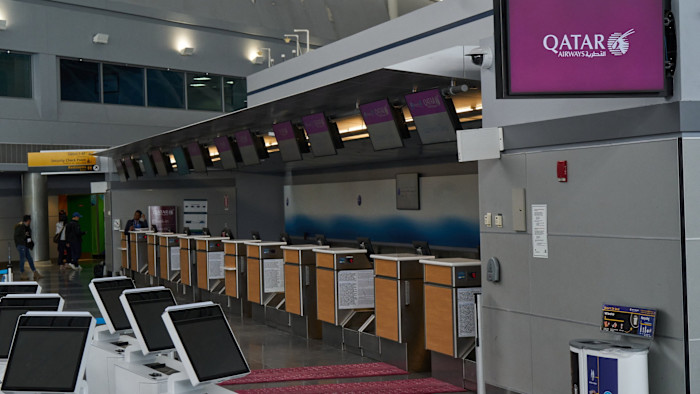
Qatar Airways said on Tuesday its flights remained grounded as the country’s airspace was still closed. Thousands more flights were cancelled on Tuesday as the conflict following the US-Israel strikes on Iran spread.
Governments have come under pressure to help their citizens stuck in the region, but most have yet to launch flights due to airspace closure and disruption across the region.
US ambassador to Israel Mike Huckabee warned Americans there were “very limited” options for leaving the country, and suggested a shuttle bus to Egypt.
“The US Embassy is not in a position at this time to evacuate or directly assist Americans in departing Israel,” he wrote on X.
France is preparing to charter evacuation flights for the “most vulnerable” among its 400,000 citizens in the Middle East, foreign minister Jean-Noël Barrot said on BFM TV on Tuesday.
Italy has dispatched teams of Carabinieri police and diplomats to Oman and the emirates to assist with the evacuation of about 70,000 Italian citizens stranded in the region, including 30,000 in Dubai and Abu Dhabi and another 20,000 in Israel.
The Italian foreign ministry said it was organising buses to ferry its citizens from the emirates to Oman and chartering flights from Muscat via Oman Air and other charter providers.
The UK government on Monday said it was considering all options to return people from the region. Ministers are known to prefer commercial flights rather than turning to chartered aircraft.
Tens of thousands of passengers remain stranded in the region after more than 10,000 flights were cancelled. Aviation data group Cirium estimates that more than 1mn passengers worldwide have been affected by the cancellations.
Emirates flights that left Dubai airport early on Tuesday — which had been closed since Saturday — included one to Heathrow and another to Manchester, as well as services to Paris, Frankfurt and Jeddah in Saudi Arabia.
Its planes will return to Dubai carrying anyone bound for the city but will not take passengers connecting for another flight. About 16 planes took off from Dubai’s main airport — normally the busiest in the world — on Monday.
Etihad flew the first passenger flight to land in the UK late on Monday evening.
The airline said its main services remained cancelled until Wednesday, while “some repositioning, cargo and repatriation flights may operate in co-ordination with UAE authorities and subject to strict operational and safety approvals”.
Businesses across the Gulf have been telling employees to work from home. Some Dubai residents have been seeking to leave via Oman or Saudi Arabia, where charter jet prices are roughly double previous levels.
Tens of thousands more passengers are still in Asia waiting for connecting flights to Europe. Some airlines have started booking customers due to fly in the coming weeks on to alternative, direct services, according to people in the travel industry.
The number of direct services between Asia and Europe has fallen in recent years due in part to the growing success of the Gulf airports as connecting centres.
Prices for those trying to catch direct flights from Asia to Europe have soared since the weekend. Some prices are close to double previous levels, according to industry executives. Virgin Atlantic said on Monday that its India services were unusually busy.
International airlines such as British Airways and Air France are still not flying into the Gulf region. EasyJet on Monday cancelled flights to Cyprus after an attack on a UK RAF base.
Read the full article here