

Unlock the Editor’s Digest for free
Roula Khalaf, Editor of the FT, selects her favourite stories in this weekly newsletter.
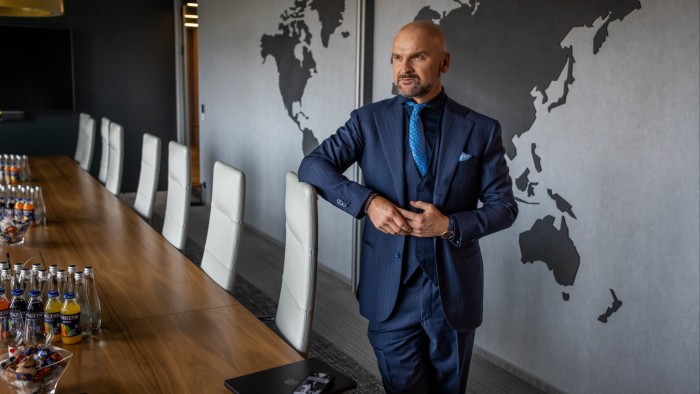
A Polish billionaire advising the government on deregulation efforts has distanced himself from comparisons to Elon Musk, rejecting suggestions he is eyeing a political career or seeking to emulate the US mogul’s drive to slash public sector jobs.
Rafał Brzoska, chief executive of parcel locker company InPost, told the Financial Times he admired Musk’s business acumen but said comparisons to the so-called US Department of Government Efficiency (Doge) — the project Musk leads — were misplaced.
“I really admire Elon Musk as a businessman, the way he built from scratch business after business, but you cannot compare our activities to Doge,” Brzoska said. He said Musk reported directly to the US president, while he could only make recommendations to Polish lawmakers.
Brzoska was appointed in February by Polish Prime Minister Donald Tusk to lead an advisory effort on how to streamline business regulation.
Tusk pledged to wield “machetes” and prepare about 120 bills to remove “barriers and unnecessary regulations”, inspired by what Brzoska’s task force proposed.
“Polish entrepreneurship is our national treasure,” Tusk said on Thursday. “It is high time to free it from the thicket of absurd regulations.”
Among Brzoska’s recommendations are simplifying tax filing requirements for businesses and streamlining regulatory approval for the defence sector, in an effort to make it easier for domestic arms manufacturers to win public tenders from the armed forces. Other measures seek to improve public services such as booking medical appointments or accessing courtrooms.
Brzoska built InPost by capitalising on the ecommerce boom, offering consumers greater delivery flexibility via automated parcel lockers. He said that Poland’s public services must now catch up through digitisation as well as deregulation.
Polish patients routinely face delays in the country’s strained public healthcare service. A centralised online booking system would considerably improve its efficiency, Brzoska said, as doctors would simply rebook appointments in case of no-shows. “Billions could be saved for our health sector,” he said.
Compared with the US, Poland already has a “thin” bureaucracy, which struggles with outdated regulations and a considerable backlog of applications.
“I can imagine how frustrating it is to ask someone who is applying for a permit to deliver five or 10 different documents, all printed out, just because these are the rules,” he said.
Brzoska’s task force comprised other business leaders, academics and former civil servants and is set to wind down its work in June. His remarks came as Musk pledged to spend “significantly” less time on Doge and instead “far more” on managing Tesla after his carmaker reported its lowest quarterly profits since the end of 2020.
But while Musk’s recent political foray extended into Europe, including support for Germany’s far-right, Brzoska denied having political ambitions. He said he accepted the assignment because he saw it as an opportunity to be “the voice of private business”, rather than take up a permanent job with Tusk’s government.
Cutting red tape has, however, emerged as a campaign topic in the Polish presidential race ahead of elections next month.
Rafał Trzaskowski, the candidate of Tusk’s Civic Platform party, is leading in opinion polls and has included a pledge to remove two Polish regulations for every item of EU legislation transposed into national law.
“If we seriously want to fight overregulation of the economy, we should accept only what is necessary,” Trzaskowski told a rally last month.
If Trzaskowski wins the two-round vote taking place on May 18 and June 1, Tusk should finally be able to press ahead with legislative changes that were blocked by the outgoing president, Andrzej Duda — a nominee of the rightwing opposition Law and Justice (PiS) party.
Tusk recently pivoted away from his pro-free market views in reaction to US President Donald Trump’s tariff war, pleading for a “re-Polonisation” of the economy. He said state-controlled energy companies should prioritise national interests over profits — a call that hit their share prices.
Trzaskowski’s rightwing rival, Karol Nawrocki, welcomed Tusk’s U-turn on economic nationalism, but suggested it was opportunistic. “First of all, Poland! Always, not just before the elections,” he wrote on social media platform X.
For his part, Brzoska said his deregulation effort was not driven by any political calculations ahead of elections. “For me, the real checkpoint is how many of our proposals reach parliament and are signed [into law] by the president.”
Read the full article here