

Unlock the Editor’s Digest for free
Roula Khalaf, Editor of the FT, selects her favourite stories in this weekly newsletter.
Shell is facing a crisis at one of its biggest bets on clean energy as it struggles to agree a rescue package for debt-laden Brazilian biofuels group Raízen.
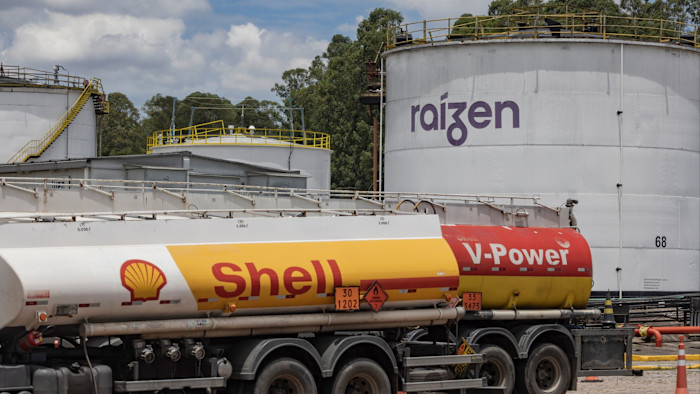
The world’s largest producer of sugarcane ethanol and operator of almost 9,000 Shell-branded fuel stations across Brazil, Paraguay and Argentina, Raízen has been hit by poor harvests, weaker fuel demand and higher interest rates.
Saddled with R$55bn ($11bn) in debt, the São Paulo-based business has been divesting assets to shore up its balance sheet and this month warned of “significant uncertainty” over its future after reporting a R$15.6bn net loss in its third quarter.
Raízen’s distress has caused alarm in Brazil, given its status as one of the country’s largest companies and its role fuelling the nation’s fleet of cars, roughly three quarters of which can run on either ethanol or petrol.
President Luiz Inácio Lula da Silva recently summoned Shell and other Raízen stakeholders to discuss how to salvage the business, according to people familiar with the situation.
“The government is very concerned about the knock-on consequences for jobs and the wider economic implications,” one of the people said, adding that bioethanol was hugely important not just to Brazil’s transport sector but also to farmers growing sugarcane.
Raízen’s debt — a mixture of bank loans, international bonds and domestic instruments — poses a significant problem for Shell.
The business is a key part of Shell’s clean energy plans and Brazil is one of the UK energy major’s most important markets. Shell is also the largest foreign oil and gas producer in Brazil, where domestic output is dominated by state-controlled Petrobras.
However, Shell is constrained by its desire to keep a tight rein on its finances.
Raizen’s shares are in penny stock territory — trading at just R$0.64 after a more than 60 per cent decline in the past year — and the company lost its investment-grade credit rating from major agencies this month.
Shell and Brazilian conglomerate Cosan each hold 44 per cent of Raízen after a 2021 initial public offering that raised more than $1bn. The two companies and Cosan shareholder BTG Pactual this week started informally sounding out creditors about a restructuring and recapitalisation plan they have been negotiating this month.
Under one proposal being discussed, Shell would inject R$3.5bn in fresh capital, while Cosan would contribute R$1bn with R$500mn coming from its founder and chair Rubens Ometto. Creditors, including Bank of America, Citigroup, JPMorgan and Mitsubishi UFJ Financial Group would convert more than a third of their holdings into equity.
The parties have also considered the possibility of breaking up Raizen by splitting out its fuel stations alongside the recapitalisation.
Cosan sees logic in this arrangement, according to people involved, while BTG — which is Latin America’s largest investment bank and invested R$4.5bn in Cosan last year — is keen to take a stake in the separated business through its private equity arm.
However, Shell believes such a break-up would take too long, according to one person close to the situation, and would also potentially reduce the visibility of its brand appearing on thousands of service stations.
“Shell very much wants to keep the company intact,” the person said. “It is simpler and quicker to do, and interest rates are 15 per cent, so they do not want to hang around.”
However, two other people involved in the talks said there was broad agreement on the main elements of the capital injection and the separation of the fuel distribution business.
The possible debt restructuring has met with scepticism from some of Raízen’s creditors, who argue that Shell and Cosan have not gone far enough and should inject at least twice as much new capital to anchor an effort to find R$20bn to pay down Raízen’s debt.
“Raízen is a central player in Shell’s global energy transition strategy, it served as a key vehicle for Shell’s growth in renewable energy over the past few years,” one said.
“The international banks have been counting on Shell to support this company at some point if needed. That is not what we have been seeing so far.”
People involved in the discussions said they hoped an agreement between Shell, Cosan and BTG could be reached as early as next week on how to proceed, which could then be formally proposed to creditors.
Read the full article here