

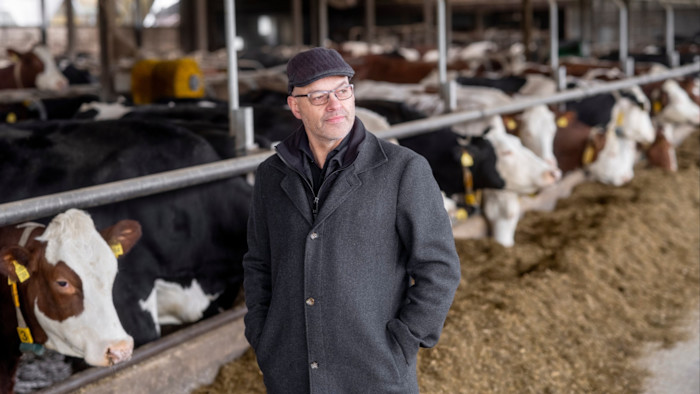
Manure gave life to the Verstraten family farm. Now it threatens to kill it.
Their dairy herd grazes on once-arid land enriched over decades by animal waste, which supports hundreds of family farms.
But just before Christmas, Dutch farmers received long-feared news from Brussels: they would have to drastically cut the amount of manure they put on their land because too much nitrogen was leaching into watercourses, damaging local wildlife.
The disposal of animal excrement has convulsed Dutch politics for years. When the government tried to compulsorily buy out livestock holdings to reduce production, it sparked a wave of rural protests that could return just as a new and fragile governing coalition takes office.
The densely populated nation of 18mn has almost as many farm animals as people, and the strain on nature is showing. Hundreds of farms are closing every year, and pig, sheep and cattle numbers are declining as their impact on the environment hits strict EU limits on nitrogen, phosphorus and nature restoration.
It is a wrenching process for a country that is the world’s second biggest food exporter by value after the US.
“Farmers feel like we are playing football. And we are the ball,” said Jos Verstraten over coffee and homemade apple cake in his 1960s kitchen in Westerbeek, near the German border.
The impact of environmental rules has combined with subsidy reductions, soaring prices for inputs such as herbicides and fertilisers, and volatile agricultural prices to cut into morale in rural communities, said Bart Millenaar of farmers’ union LTO. Nitrogen levels are constantly monitored, while farmers must secure permits to add to their livestock herds.
The crisis has fed into the country’s turbulent politics. Rural disaffection propelled a populist coalition of parties led by the far-right Geert Wilders to power in 2024. But within a year Wilders had pulled out, leaving a caretaker cabinet to limp on until this month.
The Farmers-Citizen Movement, part of the outgoing government, was punished for failing to deliver on promises to farmers that it could solve their problems — including by convincing Brussels to extend the exemption to the nitrogen limit.
Following elections last year, the liberal D66 in January announced a minority government with the centre-right VVD and Christian Democrats.
After two years without a clear farm policy, incoming prime minister Rob Jetten has pledged to cut nitrogen emissions from agriculture by 42 to 46 per cent from 2019 levels by 2030, and said the government will continue buying up farms to reduce livestock. He also wants to fund innovation including plant-based meat alternatives and sustainable pesticides.
Millenaar, of the farmers’ union, said farmers had been buffeted by the changes. “They want stability. In six years we’ve had three governments with different policies,” he said.
Verstraten, 61, has handed day-to-day control of the farm to his son. Their herd has 150 cows, up from the handful with which his father started in 1962. Verstraten expanded the farm from 24 hectares in 1991 to 55ha today to provide grassland on which to spread the muck in compliance with the rules, and to graze their expanding herd.
“It’s very expensive to invest in sustainability,” he said. “Adjusted for inflation, milk prices have not changed in 45 years, so you are a victim of the system.
“Food is so cheap [that] we have to get bigger. So it encourages intensive farming. But we have to reduce carbon emissions, reduce chemicals, reduce pollution.”
Now one more safety valve is being taken away. While the EU limits nitrogen emissions to 170kg per hectare per year, the European Commission had allowed Dutch farmers to use 250kg because of its large animal herd. The Commission ended that exemption in a letter on December 23.
Jessika Roswall, the EU’s environment commissioner, wrote that “the Netherlands continues to face very serious challenges in managing nitrates and nitrogen. A further derogation would add to these pressures at a time when water quality and nitrogen pollution remain a pressing concern.”
She said the government had not implemented an action plan to cut nitrogen emissions, which also come from vehicle fumes, industry and households. The limit will be gradually reduced to 170kg over the coming year.
The Netherlands is not alone in struggling to meet the nitrogen ceiling: it is being breached across the wet, northern countries that produce much of Europe’s milk and cheese. Ireland has been given three more years of higher limits but is reducing its dairy herd before it is too late. Belgium and Germany have been given warnings by the Commission.
Verstraten will now have to buy chemical fertiliser to replace the muck he cannot spread. He previously traded some with neighbours, handing it to them to fertilise their fields in exchange for corn and other plants to feed his cattle, but he will now have to pay for it to be removed.
He said farms like his should remain exempt from the tightened limit because they have already established large meadows to graze animals and spread the manure, enabling them to keep down water pollution. Those measures previously satisfied requirements to qualify for the higher ceiling.
Ironically, he will now start ploughing up some grassland to plant maize to save feed costs.
“It will cost €40,000 to €50,000 a year,” he said. “How can I have a future when I have to spend this money and also have to invest?”
The outgoing Dutch government failed to persuade Brussels to extend the exemption to the nitrogen limit but did succeed in getting permission to treat a type of processed manure, called Renure, as fertiliser.
Renure was approved formally on February 9 but with very tight conditions that mean few commercially available systems can produce it. It requires separating faeces and urine and stripping out the nitrogen for use as a fertiliser.
Analysis by academics at Wageningen University in January found there were only three potential solutions to the crisis: reducing livestock numbers, improving manure processing to export more or reducing the protein content of cattle feed.
But such measures come too late for many farmers. Verstraten said his son earned about €40,000 annually before tax. Last year that doubled after a shortage of milk globally drove up prices, but this year it is likely to halve as a glut lowers them again. Only his daughter-in-law’s salary will keep them afloat.
So why carry on? “We are tied,” said Verstraten. “We are very loyal to what our family has built over generations. It is emotional, not economic.
“Otherwise we would have quit a long time ago.”
Data visualisation by Keith Fray
Read the full article here