

Unlock the Editor’s Digest for free
Roula Khalaf, Editor of the FT, selects her favourite stories in this weekly newsletter.
A Ukrainian defence start-up has struck a €100mn deal to make tens of thousands of drones in Germany, the first such tie-up under a Kyiv initiative to help boost the output of the country’s defence companies.
Frontline, which was established the year after Russia’s full-scale invasion of Ukraine in 2022, will partner with Bavaria-based surveillance drone maker Quantum Systems to produce drones at a new factory in southern Germany.
The tie-up, to be announced on Monday, aims to combine Frontline’s intellectual property and war zone experience with Quantum’s automated production capabilities. Frontline also hopes to benefit from Quantum’s connections with European governments.
The project is the first deal signed under an initiative called Build with Ukraine. Launched by President Volodymyr Zelenskyy in June this year, it aims to help increase production at the country’s defence companies, which are banned from exporting domestically produced drones because they are needed for the country’s war effort.
Oleksandr Kamyshin, Zelenskyy’s adviser on strategic industries, told the Financial Times that he hoped the joint venture would be the first of 10 similar projects across Europe over the next year.
Frontline and Quantum want to produce about 10,000 drones next year at a new €40mn factory. The drones initially produced will be used exclusively by Ukraine.
The contract will be paid for by the German government, which this year became the world’s largest supplier of military aid to Kyiv in nominal terms after the US scaled back its support.
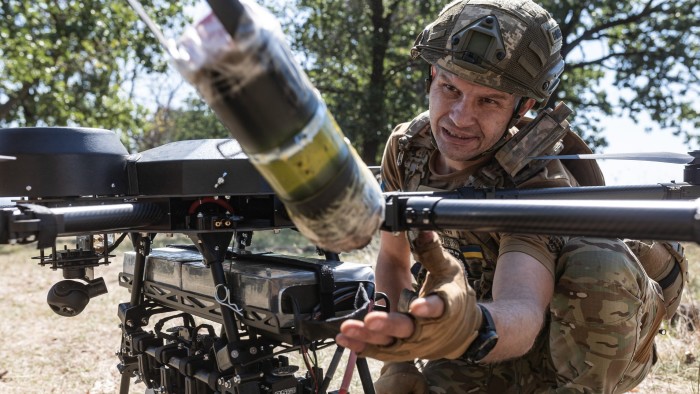
The Linza is a small multipurpose drone that has been used by Ukrainian forces to deliver goods to the front line, from water and cigarettes for soldiers to small bombs that can be dropped on Russian targets.
Frontline currently produces a few hundred a month, but it aims to manufacture at mass scale in a bid to replace Chinese-made drones, such as the DJI Mavic, which has become a battlefield workhorse for the Ukrainian military.
Mykyta Rozhkov, the company’s chief marketing officer, said the facility in Germany would enable the company to produce “on safe ground” far away from the risk of attacks by Russian drones or ballistic missiles.
After the first 10,000 drones, the two companies will have the right to sell any excess drones not needed by Kyiv to other western militaries.
Matthias Lehna, a Quantum executive who will become head of the new joint venture, said the company was already in discussions with the German armed forces about the possibility of supplying them with the jointly made product.
“If we exceed the demand from Ukraine, we believe that this will also be available for other end users,” he said.
Rozhkov said that producing drones for European armed forces would help fund research and development as Ukrainian companies race to keep up with the furious pace of innovation on the battlefield. It would also help finance the expansion of domestic production.
The company would also benefit, he said, from drawing on German expertise in industrial manufacturing as well as building a European supply chain. The company buys many of its components from China due to their low cost and rapid delivery, but is eager to reduce its reliance given Beijing’s support for Russian President Vladimir Putin and his war effort.
“It will give us a new perspective on our manufacturing processes and allow us to implement the German experience of production in automation and scaling production that will ultimately make our products better,” Rozhkov said.
Although both companies said the cost of production in Germany was expected initially to be slightly higher than in Ukraine, they aimed to use mass production and automation to offer a competitive price.
Some other Ukrainian companies have begun exploring similar tie-ups outside their home country. MITS Capital, a defence technology investor, is seeking to set up a joint venture in Denmark with three Ukrainian defence players: Tencore, a maker of ground drones, Infozahyst, a signals intelligence company, and Unwave, which makes equipment for electronic warfare.
Read the full article here