


Decentralized GPU networks are pitching themselves as a lower-cost layer for running AI workloads, while training the latest models remains concentrated inside hyperscale data centers.
Frontier AI training involves building the largest and most advanced systems, a process that requires thousands of GPUs to operate in tight synchronization.
That level of coordination makes decentralized networks impractical for top-end AI training, where internet latency and reliability cannot match the tightly coupled hardware in centralized data centers.
Most AI workloads in production do not resemble large-scale model training, opening space for decentralized networks to handle inference and everyday tasks.
“What we are beginning to see is that many open-source and other models are becoming compact enough and sufficiently optimized to run very efficiently on consumer GPUs,” Mitch Liu, co-founder and CEO of Theta Network, told Cointelegraph. “This is creating a shift toward open-source, more efficient models and more economical processing approaches.”
From frontier AI training to everyday inference
Frontier training is concentrated among a few hyperscale operators, as running large training jobs is expensive and complex. The latest AI hardware, like Nvidia’s Vera Rubin, is designed to optimize performance inside integrated data center environments.
“You can think of frontier AI model training like building a skyscraper,” Nökkvi Dan Ellidason, CEO of infrastructure company Ovia Systems (formerly Gaimin), told Cointelegraph. “In a centralized data center, all the workers are on the same scaffold, passing bricks by hand.”
That level of integration leaves little room for the loose coordination and variable latency typical of distributed networks.
“To build the same skyscraper [in a decentralized network], they have to mail each brick to one another over the open internet, which is highly inefficient,” Ellidason continued.

Meta trained its Llama 4 AI model using a cluster of more than 100,000 Nvidia H100 GPUs. OpenAI does not disclose the size of the GPU clusters used to train its models, but infrastructure lead Anuj Saharan said GPT-5 was launched with support from more than 200,000 GPUs, without specifying how much of that capacity was used for training versus inference or other workloads.
Inference refers to running trained models to generate responses for users and applications. Ellidason said the AI market has reached an “inference tipping point.” While training dominated GPU demand as recently as 2024, he estimated that as much as 70% of demand is driven by inference, agents and prediction workloads in 2026.
“This has turned compute from a research cost into a continuous, scaling utility cost,” Ellidason said. “Thus, the demand multiplier through internal loops makes decentralized computing a viable option in the hybrid compute conversation.”
Related: Why crypto’s infrastructure hasn’t caught up with its ideals
Where decentralized GPU networks actually fit
Decentralized GPU networks are best suited to workloads that can be split, routed and executed independently, without requiring constant synchronization between machines.
“Inference is the volume business, and it scales with every deployed model and agent loop,” Evgeny Ponomarev, co-founder of decentralized computing platform Fluence, told Cointelegraph. “That is where cost, elasticity and geographic spread matter more than perfect interconnects.”
In practice, that makes decentralized and gaming-grade GPUs in consumer environments a better fit for production workloads that prioritize throughput and flexibility over tight coordination.
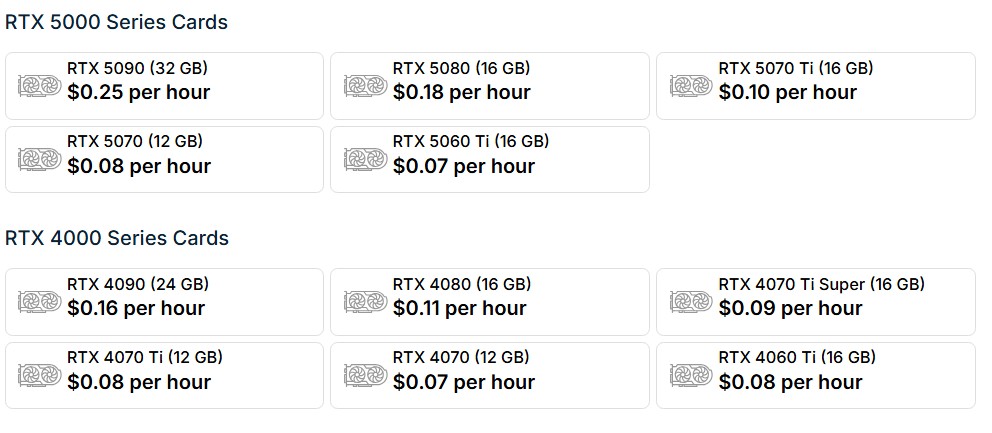
“Consumer GPUs, with lower VRAM and home internet connections, do not make sense for training or workloads that are highly sensitive to latency,” Bob Miles, CEO of Salad Technologies — an aggregator for idle consumer GPUs — told Cointelegraph.
“Today, they are more suited to AI drug discovery, text-to-image/video and large scale data processing pipelines — any workload that is cost sensitive, consumer GPUs excel on price performance.”
Decentralized GPU networks are also well-suited to tasks such as collecting, cleaning and preparing data for model training. Such tasks often require broad access to the open web and can be run in parallel without tight coordination.
This type of work is difficult to run efficiently inside hyperscale data centers without extensive proxy infrastructure, Miles said.
When serving users all around the world, a decentralized model can have a geographic advantage, as it can reduce the distances requests have to travel and multiple network hops before reaching a data center, which can increase latency.
“In a decentralized model, GPUs are distributed across many locations globally, often much closer to end users. As a result, the latency between the user and the GPU can be significantly lower compared to routing traffic to a centralized data center,” said Liu of Theta Network.
Theta Network is facing a lawsuit filed in Los Angeles in December 2025 by two former employees alleging fraud and token manipulation. Liu said he could not comment on the matter because it is pending litigation. Theta has previously denied the allegations.
Related: How AI crypto trading will make and break human roles
A complementary layer in AI computing
Frontier AI training will remain centralized for the foreseeable future, but AI computing is shifting away to inference, agents and production workloads that require looser coordination. Those workloads reward cost efficiency, geographic distribution and elasticity.
“This cycle has seen the rise of many open-source models that are not at the scale of systems like ChatGPT, but are still capable enough to run on personal computers equipped with GPUs such as the RTX 4090 or 5090,” Liu’s co-founder and Theta tech chief Jieyi Long, told Cointelegraph.
With that level of hardware, users can run diffusion models, 3D reconstruction models and other meaningful workloads locally, creating an opportunity for retail users to share their GPU resources, according to Long.
Decentralized GPU networks are not a replacement for hyperscalers, but they are becoming a complementary layer.
As consumer hardware grows more capable and open-source models become more efficient, a widening class of AI tasks can move outside centralized data centers, allowing decentralized models to fit in the AI stack.
Magazine: 6 weirdest devices people have used to mine Bitcoin and crypto
Read the full article here