

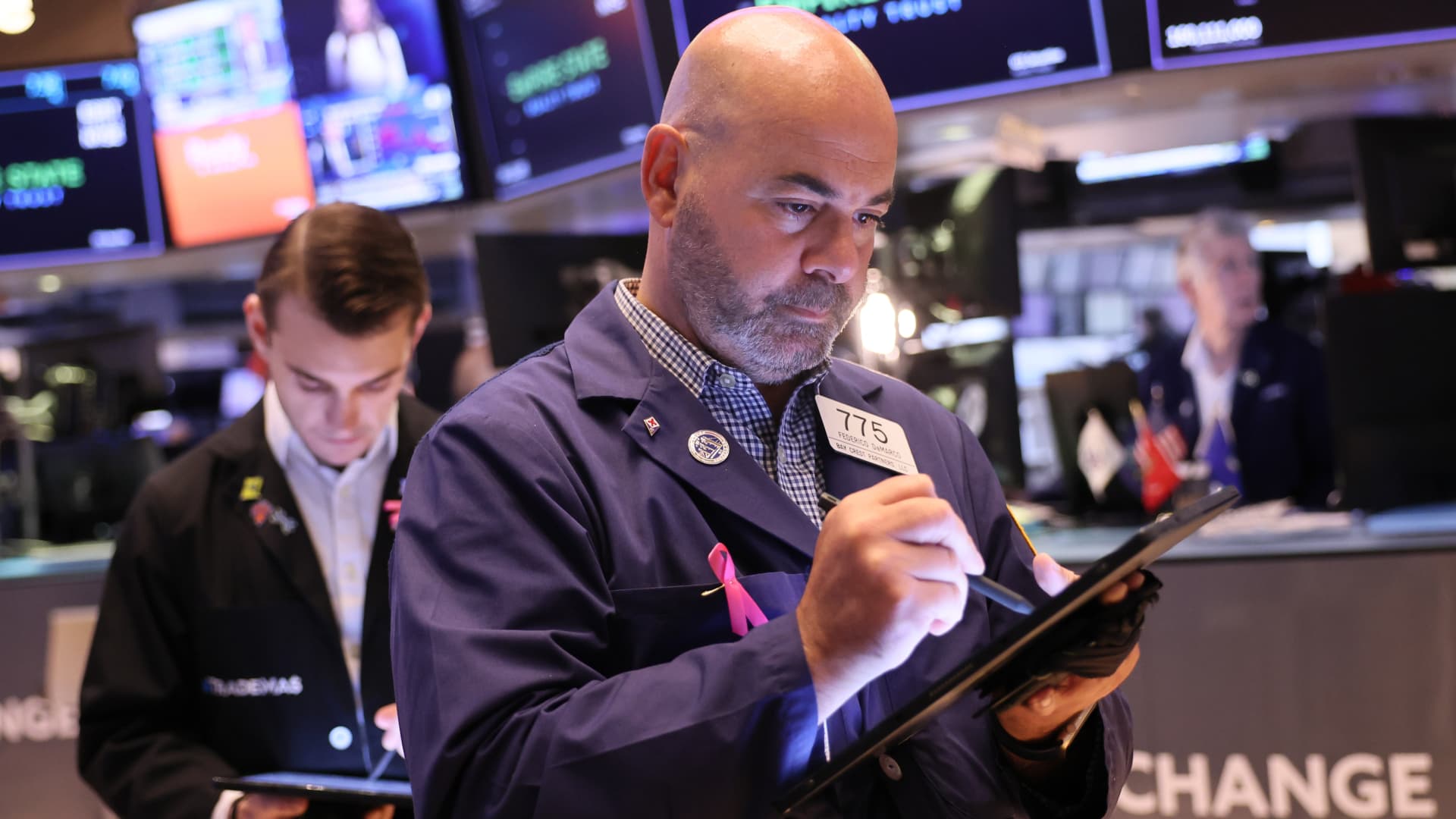
Traders work on the floor of the New York Stock Exchange during morning trading on October 04, 2023 in New York City.
Michael M. Santiago | Getty Images
The S&P 500 ticked up Wednesday as Treasury yields pulled back from multiyear highs following the release of much weaker-than-expected jobs data.
The broad market index added 0.3%. The Dow Jones Industrial Average traded near the flatline, while the Nasdaq Composite advanced 0.8%.
Consumer discretionary was the best-performing sector, rising more than 1%. Tesla and Norwegian Cruise Lines led the sector gains, adding 4% and 2.9%, respectively.
Energy was the S&P 500’s worst-performing sector Wednesday. Phillips 66 and APA declined more than 4%, while Marathon Petroleum and Valero Energy all dropped at least 3% as crude prices fell.
Wednesday’s moves follow the release of new jobs data. ADP said 89,000 private payrolls were added last month. That’s well below a Dow Jones forecast of 160,000 and fewer than an upwardly revised 180,000 payroll additions from August.
Treasury yields pulled back slightly from their 2007-level highs on the data. The 10-year Treasury yield was last trading at 4.745%.
“Anytime you have big momentum in one direction, there’s going to be days where you get a little bit of reprieve and in this case, you get a reprieve in rates and equities. The broader trend is really the downside from here,” said Ross Mayfield, investment strategy analyst at Baird.
Higher interest rates have increased fears of a recession and have pushed mortgage rates near 8%. Consequently, mortgage demand fell to its lowest levels since 1996.
“The market is being dragged around by interest rates,” said Harris Financial Group managing partner Jamie Cox. “[We’re] seeing a divergence — a big difference — between fixed income and equities,” Cox added.
Investors remain on edge and are looking toward Friday’s release of September’s nonfarm payrolls data for more indications on the strength of the labor market.
The data comes on the back of a losing session on Wall Street after job openings data indicated the labor market is still strong and bond yields marched higher. The Dow notched its worst session since March and turned negative for the year. The S&P 500 is now down 8% from its July high, nearing a 10% drop, which is the official definition of a correction.
“I don’t think you get a broader [rally] participation until rates ease up, and that’s only if rates ease without some sort of financial crisis or hard landing recession,” Mayfield said. “Every day that we’re this high on rates [and] every basis point deeper into restrictive territory, probably reduces the odds of a soft landing in 2024.”
Read the full article here