

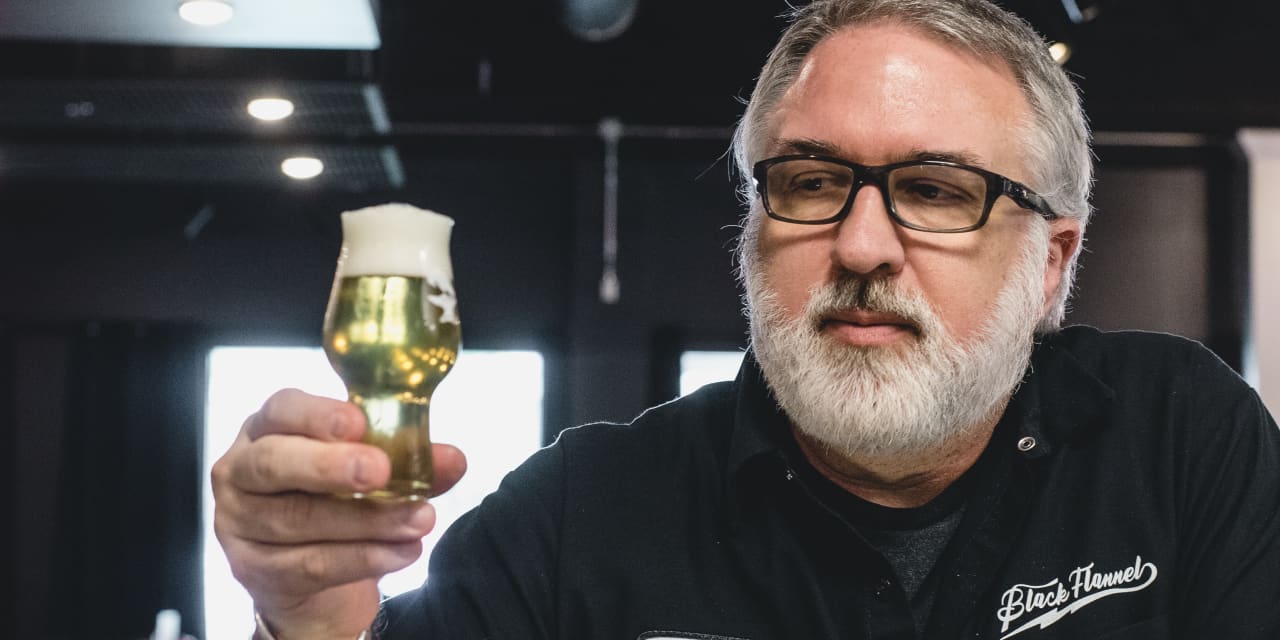
Chris Kesler wears many hats at Black Flannel. The company he founded is one part brewery, one part small-batch distillery, and one part James Beard-nominated restaurant.
Like the eclectic mix of Black Flannel, Kesler is many things too: he’s chief brewer, an advanced cicerone, and head of research and development of his Essex, Vt., operation.
MORE: Through Tragedy, This Tennessee Getaway Has Become a Celebrity Magnet
His distilling preferences are wonky, sometimes unconventional—lifted from 200-year-old treatises—and others unheard of. When he’s not nerding out on drink-making, he’s figuring out ways to make his facility more eco-friendly—nonprofit Efficiency Vermont named Black Flannel the greenest brewery in the Green Mountain State—and, as a lead educator, he’s writing spirits 101 courses held at the brewery, culinary craft cocktail classes, or weeklong intensives on the business of craft distilling.
Kesler spoke to Penta on everything from Black Flannel’s white beet spirit, the beauty of absinthe, and the beer and spirit styles that most Americans have never heard of.
Penta: What inspired you to brew or distill your first drink?
Chris Kesler: I was a craft beer and craft spirits fan long before developing a desire to make them. My wife, Deb, first gave me a home-brew kit, but it wasn’t until almost a year later—the month I turned 50—that I finally decided to take the plunge.
The resulting Pale Ale was good, but it sparked something I hadn’t felt with any other “hobby” before. I became obsessed and after brewing about 50 batches in as many weeks, I entered my first home-brew competition. My New England IPA called Disco Montage was judged as top 2 in a competition that included a few hundred entries, and I was able to brew it at 14th Star Brewing Company for a statewide, one-time distribution. That experience sparked the next level of interest: to become a professional brewer.
Were you distilling at the time, too?
Parallel to brewing, I developed an interest in distilling since both use similar equipment in their production. However, home distilling is illegal. But I was able to practice the mechanics of distilling by purchasing a column for my 10 gallon electric water boiler and made essential oils. I met up with two distillers [who are now Black Flannel’s spiritmaster, Dave Mosher, and head of distilling, Travis Johnson] and they worked with me on R&D. After producing some truly amazing R&D batches of American Whiskeys, Genever, Agave Spirit, and other brandies using fruits and vegetables, we decided to open Black Flannel on July 1, 2020.
Why divide your attention between spirits and beer?
When you produce spirits, there is part of the process that is identical and uses similar equipment as beer production. When we planned our facility, because of redundancy, we didn’t need to purchase as much equipment as each individual entity would have to on its own.
Since we have both the brewery and distillery in close proximity, we are able to mash grains and take multiple runnings of sugary liquid. The first runnings contain the highest concentration of sugars, which gets fermented with whiskey yeast, and distilled into a spirit. In some cases, we’ll use that same grain and rinse it again to extract the remaining sugars to be brewed into a low alcohol beer. The process of making more than one product from the same batch of grain is known as Parti-gyle, a process created and used in traditional brew houses in the U.K. From our awareness, we are the only brewery and distillery combination in the U.S. that uses a Parti-gyle to produce both a spirit and a beer from the same grain.
Besides unique processes, you also distill some delicious, but peculiar spirits. How did you come up with the idea for a white beet spirit?
Our Spiritmaster Dave Mosher created it when he was experimenting with vegetables as a substrate, like sweet potatoes and butternut squash. A friend of his, who is a local Vermont farmer, mistakenly grew white beets one summer and he didn’t want them. Dave sampled a bite and was overwhelmed with how sweet they were. He thought, “I could ferment a mash of these.” He did … and the result blew people away. We’ve been making it from seed to glass ever since.
Why invest in Absinthe when there’s a stigma around the drink in the United States and no great demand?
I developed an interest in Absinthe about 20 years ago when it was still illegal in the U.S. In my travels, I was able to try a number of Absinthes produced across Europe, and more recently, a few quality versions produced in the United States.
Much like Cannabis was demonized for most of the past century, Absinthe was banned in parts of Europe and the United States for almost 100 years. For decades, most people thought that consuming Absinthe could lead to major health issues. Testing showed that a key ingredient in Absinthe—Wormwood—contained a neurotoxin called thujone. The truth is the herb sage contains a higher concentration of thujone and there is more damage done to your body from fluoride in common household toothpastes. Regardless, Wormwood is what the wine industry latched onto in the push to make Absinthe illegal in 1910 saying it drove normal people insane. Until that point, Absinthe sales had surpassed wine, (hence the wine industry’s push to make it illegal).
What history inspired your specific Absinthe recipe and process?
While doing a deep dive into research on production and manufacturing techniques for Absinthe, I came across a text written by French chemist Pierre Duplais. His Traité de la Fabrication des Liqueurs et de la Distillation des Alcools is the authoritative French distillation guide. It went through seven editions from 1855 to 1900 and is the basis of understanding of 19th-century French distillation techniques.
MORE: Meet the Woman Taking the ‘Blood Sport’ out of Buying a Coveted Hermès Birkin Bag
I found a translated English edition published in Philadelphia in 1871. There is a special section on Absinthe, which is the most accurate and comprehensive guide to the recipes and techniques used by late-19th-century Absinthe distillers, and is informally regarded as the “bible” of those seeking to duplicate their recipes today. From the recipes and techniques described in this section, I took my favorite aspects and scaled a small R&D batch. The results were beyond my wildest expectations. We anticipated the need to try a dozen or more R&D batches to get the formula right, but found we absolutely loved the results of our first try.
What drinks are you experimenting with now?
Our most recent development in the distillery is a line of ready to drink canned cocktails like T-Thyme [made with vodka, a thyme-infused black tea, lemon, and simple syrup] and Cool Hand Cuke [gin with cold-pressed cucumbers, mint, lime, and simple syrup].
We also have a number of wild fermentation beers aging in barrels delivering unique American Sour offerings, and a Solera project where we package off one-third to one-half of a seven-barrel fermenter and add fresh wort, allowing the existing yeast and other microbes to develop new and complex flavor characteristics.
This interview was edited for length and clarity.
Read the full article here