

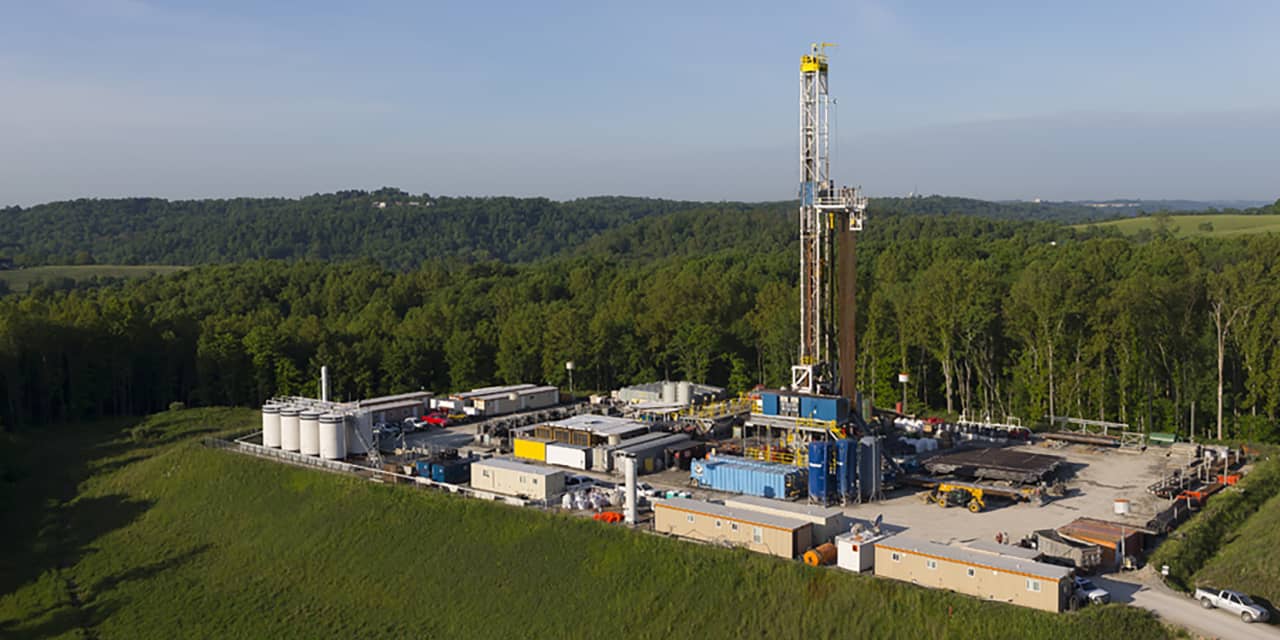
Take the combination of two inexpensive natural-gas stocks, logical cost savings, and the probability of rising commodity prices, and you have a deal that’s well worth a look.
That would be the merger of
Chesapeake Energy
and
Southwestern Energy,
which agreed earlier this month to combine in an all-stock deal. Southwestern shareholders will receive 0.0867 Chesapeake share for each Southwestern share they hold and own about 40% of the postmerger company. Chesapeake’s recent $77 per share price implies a market value of about $17 billion for the combined company, making it the largest U.S. natural-gas-focused company by market value.
Chesapeake’s stock has slid 2% since the deal was first speculated about in the press on Jan. 5, amid volatility in natural-gas prices. The merger, though, makes a lot of sense. By combining acreage and facilities, Chesapeake and Southwestern will gain greater efficiencies and scale, reducing costs. The resulting company should also have a sounder balance sheet as it pays down debt over time. Higher natural-gas prices in a few years add to the potential upside. And as a pure play, the new Chesapeake/Southwestern will have an element of scarcity value for investors seeking targeted natural-gas exposure in a large-cap stock that could eventually find itself in the
S&P 500
index.
“The benefits of this deal go beyond just synergies,” says Jefferies analyst Lloyd Byrne, who has a Buy rating and $120 price target on Chesapeake stock, up 55%. “Generalist investors with interest in natural gas as a long-term investment theme should naturally be looking at Chesapeake/Southwestern.”
Make no mistake: A bet on Chesapeake hinges on whether natural gas remains relevant for the foreseeable future. For all of the momentum toward a greener energy system—U.S. electricity generation from solar and wind increased more than threefold from 2012 to 2022, according to the Energy Information Administration—natural-gas power has climbed 38%, to become the largest source of electricity generation in the U.S. Even in California, which has among the most aggressive decarbonization targets in the country, three natural-gas power plants that were originally slated to close in 2020 will instead operate until at least 2026, officials said last year. Others will remain in service even longer.
It’s not just a U.S. phenomenon. India’s government wants to nearly triple electricity production from natural gas by 2030. China, the world’s largest energy consumer, is increasing its use of natural gas as it shifts away from coal. Europe continues to rely on natural gas as it makes its green transition. Natural gas will remain essential, even as oil and coal fade away.
“People mistakenly treat the terminal-value risk for fossil fuels all the same,” says Mark Viviano, a portfolio manager at energy-focused investment firm Kimmeridge. “Natural-gas [demand should be around] longer than oil, which should mean that natural-gas stocks will trade at a premium versus oil stocks over time.”
Much of the growth in demand in the U.S. will come from exporting more liquefied natural gas, or LNG, which can be transported on ships, rather than via a pipeline. It’s increasingly a geopolitical imperative for the U.S. to help reduce its European allies’ reliance on Russian energy.
The challenge is getting North American–produced natural gas across the pond. Though the Biden administration just delayed approval of all new LNG export terminals over climate concerns, other projects are already under way, and national security and economic considerations should win out. The EIA expects U.S. LNG export capacity to double by 2027, to about 21.1 billion cubic feet per day, or bcf/d, including five new projects. That’s about 17% of the average total U.S. production of about 125 bcf/d in 2023.
Increasing demand is unlikely to be matched by increased supply. Futures markets are pricing in meaningfully higher natural-gas prices in the next few years. The current, or spot, price of U.S. natural gas was recently about $2.60 per million British thermal units, or MMBtu. Compare that to the December 2024 futures price of $3.60 per MMBtu. The European natural-gas price is four times the U.S. price.
“You’ll still have plenty of [weather driven] volatility in the short term, but the long term, when adding that LNG [export] demand, is for a higher natural-gas price,” says Jefferies’ Byrne.
That is good news for Chesapeake. Once the standard-bearer of the U.S. shale revolution under co-founder and CEO Aubrey McClendon, the Oklahoma-based natural-gas producer has come a long way since filing for bankruptcy in 2020, when the pandemic caused natural-gas prices to plummet and cash flow dried up. Since returning to public markets with a new balance sheet and management team, Chesapeake has overhauled and streamlined its portfolio to focus on the U.S.’s most attractive gas-producing areas. The company has sent billions of dollars back to shareholders in dividends and buybacks and has minimal net debt on its balance sheet. It’s a transition that mirrors what has happened across the energy sector.
“The focus has gone from very, very high-growth targets to a greater emphasis on free-cash-flow generation, better balance sheets, and more shareholder-friendly management teams,” says David Giroux, chief investment officer of T. Rowe Price Investment Management.
Chesapeake/Southwestern will be even stronger. The yet-to-be-named combined company will control 1.2 million acres in Appalachia’s Marcellus shale patch and 650,000 acres in the Haynesville shale, which straddles Louisiana, East Texas, and a corner of Arkansas. There’s considerable overlap: Many of Southwestern’s current assets were owned by Chesapeake a decade ago. Contiguous acreage and greater scale should lead to lower operating costs for the new company as procurement and transport costs fall. Capital expenditure spending should become more productive by being able to place wells more efficiently and drill laterally longer. Management is targeting $400 million a year in annual cost savings by 2026—an estimate that several analysts see as conservative.
“The two companies combined will have the best ability to deliver natural gas to markets where it’s needed most, at the best possible cost structure,” says Chesapeake CEO Nick Dell’Osso Jr., who will lead the company after the merger closes.
The new company will be the U.S.’s largest independent natural-gas producer. Chesapeake/Southwestern extracted at a combined rate of 7.3 bcf/d in the third quarter of 2023, more than current independent leader
EQT’s
5.7 bcf/d, and closer to
Chevron
and
Exxon Mobil,
which produced 7.9 and 7.7 bcf/d, respectively, mostly from gas captured as a byproduct of oil extraction. The new company plans to export about 20% of its production to higher-price international markets.
What’s more, it should be big enough to join the S&P 500, adding index-fund demand and putting it in the investible universe of generalist large-cap investors. Management expects to pay down enough debt to earn an investment-grade credit rating within a year of closing the deal, even as it maintains its variable dividend policy postmerger, consisting of an annual base dividend of $2.30 per share, paid quarterly, plus 50% of the previous quarter’s free cash flow. Buybacks should resume once debt comes down.
The result may be a higher valuation multiple for the stock, says Giroux, a member of the Barron’s Roundtable and manager of the
T. Rowe Price Capital Appreciation
fund, which is among the largest holders of Chesapeake stock. EQT, with a market value of about $15 billion, trades for a multiple of about 5.5 times its enterprise value to expected earnings before interest, taxes, depreciation, and amortization, or Ebitda, over the coming year—about a point higher than Chesapeake or Southwestern today. Closing that valuation gap alone could mean 20% of upside for the combined company. And that’s before merger synergies or higher natural-gas prices boost earnings.
That combination of a low valuation today and the potential for higher gas prices tomorrow should be all that investors need to take a look at Chesapeake now, says Kimmeridge’s Viviano. “That’s a pretty powerful combination that you don’t normally get,” he says. “It’s a unique opportunity.”
One that shouldn’t be missed.
Write to Nicholas Jasinski at [email protected]
Read the full article here