

The humanitarian and financial toll of war is high, so it’s little wonder that geopolitical tensions abound on the list of investor concerns in 2024. Yet the cruise industry appears to be navigating the situation well.
From the upcoming U.S. presidential election to the wars in Ukraine and the Middle East, and escalating saber rattling out of Beijing about Taiwan, there’s no shortage of worries about conflict and unrest around the world.
That would seem a particularly pressing concern for the cruise industry, given that it needs peaceful waters to sail around the globe. These headwinds are still being overshadowed by robust demand, however, to judge by recent industry updates.
To wit, the Red Sea has seen increasing violence and a blockade in recent weeks, that’s upended sailing routes for shipping as well as cruising. Nonetheless, the impact to big cruise lines so far seems relatively contained.
In mid-January
Royal Caribbean
said it was closely monitoring the situation, and had thus far canceled two voyages. On Tuesday,
Carnival
said a dozen of its ships were rerouted due to the Red Sea conflict, a move that will ultimately knock off seven cents to eight cents from full-year earnings per share.
Yet both stocks were rising on Wednesday, along with that of
Norwegian Cruise Line Holdings.
Collectively, the companies are the Big Three of the industry.
That could be due to the fact that the impact of the Red Sea violence appears fairly limited: Carnival is expected to earn nearly a dollar a share for 2024 as a whole. In addition, as William Blair analyst Sharon Zackfia notes, the company hasn’t seen the region’s troubles impact booking trends, and it doesn’t have any other itineraries scheduled for the Red Sea until November.
In fact, investors are far more heartened by the fact that in Tuesday’s update, Carnival also said the start of wave season (the peak booking period for cruises) was already coming in well ahead of expectations, with bookings volumes since November hitting an all-time high.
That gives management confidence that “the healthy momentum in the business and the expected outperformance to offset the impact of the rerouting of ship itineraries through the Red Sea,” writes Zackfia. She reiterated an Outperform rating on the shares, bolstered by her expectation that the company can log an increase in adjusted earnings before interest, taxes, depreciation, and amortization, or Ebitda, of nearly 50% over the next two years.
The situation looks similar at Royal Caribbean, which has stated that only 1.5% of its business has exposure to the region. Truist Securities analyst C. Patrick Scholes met with senior management after the company’s midmonth update, and noted that they said there had been “no impact to bookings in the Eastern Mediterranean from recent incidents in the Red Sea.”
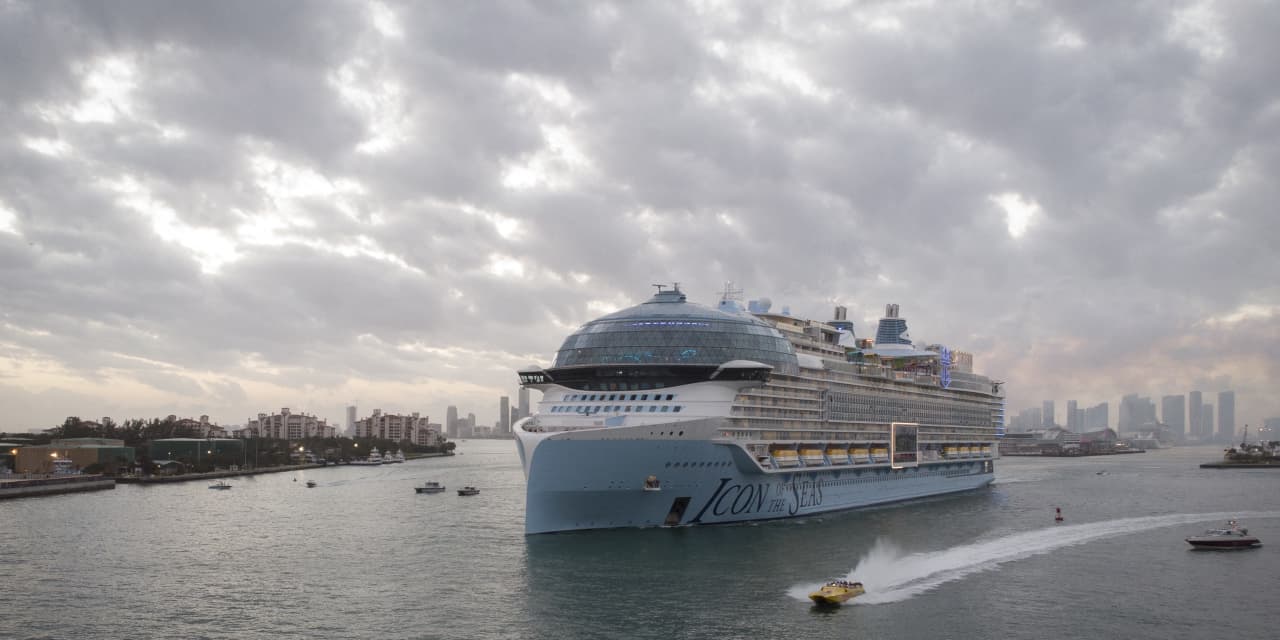
He reiterated that Royal Caribbean is his favorite cruise stock, which is seeing a lot of positive attention around its rollout of the world’s largest cruise ship. “We see this buzz providing a positive halo for the entire industry during Wave Season,” he writes.
Investors will get more detail on Royal Caribbean’s booking trends when the company reports results on Thursday. Norwegian’s earnings are expected in late February, followed by Carnival in March.
Of course, there is the chance that an increase or expansion of violence in the region will become a larger problem for cruise operators. Wells Fargo analyst Daniel Politzer noted earlier this week that his survey with 44 travel agents revealed that “geopolitics is having an impact and some customers are canceling last minute, even forfeiting deposits.”
Still, that doesn’t negate the fact that nearly everything else appears to be going well for the industry. “Our survey work shows cruise demand remains stable at an elevated level, with no major change in the overall outlook,” he writes.
By other metrics, Carnival and Norwegian look ripe for further gains—potentially big ones—in 2024.
In the end, cruises are benefiting from consumers’ ongoing desire to travel. Increasing worries about all that could go wrong on the world stage may make some people feel they need to get away from it all even more urgently.
Write to Teresa Rivas at [email protected]
Read the full article here