

The tiny region of Cornas sits at the southern tip of the Northern Rhône Valley in France and is home to some of the most weighty, structured, and delicious wines in the world. Producers such as Auguste Clape, Thierry Allamand, and Jean-Luc Colombo have long raised the profile of this Syrah-only appellation, yet it often plays the underdog for collectors to its better-known cousins, Hermitage and Côte Rôtie.
That’s partly because the wines, from grapes grown in a slightly warmer climate of the north, can be meatier and denser, tougher to love. But their profile has changed markedly in recent years as fresher, more nuanced, but still substantial, Cornas wines are produced. Among the best at evoking Syrah’s layered flavors, textures, and potential freshness is Domaine Alain Voge, which bottles four Cornas wines from its nearly 20 acres of vineyards, including two single-vineyard wines that are only produced in stellar years.
Though small, Cornas is home to several winemakers and the terroir—the soil, topography, and sun exposure that exists from the bottom to the top of the region’s three amphitheater-shaped slopes—can differ.
“We have an identity, but we have a lot of diversity inside [it],” says Lionel Fraisse, general manager of Alain Voge..
The region is about 345 acres in all—slightly bigger in size than Hermitage, a 20-minute drive north, but less than half the size of Côte Rôtie, an hour up the Rhône valley—with steep, granite slopes rising up about a quarter of mile from the narrow streets of the village.
On an unusually hot day in October, Fraisse, 56, stands among the vines that are a brief walk from Alain Voge’s winery in the center of town, gesturing up the east-facing slope as he talks about the distinct terrain, the history of Cornas, and the critical role of the late producer Alain Voge within it. Grasses grow at the bottom of the slope between rows of vines averaging 50 years of age, already picked clean for the season from land certified organic and biodynamic since 2016.
Voge, who died at age 81 in 2020, had grown up as the son of a winegrower and fruit merchant, who began to focus only on the vines shortly after his father died in the mid-1960s. In the early 1970s and again in the mid-1980s, he and some (but not all) fellow growers and winemakers fought for preserving and protecting the vineyards against urban development.
Fraisse’s uncle Robert Fraisse, a lifelong best friend of Voge’s, grew white Marsanne grapes in neighboring Saint-Péray, and the families were close. Voge became a tenant farmer of the Fraisse estate in the mid-1990s, eventually creating the wine Fleur de Crussol from vines on the property that are an average of 80 years old—the oldest within the Saint-Péray appellation. The wine’s name comes from the limestone mountain range Crussol, and the beautiful, crumbling limestone Château de Crussol, situated opposite the slope where the vines grow.
The wines of Saint-Péray have had an even more difficult time gaining widespread notice, but Alain Voge makes three fascinating still wines from the low-acid Marsanne grape, which are opulent but full of freshness, wines that go great with food. The winery also makes a 100% Marsanne sparkling wine in the traditional Champagne method from the region, with no added sugar.
Though Fraisse grew up in Saint-Péray, and worked with his uncle, the vineyards didn’t hold much opportunity when he was young. Instead, he became a printer at a high school in Paris. In 2011, when he was 45, “we can say the middle-aged crisis took me back,” Fraisse says.
Before Voge would take him on, Fraisse had to learn vineyard management and wine making at a college, and to apprentice for two years at the winery. He eventually worked under managing director Albéric Mazoyer, who had begun the winery’s shift to organic agriculture in 2006. Fraisse stepped into Mazoyer’s role when he retired.
Today, Alain Voge produces 90,000 bottles from 20 acres in Cornas and another 10 in Saint-Péray, on land mostly owned by Fraisse’s family. The winery also produces a wine from Saint-Joseph, a Syrah appellation that stretches 60 kilometers north along the Rhône river and a Côtes du Rhône made from wines purchased from organic vineyards close to Cornas. The winery business is owned by Alain’s daughter Nathalie Voge and M. Chapoutier, a respected producer based up the river in Tain l’Hermitage, with natural-yeast fermentation and production taking place in low-ceiled cellars right in the middle of town.
Alain Voge’s four Cornas wines include Les Chailles, which is made largely from grapes grown from the bottom of several slopes on vines averaging 50 years. The grapes are destemmed and macerated (soaked in grape juice) for three weeks in steel tanks before being aged 18 months in small, 228-liter barrels with no new oak, creating a fresh, perfumed, elegant style in the 2021 vintage (averaging about US$38 on Wine-Searcher).
Les Vieilles Vignes is the producer’s classic wine, created from vines that are up to 70 years old, also grown about 200 yards up several slopes. The grapes are macerated with about 20% in “whole cluster” form, stems and all, a technique that creates wine with a deeper color, lots of earthy flavors, and more structure, allowing it to age longer. The 2021 averages about US$56 on Wine-Searcher.
The winery also makes two single-vineyard Cornas wines that are produced “only when the identity we’re looking for is present,” Fraisse says.
Perhaps the most notable is Les Vieilles Fontaines, a full-bodied, age-worthy wine with hints of spice and classic earthy Cornas flavors in the 2020 vintage. Fontaines has been made selectively since 1988 from vines an average of 80 years old, fermented in, at most, 25% new oak barrels. The 2010 vintage flew off shelves after being awarded 100 points by the former wine critic Robert Parker, so the wine is only available on allocation. If you can find a 2016, a bottle is a relative bargain—perhaps owing to its underdog status—with a market price of about US$126, according to Liv-ex.
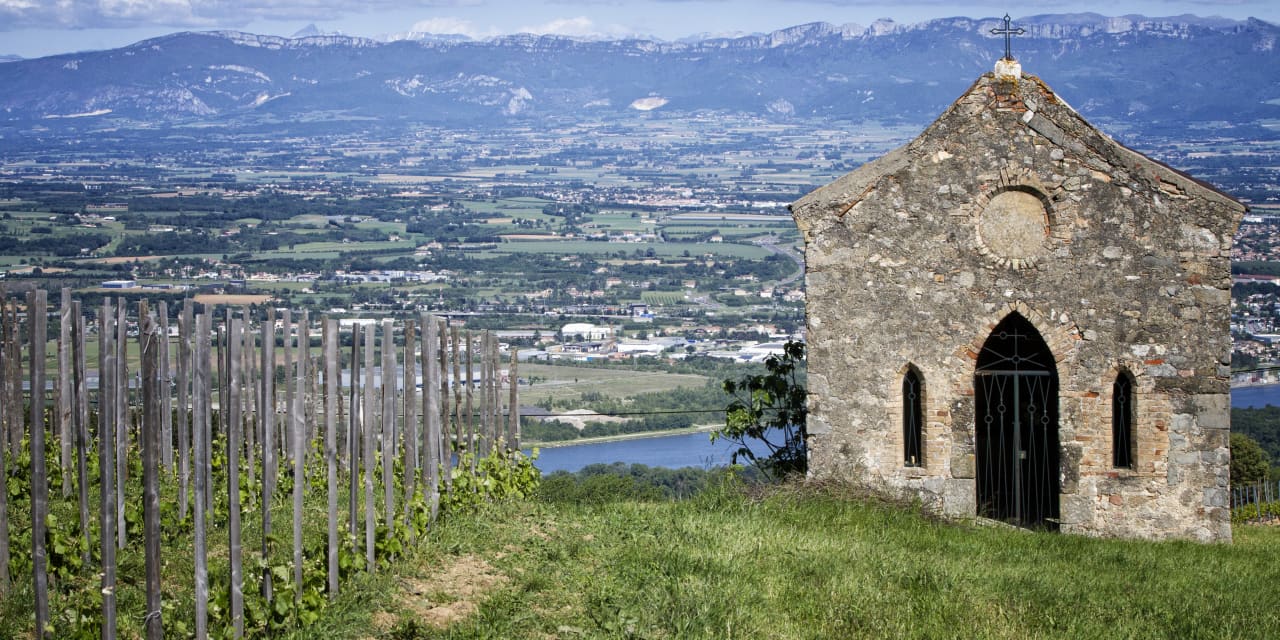
For Chapelle Saint-Pierre, a wine made from a vineyard near the chapel of Saint-Pierre-aux-Liens at the highest point in Cornas, a quarter mile up the slope, that identity is “freshness and finesse,” evident in the bright 2021 vintage (US$61 a bottle on Wine-Searcher)—only the third to be produced.
That freshness is achieved from the cooler heights of this vineyard, which was only designated in 2016. Voge had planted vines here in the 1990s, however, in pursuit of a brighter style, long before climate-change was the pressing concern it is today for the region’s winemakers. The vineyard exemplifies the diversity possible within the granite slopes of Cornas.
“This is really the Voge style pushed to the maximum—with freshness, freshness always,” Fraisse says.
Read the full article here