

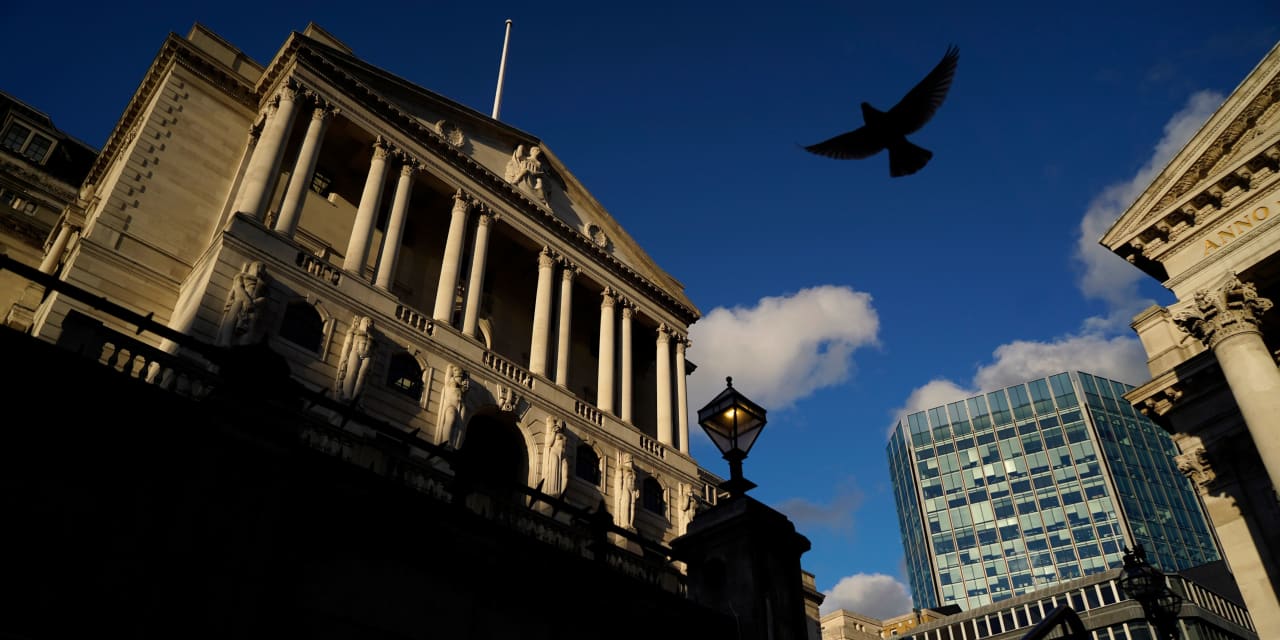
The European Central Bank and the Bank of England are expected to follow the same course as the Federal Reserve in keeping interest rates unchanged this month.
Both make their final decisions of the year on Thursday, and economists expect them to hold steady. The ECB will update its forecasts for inflation and growth, giving investors clues about when rates might change.
The ECB and the BOE have spent much of 2023 following in the wake of the Fed’s moves, lifting borrowing costs but not going quite as far as their U.S. counterpart. The question now is how their paths might diverge in 2024.
The U.S. economy looks stronger than Europe’s. U.K. output unexpectedly contracted in October, data showed Wednesday. Germany’s economy—the biggest among the 20 nations that use the euro—shrank in the third quarter, while France’s expanded by just 0.1%. By contrast, the U.S. economy grew at its fastest pace in nearly two years in the July-September period.
Inflation rates are dropping rapidly across all three economies, but to varying degrees. In the U.K., it stood at 4.6% in October—well above the 3.1% U.S. rate. In the euro zone, it’s 2.9%. The Fed, the ECB, and the BOE all share a similar goal of keeping inflation at around 2%.
“Despite the euro area and U.K. having weathered the economic storm thus far, ongoing weakness in the surveys continues to suggest mild and short recessions in both,” said George Buckley, an economist at Nomura. “We see the next moves being rate cuts in June 2024 for the ECB and August for the BOE,” though markets are pricing in earlier reductions.
At Wednesday’s decision, the Fed kept its options open. Chairman Jerome Powell said officials “believe that our policy rate is likely at or near its peak for this tightening cycle.” Its forecasts suggest three quarter-point rate reductions next year. Markets are pricing in the first Fed cut around May.
Write to Brian Swint at [email protected]
Read the full article here