

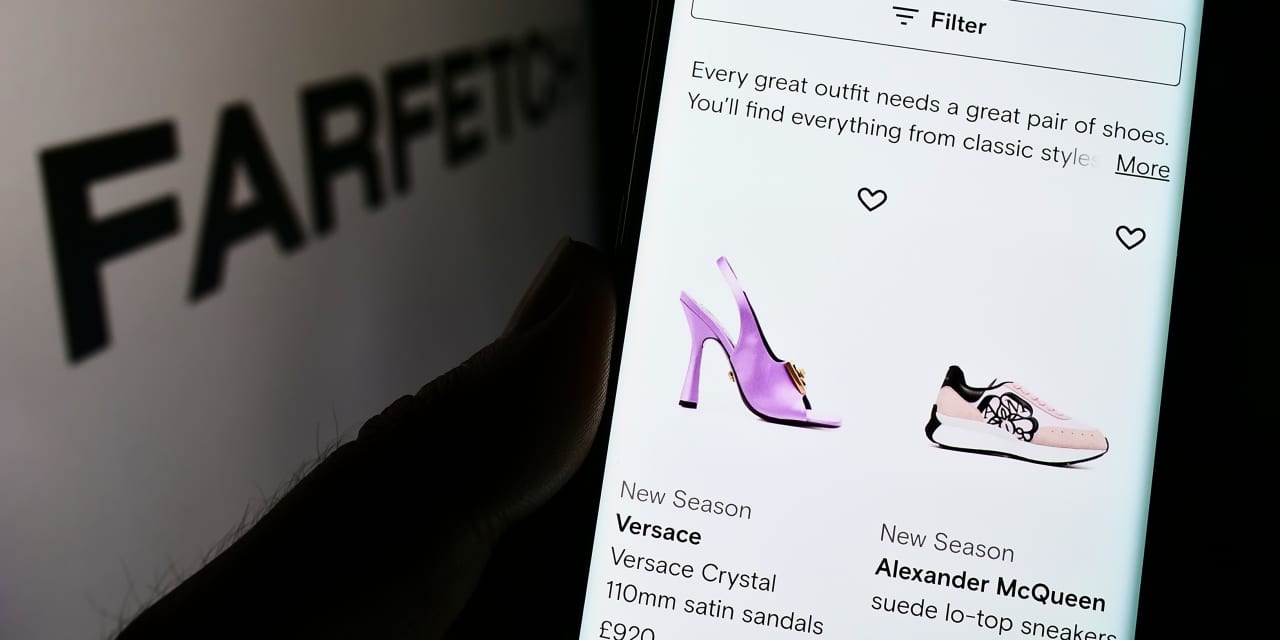
Farfetch
may specialize in luxury goods, but it’s been anything but luxurious for bondholders, who are simply trying not to get wiped out.
Farfetch is a global luxury fashion platform, launched in 2007 by Jose Neves, with customers in 190 countries and territories offering more than 3,500 brands from over 1,400 luxury sellers from the Farfetch Marketplace. It’s also set to sell its online luxury retailing platform to South Korean e-commerce company
Coupang
and wipe out its equity holders and $1 billion of convertible debt.
Now, an ad hoc group of bondholders, representing over 50% of Farfetch’s $400 million of convertible notes due in 2027, has retained Pallas Partners, a U.K-based law firm, and Ducera Partners, an investment bank, “to urgently evaluate options to protect its interests in the face of the value destruction that it believes will be effected should the Coupang sale go ahead,” according to a press release issued earlier Friday.
A Farfetch spokesman said the company had no comment on the bondholder statement Friday.
Based on the trading of Farfetch debt, the investment community isn’t optimistic that the group will succeed. The convertible debt is trading at 2 cents on the dollar. And Farfetch’s U.S.-listed equity is languishing at just 4 cents a share.
Despite the market pessimism, the bondholder group could succeed in getting a recovery that is considerably more than zero. The group could find allies in Richemont, the European luxury goods company, and
Alibaba Group Holding,
the Chinese e-commerce giant, which each hold half of a separate $600 million of convertible debt also issued by Farfetch. The two bond issues rank equally in the company’s capital structure.
Richemont said in late December after Farfetch announced the sale to Coupang that it’s “reasonable to expect” that the debt, which it had carried for about $235 million in November, or roughly 75 cents on the dollar, “will not be repaid.”
What gives room for hope? Farfetch has an attractive platform in which smaller luxury brands and leaders like Louis Vuitton, Versace, and Dolce and Gabbana sell their products. This is a company that had a market value of above $20 billion in 2021.
The company didn’t appear to be overleveraged on June 30, the date of its most recent financial statement. It had roughly $1.6 billion of debt and about $450 million in cash.
As recently as last August, when it reported second-quarter results, Farfetch sounded upbeat. It said 2023 was “set up to be a great year” and while not profitable in the first half, the company projected positive free cash flow for the year.
The company also highlighted its “strong liquidity,” and ”partnerships with leading luxury brands.” It said it expected to end 2023 with cash and equivalents of over $800 million.
Farfetch generated $1.1 billion of revenue in the first half of 2023. Its earnings before interest, taxes, depreciation, and amortization were negative $30 million in the second quarter—not great but also not terrible.
In August, the analyst consensus valued Farfetch at $3 billion (including debt and equity), according to the bondholder group.
Before its June quarterly results were announced in August, the company’s stock traded around $5 a share, valuing the business at $2 billion, and the public convertibles traded for 75 cents on the dollar.
The financial unraveling of the company came quickly.
On Nov. 28, it said it would not be reporting third-quarter results as scheduled on the following day and that “any prior forecasts or guidance should no longer be relied upon.”
Then on Dec. 18, it said it reached a deal with Coupang and investment firm, Greenoaks Capital Partners, to provide a $500 million bridge loan facility to the company and that Coupang planned to swap its bridge loan for the Farfetch business.
The company said it had completed a “thorough and extensive process to secure additional liquidity for Farfetch Limited and its subsidiaries. Without such liquidity, Farfetch Limited and its subsidiaries would have been unable to continue as a going concern.”
Under the plan, Farfetch said it “expects that holders of its Class A and B ordinary shares and its convertible notes will not recover any of their outstanding investments.”
The deal with Coupang had the support of investors who held 80% of Farfetch’s senior secured debt of $600 million.
There is a go-shop period during which Farfetch can explore other offers, but the bondholder group says the process makes it “unviable” for other investors to come forward with alternative proposals because any buyer would have to pay a $1 billion fee, according to the press release.
The bondholder group also complained that there was no “transparency or governance” in the sales process.
The bondholder may seek to determine Farfetch’s current business and financial situation including how much cash the company had on its balance sheet prior to the Coupang deal. The group probably will seek to find out if the company’s financial situation is as grim as it portrays.
One possibility is that Coupang agrees to pay more for Farfetch and enable some recovery value for the $1 billion of convertible bondholders. A recovery value of 30 to 40 cents on the dollar might be acceptable to the group.
The markets are putting a low likelihood of such a deal—or anything positive for the convertible bondholders—given the ultra-depressed price of the converts.
But a lot isn’t known about Farfetch’s financial condition. That creates the possibility that something good happens for the bondholders, and maybe even for the equity holders, relative to the wipeout that they now face.
Write to Andrew Bary at [email protected]
Read the full article here