

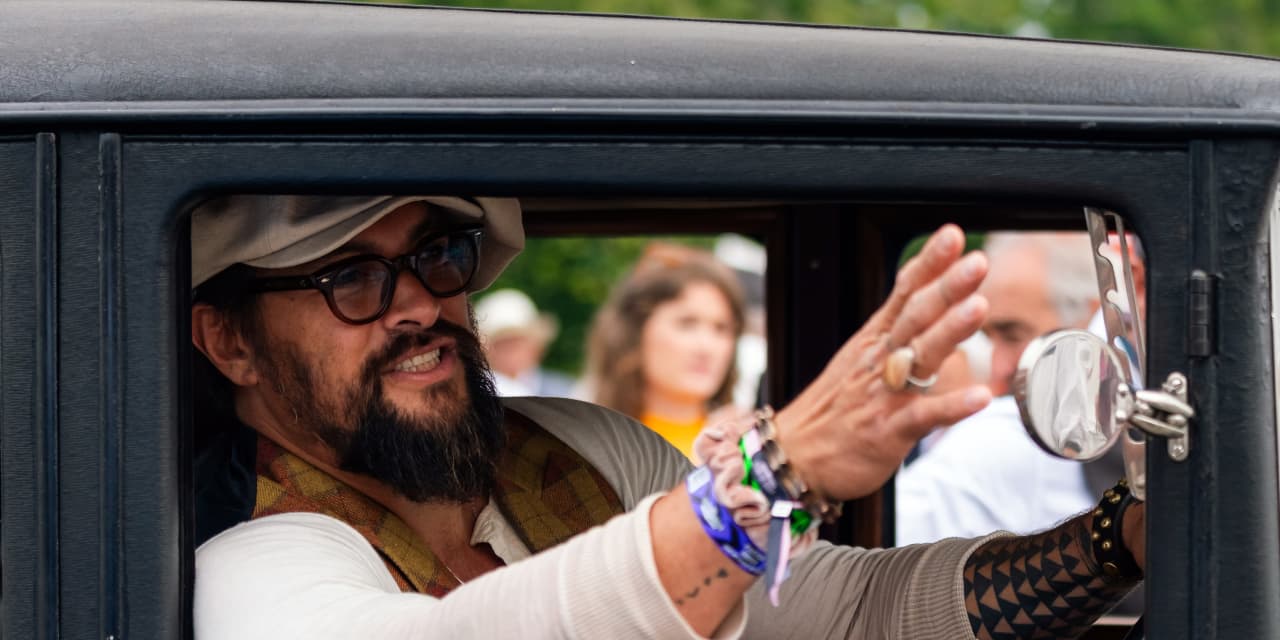
When he’s not appearing as the villain in the 10th Fast & Furious movie, riding his chopper or listening to his beloved heavy metal music, actor Jason Momoa can be found tooling around in his 1929 Rolls-Royce Phantom II. It’s the one without a tailpipe—Momoa had the classic car converted to electric power by Electrogenic in England.
This is an unlikely EV conversion, both because these are big, heavy cars and because their long, skinny design makes it tricky to place the batteries and motors.
“I needed a team that would appreciate the storied history of this car while updating its technology,” Momoa said in a news release. “Electrogenic is all about honoring vintage cars and making them electric without losing any of the vehicle’s character.”
Momoa reportedly bought the Rolls for an undisclosed at auction during England’s Goodwood Festival of Speed, and then decided to do the EV conversion over there. “The car’s quiet anyway,” he says, adding that Electrogenic founder and CEO Steve Drummond, a mechanical engineer with a passion for renewable energy, was “super positive about the whole thing.”
Drummond described the 18-month project as “undoubtedly the most complex classic car EV conversion ever undertaken.”
Momoa hosts the series On the Roam on HBO Max, where the Phantom EV conversion is featured.
The Phantom was introduced in 1925, replacing the long-running Silver Ghost. Both names referred to the cars’ relatively silent running, which became a Rolls-Royce trademark and provided an easy entry into the company’s own first electric car, the Spectre. The Phantom II, with a revised engine and all-new chassis, replaced the first-generation in 1929, and Momoa’s car is an early example of that iteration, with coachwork by H.J. Mulliner & Co.. Given their high price, these Rolls-Royces were never common. Just 1,681 cars, from various coachbuilders, were constructed on the Phantom II chassis.
The engineers at Electrogenic had to evict the Phantom’s 7.7-liter straight-six engine, which in 1929 boasted an aluminum head. Power was said to be “sufficient,” which it still is with a 201-horsepower electric motor driving the rear wheels. Under the hood now is a period-looking hand-crafted and hand-riveted polished box housing the 93-kilowatt-hour battery pack. A single-speed direct drive transmission connects to a 150-kilowatt electric motor, which produces 738 pound-feet of torque to the prop shaft.
Although EV battery packs are notoriously heavy, so are old Rolls-Royce engines. The straight six hit the scales at 1,650 pounds, so replacing it with a battery pack was relatively weight-neutral. As outfitted, the Rolls has 150-mile range, with three performance modes, Drive, Eco, and Sport.
The two-ton car looks old but can connect to the most modern rapid chargers, and was updated with a Bluetooth audio system. The 1929 gauges still look the part, but now they’re reading an electrical system. The fuel gauge displays the current charge, the amp meter the energy flow and the water gauge the electric motor’s temperature.
The car could have been outfitted with new brakes and other components, but Electrogenic wanted to keep it as original as possible. Since the engine was gone, they had to find new ways to make the car’s “through-flow” chassis lubrication and mechanical braking system work as intended. The original brake levers and cables were rerouted, and enhanced with a hydraulic system for better stopping power.
Anyone who’s driven cars from the 1920s and ‘30s knows they can be a handful, with very heavy steering and non-synchromesh gearboxes that require careful double de-clutching. The sympathetic updates make Momoa’s car much easier to drive. Electrogenic says it’s “a Phantom that performs as Rolls-Royce’s engineers of a century ago would have wanted had they possessed the requisite technology: It’s silent, effortless and graceful—and startlingly fast.” The original gas engine, though huge, produced only 40 or 50 horsepower.
Electrogenic is based in Kidlington, outside of Oxford. It has converted all sorts of cars, including examples of the Volkswagen Karmann Ghia, Porsche 356, Land Rover Defender, Jaguar E-Type and even a vintage Morgan sports car. The company also makes drop-in EV conversion kits for others to install. The company designed its own vehicle control unit software for battery vehicles, its own range of reduction gearboxes, and its own charging systems.
The U.S. also has companies providing components and converting all manner of cars to electric, including EV West in San Marcos, Calif.. And Rolls-Royce is now selling its own first EV, the Spectre, which uses a 102-kWh battery and twin motors to produce 584 horsepower and 663 pound-feet of torque. The car sells for US$420,000 in the U.S. and US$495,600 in Canada.
Read the full article here