

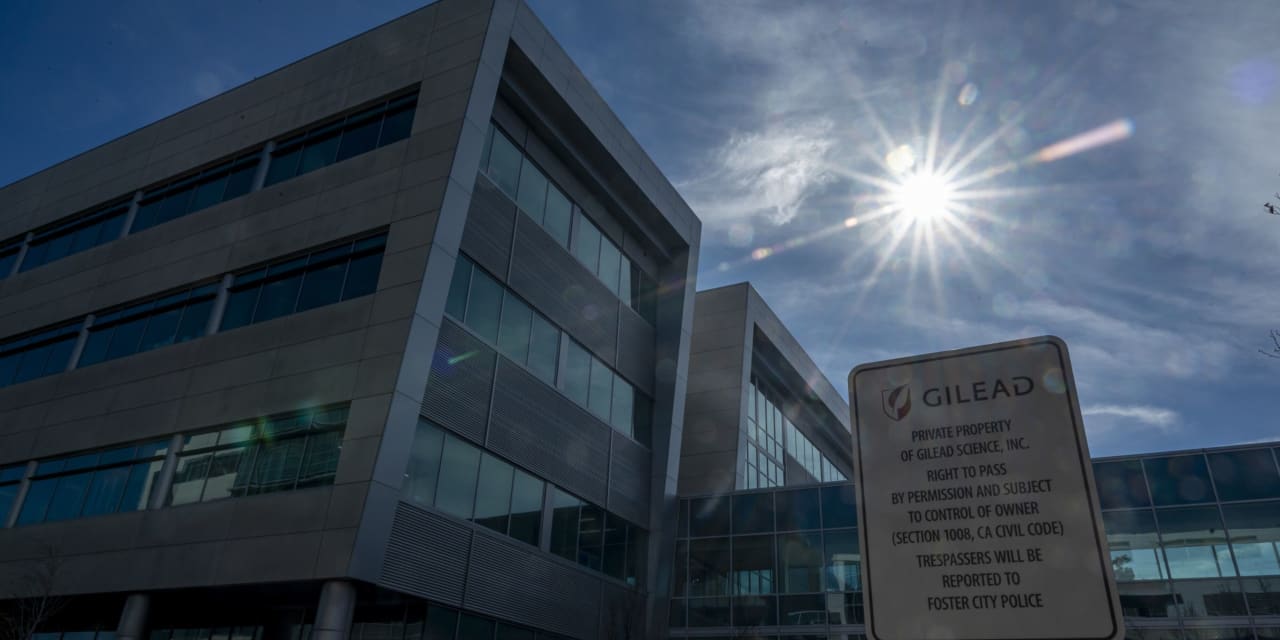
Days after it turned in an uninspiring earnings report that sent its shares tumbling,
Gilead Sciences
disclosed a $4.3 billion deal to buy
CymaBay Therapeutics,
a biotech company focused on liver diseases.
CymaBay is developing a drug called seladelpar as a treatment for primary biliary cholangitis, an autoimmune condition affecting the bile ducts in the liver. Shortly after the Monday announcement, CymaBay said that the Food and Drug Administration had accepted its application for approval of seladelpar, and that it would issue a decision in August.
Analysts say that the drug could soon be the best treatment option for patients with the condition.
Gilead
agreed to pay $32.50 per share in cash for CymaBay, a 26.5% premium over the stock’s Friday closing price of $25.69. Trading in CymaBay shares was halted on Monday morning shortly after the deal was announced, but the price jumped to $31.90 once trading resumed.
Last Tuesday, Gilead announced earnings that were generally in line with expectations, but issued disappointing updates on two drugs it is developing.
The company has had something to prove after a trial of its blockbuster cancer drug Trodelvy yielded disappointing results in late January, sending the stock slipping. Trodelvy is currently approved to treat a number of forms of breast and urothelial cancer, but the company hopes to expand into other cancers. Gilead CEO Daniel O’Day told Barron’s last week that the company’s “conviction around Trodelvy has not changed at all” since the January data release, but the stock was down 9.1% on the year as of the close of trading on Friday.
Gilead shares were up 0.3% in early trading on Monday.
In a note published ahead of the CymaBay news, Oppenheimer analyst Hartaj Singh summarized Wall Street’s take on Gilead. “A rough start to a new year,” Singh wrote.
The CymaBay acquisition looks like a shot at changing that narrative.
In a statement, O’Day said that Gilead is “looking forward to advancing seladelpar by leveraging Gilead’s long-standing expertise in treating and curing liver diseases.” The company famously marketed pathbreaking hepatitis c medicines Harvoni and Sovaldi, though it drew heavy criticism for its pricing strategies on the drugs.
Sales of seladelpar are expected to grow to $748 million per year by 2028, according to a FactSet survey of analysts covering CymaBay.
Write to Josh Nathan-Kazis at [email protected]
Read the full article here