

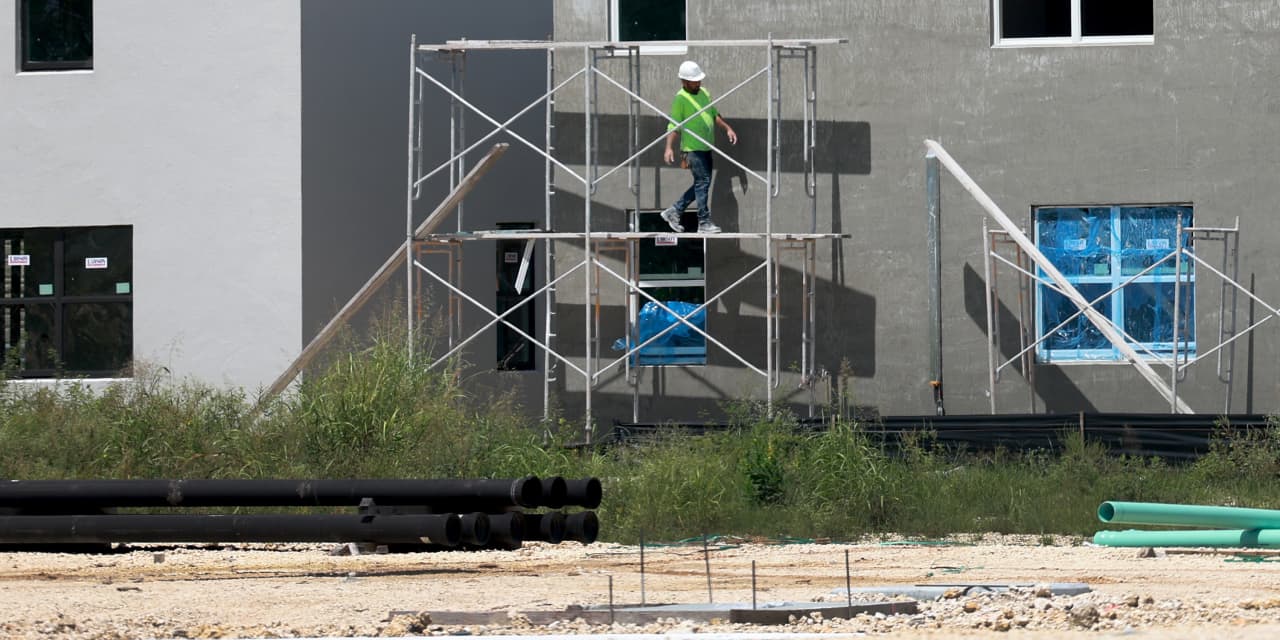
In a sign of strength in the market for new homes, housing starts unexpectedly surged in November.
Starts, an indicator of new home construction logged when a builder begins work on a home, rose to a seasonally adjusted annual rate of 1.56 million, up 14.8% from the month prior. The climb brought housing starts to the highest level since May. Economists had expected starts to be about flat with October’s preliminary rate, according to FactSet estimates.
Both single-family and multifamily starts gained. Construction of one-unit structures rose 18% to a seasonally adjusted annual rate of 1.14 million—the highest since April 2022. Starts in structures with five or more units rose about 9% to a seasonally-adjusted annual rate of 404,000.
Permits, a forward-looking indicator of future construction, fell. New units were authorized at a seasonally adjusted annual rate of 1.46 million, down from a revised 1.5 million rate in October.
This is breaking news. Read a preview of this report below or check back later for more analysis.
Home builders this year have been the beneficiaries of a highly unusual housing market, as buyers sought out new construction amid a dearth of existing inventory. Declining mortgage rates could spark even more interest.
Despite the recent strength, new-home construction likely dipped in November, according to economists. Housing starts, a measure of new construction are estimated to have declined 0.87% to a seasonally adjusted annual rate of 1.36 million, according to FactSet. Permits, a forward-looking indicator of future construction, is projected to have fallen to a seasonally adjusted annual rate of 1.46 million, down about 2.5% from the month prior. The government data are set for release on Tuesday morning.
The two indicators offer a glimpse into the market for new homes, rising when builders ramp up production to meet demand and falling when they slow down. But November’s numbers could be less telling of current conditions than usual: mortgage rates, one of the main levers of housing costs, fell significantly in December. That development could lead to increased demand—and, by extension, more home building.
Builders in December noted a shift, according to the National Association of Home Builders’ monthly confidence reading. “With mortgage rates down roughly 50 basis points over the past month, builders are reporting an uptick in traffic as some prospective buyers who previously felt priced out of the market are taking a second look,” Alicia Huey, the trade group’s chairman, said in a statement.
Freddie Mac’s
weekly reading pegged last week’s average 30-year fixed mortgage rate at 6.95%—the lowest such rate since August. Further declines are likely in store: the 10-year Treasury yield, with which mortgage rates often move, fell below 4% last week—a level it remained under as of Monday afternoon. Rates published every weekday by Mortgage News Daily were at 6.64% on Friday, down 0.45 percentage point from the Friday one week prior.
Lower mortgage rates are a positive sign for builders—though it’s too soon to tell if the recent drop in rates has been enough to stir up buyer demand during a typically slow period for sales.
“With some potential buyers already checked out for the holidays, purchase market demand in the 2024 homebuying season will ultimately be dictated by where 30-year rates are sitting early next year,” Andy Walden, vice president of enterprise research at ICE Mortgage Technology, told Barron’s last week.
Whether buyers roar back has yet to be seen—but investors in builders already have. Two exchange-traded funds tracking home builders and related industries,
SPDR S&P Homebuilders,
and
iShares U.S. Home Construction,
are up roughly 55% and 64%, respectively, so far this year. Both are on track for their best years since 2012.
In a year largely defined by rising mortgage rates and worsening housing affordability, builders have come out on top. Sales of previously owned homes sank in recent months as owners opted to hold onto their historically low mortgage rates. But new homes in recent months were sold at rates well above prior-year levels.
There’s reason to think buyers will continue to seek out newly built properties once more existing homes hit the market, the co-CEO of one of the nation’s largest builders said last week.
“To the extent that interest rates do activate the resale market, and additional supply comes on the market, along with that supply comes additional demand,” Stuart Miller,
Lennar’s
co-CEO and executive chairman, said on an earnings call last week. “What has been missing from the market is the traditional resale buyer looking for that move-up home.”
The best way for investors to gauge the near-term impact of the drop in mortgage rates is likely the Mortgage Bankers Association’s coming mortgage application volume report, released weekly on Wednesday mornings. Application volume over the past month has climbed from multidecade lows—with refinance applications leading the way in recent weeks. The index measuring refinance application volume rose 19.4% during the week ended Dec. 8 to its highest level since mid-July.
Other data expected this week, the National Association of Realtors’ existing-home sale report and government new sales data, will offer additional insight into the November housing market. Existing-home sales have slumped for five straight months, dropping in October to the lowest seasonally adjusted annual rate since August 2010.
New home sales slumped slightly too, but at a level nearly 18% higher than the same month in 2022. Economists expect sales of existing-homes to drop slightly in November, while new home sales are expected to rise slightly, according to FactSet.
Write to Shaina Mishkin at [email protected]
Read the full article here