

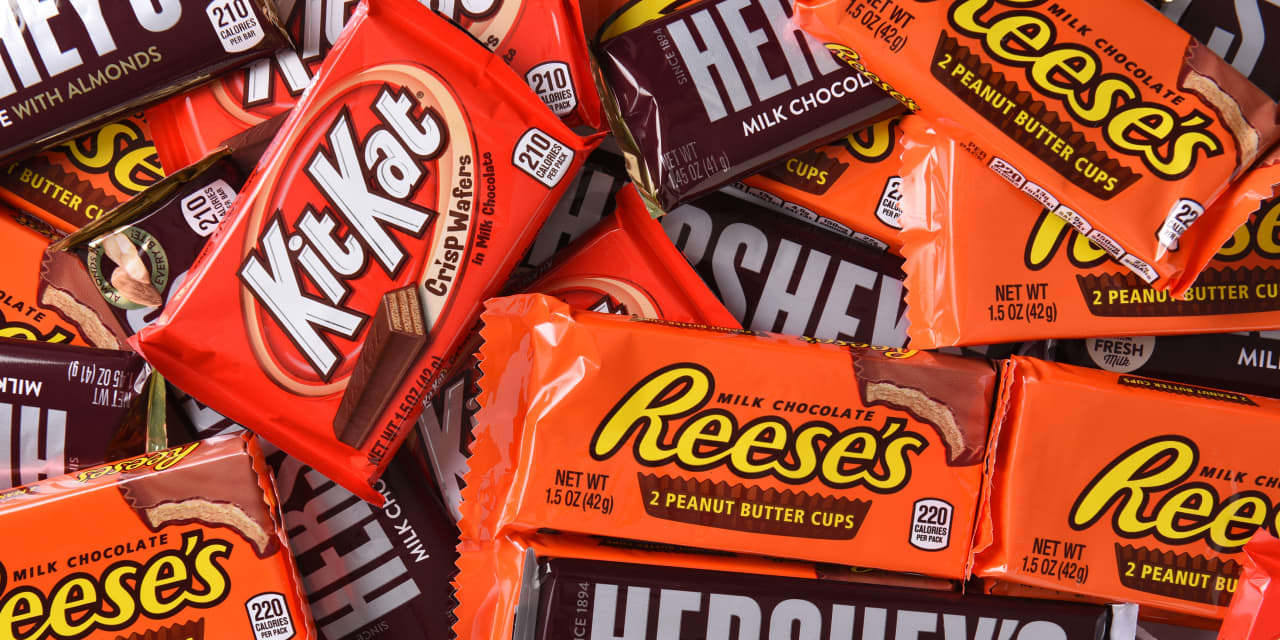
Late last week, a new fear gripped Wall Street: That weight loss drugs from
Eli Lilly
and
Novo Nordisk
are going to destroy the U.S. market for sugary snacks. Investors piled into the trade, and on Thursday, shares of the Coca-Cola Company had their worst day since 2020, dropping 4.8%.
Other snack makers fell too: Shares of
PepsiCo
(PEP) were down 5.2%, and
Mondelez International
(MDLZ) dropped 5.3%.
Hershey Company
(HSY), Conagra Brands (CAG), and
Constellation Brands
(STZ), and
Utz Brands
(UTZ) also fell.
The logic behind the selloff was easy to grasp. Drugs like Novo’s (ticker: NVO) Wegovy and Ozempic, and Lilly’s (LLY) Mounjaro, cause weight loss by easing food cravings. If America is about to become “Ozempic Nation,” who’s going to eat all the Chips Ahoy?
But investors betting on the end of processed food are overlooking the vast uncertainties that lie between the current obesity drug landscape, where the number of patients on Wegovy in the U.S. is in the “hundreds of thousands,” according to Novo, and a theoretical future where nearly a quarter of American adults are on the drugs, and lose their taste for products from snack food behemoths like Coca-Cola (KO).
Analysts from
Bank of America
laid out the case in a note last Friday, writing that they expect “total calorie consumption” in the U.S. to drop between 1% and 3% by 2030, assuming between 20 million and 50 million people in the U.S. are on anti-obesity drugs by then.
That estimate, and others like it, leaps over the enormous financial barriers that make uptake of these medicines by 50 million people, or nearly 20% of the U.S. adult population, almost unthinkable.
Wegovy costs more than $16,000 a year. Paying for such an expensive medicine for so many people, even factoring in the rebates the drugmakers will likely pay to pharmacy-benefit managers, is simply outside of the scale of anything the U.S. healthcare system has seen before.
As I wrote last month, spending at this level could break the rickety system of insurers and federal government programs that pay for Americans’ medicines, and there’s every reason to believe that payors will do whatever they can to limit how many people can take the drugs.
That uptake assumption from the Bank of America food and beverage analysts is even higher than a recent estimate from
J.P. Morgan’s
Chris Schott, who says he expects 15 million patients on anti-obesity medicines by 2030—equating to $50 billion in spending on the drugs. That’s roughly a tenth of the $421 billion spent on retail drugs in 2021, according to a government report.
Insurers and government agencies simply can’t afford that, and it’s hard to imagine a situation where they pay it.
Lower prices for the medicines, and the arrival of cheaper pills, might change insurers’ calculus over the long term. For the foreseeable future, however, strict coverage limits will necessarily limit uptake to a very narrow subset of the roughly 40% of U.S. adults with obesity.
What’s more, all these assumptions are contingent on doctors and regulators remaining comfortable with the drugs’ safety profile. In a research letter published in the Journal of the American Medical Association in early October, researchers reported that patients who took two Novo GLP-1 drugs for weight loss, Wegovy and an earlier product called Saxenda, had higher risk for developing pancreatitis, gastroparesis, and bowel obstruction than those who took another type of weight loss medicine, marketed under the name Contrave.
All that makes it very hard to take seriously investor doomsaying over the future of sugary snacks. The snack executives are saying the same thing: On an investor call Tuesday morning, after reporting strong earnings, PepsiCo CEO Ramon Laguarta said that the impact of the GLP-1 drugs so far was negligible.
It’s only natural that investors who missed out on
Eli Lilly’s
extraordinary 300% climb since the start of 2020 are looking for another way to play the weight loss drug boom. Betting against sugary snacks doesn’t seem like the way to do it.
Write to Josh Nathan-Kazis at [email protected]
Read the full article here