

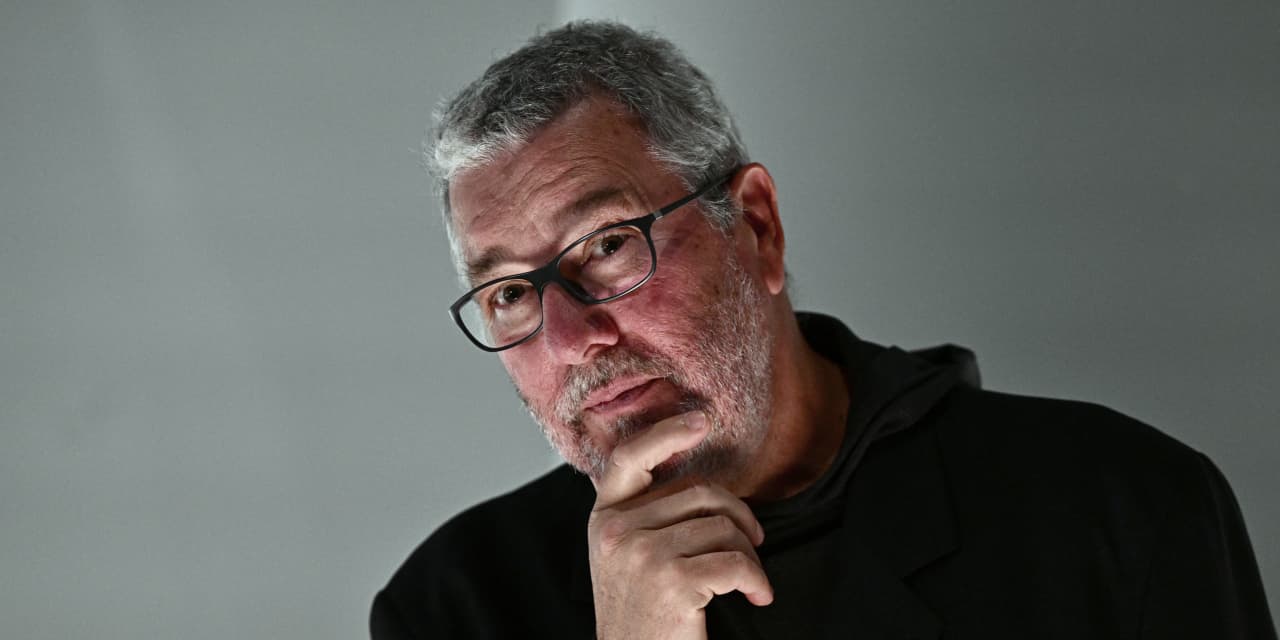
Philippe Starck, widely hailed as one of the most prolific and inventive designers of this or any era, isn’t slowing down.
Starck, a Paris native who recently turned 75, continues to employ his practice across all domains, from everyday products to architecture, and large-scale engineering projects. Ask him what he’s currently up to and one can expect a free-flowing, train-of-thought answer that is bound to take several minutes.
“I am constantly working on more than 200 different projects,” Starck says. “The idea is that I am constantly looking for new solutions with the aim of serving my community.”
Recently, he has been focusing much of his time on space projects. At the United Nations climate conference in Dubai late last year, he launched HRS by Starck—a partnership with the French company Hydrogen Refueling Solutions (HRS) to create minimalist designs for the piece of transportation infrastructure.
Starck is also working with American space companies such as Axiom, for which he designed the habitation module for its space station’s crew quarters, and Orbite, for which he’s creating an astronaut training complex.
But the project that’s bound to reach the widest market might be his foray into the world of footwear, a collaboration with the French footwear designer Karim Oumnia and his recently launched AI sneaker service, Baliston. The end result—a line of breathable, wearable shoes known as Baliston by Starck—seeks to revolutionize the footwear industry in myriad ways.
“All my life, I have tried to be useful. And the closer you are to people and to the body, the more useful you can be to your community,” Starck says. “I was never interested in making shoes, they are fashionable objects with too short of a lifespan that contributes to global pollution.”
Now available to the public, the shoes—which took more than a decade to create—are made from only five materials, all eco-sourced and 100% recyclable. An embedded proprietary sensor module utilizes AI technology to capture biometric data that is sent directly from the shoe to the company, which creates custom solutions by analyzing the wearer’s posture, weight, patterns of movement, and more.
“With Baliston, the shoe is the medium, the vector of a high-tech sustainable ecosystem that takes into account the notions of ecology, well-being, comfort, and, eventually, design as well,” he says. “The creative process was complicated because it is a 100% virtuous project, and design was only driven by ecological and economical parameters: to use the minimum of matter and energy for the maximum of service. I could work with only bio-based materials, like organic cotton, recycled plastic, or sugar cane.”
Customers can acquire a pair of shoes in one of two ways: by opting for a one-time purchase (current price: US$150) or signing up for a membership (US$250 per year). The membership includes fitted comfort insoles and unlimited replacements when the sensor modules indicate the shoes and insoles are worn-out. This process allows every shoe produced by the company to be collected at the end of its life and completely recycled.
“The shoes are made for that purpose: to create for the first time a shoe with insoles personalized to your gait, to the ergonomics of our body in movement,” he says. “This is completely new. Baliston is not a shoe, it is a revolution.”
Starck—who, along with his wife, Jasmine, spends most of his time “on airplanes or in middles of nowhere,” as he puts it—recently spoke with Penta while traveling between projects.
Penta: Your career has given new meaning to terms like ‘prolific’ and ‘design’… what do those words mean to you, and how do you describe your overall approach?
Philippe Starck: I have a multifaceted prolific creativity, which is the result of my mental illness that I call “creativity.” I work on many different projects at the same time, and I usually achieve one big project every day; I have created more than 10,000 projects so far, it seems. Design as an expression of creativity cannot save lives, but it can be a useful tool if at the service of humanity. My focus has always been turned toward dematerialization, the elegance and intelligence of the minimum.
Materiality has always disgusted me. Unfortunately, I was part of a generation who thought that any idea had to be turned into a product. Today, I think it is more and more about the service, and we can help a community without materiality. That is the future of design.
MORE: Amid Geopolitical Concerns, Major Philanthropy Continues to Forge Ahead…Creatively
Can you expand on that, in terms of how you envision design being different in the future?
For a long time, I have been predicting the demise of trends, which by definition are ephemeral, consume too much energy and create cynicism and contempt. Today, the most modern words are transmission and heritage. Things have to be intelligent, honest, and durable, and that doesn’t preclude love, not to mention vision, and above all humor. To create objects that last, we must go to the center of things, use the minimum of energy and sustainable materials to guarantee timelessness and longevity and of course with a cultural longevity too. In that sense, dematerialization and bionism [application of biologically inspired engineering]—through the use of biomechanics in particular—are key because it is the future of humanity, of our mutation.
MORE: Elton John Fans Pay US$8 Million for His Treasures at Auction
What are your thoughts on artificial intelligence and as it pertains to being creative?
If AI is used to produce the fastest calculation of a mass of information, it gives some results, and it is nice to have a little help from a friend. But I have doubts on the creativity it can replicate—as creativity is the last magic nestled in the human brain, it is the miracle of human genius. Yet, I cannot be impartial. My mental illness of creativity (I am also neuro-divergent) gives me an advantage compared to computers: Where they use orthogonal architecture, mine is diagonal. That is why I am not limited by any computer program or software. With my paper pad and my pen, I am absolutely free.
How do you view the role of a designer in society?
At birth, everyone signs a contract with their community, their family, their civilization, their animal species. And this contract can take many forms. But above all, the basis of the contract is that we are here to help each member of our community and to help our species as a whole to evolve. So, inevitably, everyone’s role is a political, social, and human one. For a designer, it is even more vital. Not because we are designers, but because we are producers of ideas, producers of projects that ultimately translate into a product.
That is a huge responsibility, because every color, every shape, every material has a meaning. And through their creations, designers can guide and inspire the people who buy and use the product. I have built myself a strong working ethic, which has always been the same because it is based on my inner personal values. I stick to it naturally and absolutely.
You’ve been a longstanding advocate of what you refer to as “democratic design.” How do you describe this approach, and what’s the biggest societal aspect that could benefit from it?
The concept of democratic design is very simple: to guarantee the best quality at accessible prices so that the maximum number of people can have access to the best service. After more than 40 years of work, I have won this battle, as almost everyone can afford a quality designer chair for a very reasonable price. The next challenge is democratic architecture, with a house that could cost the price of a car. I don’t believe in demonstrative architecture, in architectural gestures, in monuments whose only interest is to be regularly knocked down. I would like people to have a roof over their heads, without being forced to go into debt for the rest of their lives. Today, one of the first expenses of a household, after food, is housing, sheltering the family from the cold and the heat. This is a shame.
Architecture needs to cleanse itself of its venalities, its greed, its narcissism, and get back to the real need, which is to give people a home. In 2014, I created P.A.T.H., which are Prefabricated Accessible Technological Homes providing a reliable and intelligent solution for us, our children, the children of our children facing the challenges of housing ecology and economy. But we can go even further with industrialization and prefabrication, which I believe represent the future of the home. Because these two can improve quality, be designed by very good designers, and become affordable for everyone.
This interview has been edited for length and clarity.
Read the full article here